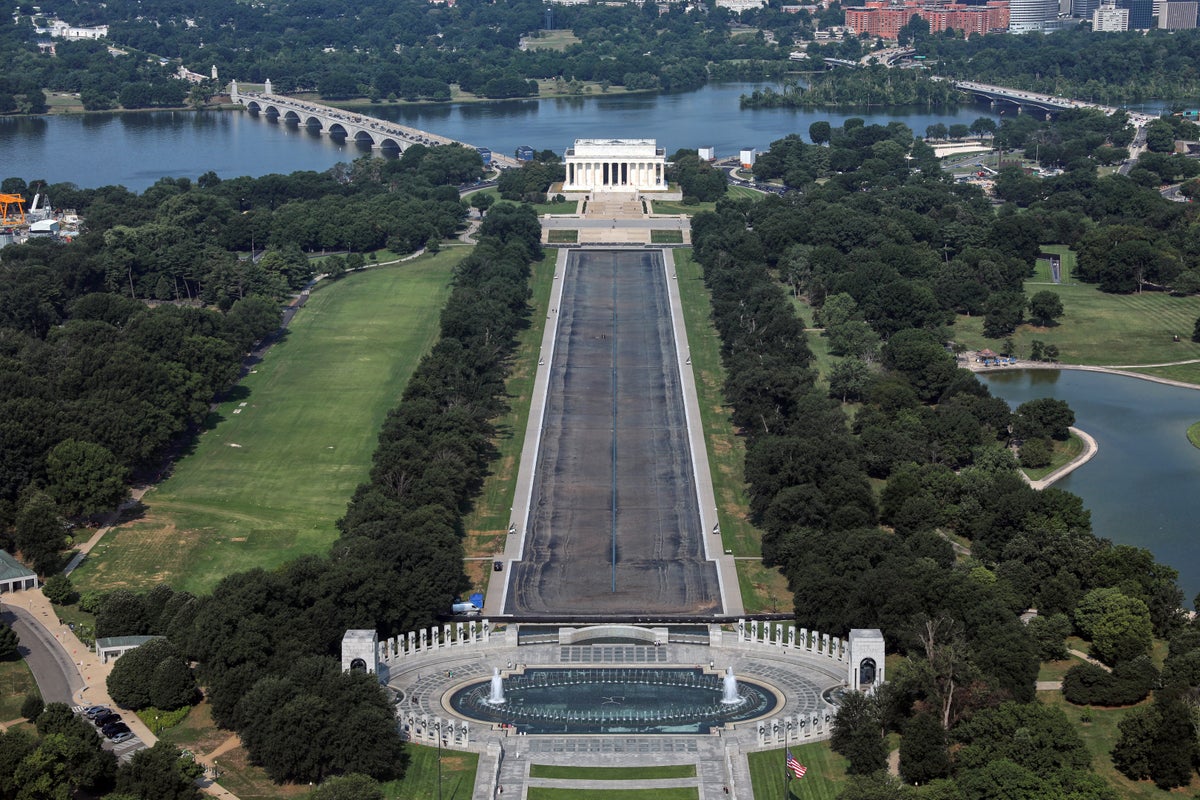
The Lincoln Memorial Reflecting Pool was supposed to gleam like a postcard for America's 250th birthday. Instead, a peek from the top of the Washington Monument reveals a massive, multi-million-dollar concrete basin that looks dull, gray, and completely beat up.
If you followed the saga of this renovation, you know it didn't start with gray. It started with a highly publicized, deeply polarizing shade of deep blue that the Trump administration insisted on calling "American flag blue". Now that the water has been drained to clean up debris from the Independence Day fireworks, the truth is out: that vibrant blue liner is already fading rapidly. It is turning a washed-out shade of gray, and chunks of it are physically peeling right off the concrete floor.
What went wrong? The administration points to shadowy vandals armed with box cutters. Experts, however, point to basic chemistry, rushed construction, and some incredibly predictable physics.
The Ballooning Cost of a Bright Blue Dream
This project didn't just fade; it bled cash. When the renovation was first cooked up, the initial public estimate floated around $1.5 million. By the time the contracts were actually distributed and the work got underway, the final bill skyrocketed past $16 million.
Atlantic Industrial Coatings pocketed $14.7 million just to paint and waterproof the floor. Another $1.7 million went to Green Water Solutions for a fancy water-purification setup. For that kind of money, you expect a finish that lasts a century, which is exactly what was promised. Instead, the liner barely survived a single month before it started looking like an old, neglected YMCA pool.
The visual change isn't just an aesthetic bummer; it flies in the face of federal historic preservation laws. The original design intent of the 1920s landmark was always to feature a quiet, subordinate, dark gray or black bottom. That darkness is what creates the perfect, glassy mirror effect reflecting the sky and the Washington Monument. Turning it bright blue made it look less like a solemn national monument and more like a water park.
Vandalism Versus Bad Chemistry
The official word from the top is that the peeling and fading are the results of deliberate sabotage. Interior Secretary Doug Burgum and others have stuck fiercely to the narrative that a "350-foot gash" was sliced into the liner by bad actors. They even arrested a former Olympic canoeist, David Hearn, who claims he was just touching a piece of already-peeled sealant out of pure curiosity. Three others face misdemeanors for picking up loose paint chips.
But if you talk to commercial pool contractors and water quality experts, the vandalism theory starts to show some major cracks.
- Improper Surface Prep: Getting a thick waterproof coating to stick to a massive, century-old slab of outdoor concrete is notoriously brutal. If there is even a hint of moisture or trapped water intrusion underneath when the liner is applied, bubble-ups and massive peeling are inevitable.
- The Algae Greenhouse Effect: Painting the bottom a dark, vibrant blue dramatically increases water temperature by absorbing sunlight. Combine hot water with shallow, stagnant conditions, and you get an absolute breeding ground for algae. Within days of filling, the pool turned a murky, boggish green, requiring heavy chemical treatments and aggressive scrubbing that likely stripped the color right out of the liner.
- Chemical Burn: Treating that massive, immediate algae bloom meant dumping heavy doses of chlorine, ozone nanobubbles, and clearing agents into the water. High concentrations of these chemicals, combined with intense summer UV rays, will bleach almost any pool liner straight to gray in record time.
From the high vantage point of the Washington Monument, those alleged 350-foot knife slashes are nowhere to be seen. What is visible is a uniform, sad fade.
What Happens Next
The National Park Service is stuck in a loop. The current game plan is to patch up the spots where the coating peeled, blame the weather and the courts, and fill the basin right back up. But unless they fix the underlying science of how that liner interacts with water, chemicals, and the baking D.C. sun, they are going to be draining it and repainting it every few weeks.
For anyone managing large-scale outdoor infrastructure or historic preservation, the takeaway is clear: you can't out-finesse engineering reality with a bigger budget and a louder press release. If you rush the cure times, pick the wrong color for water physics, and ignore the historical design parameters, nature is going to win every single time. Expect to see the Reflecting Pool stay a dull, mottled gray for the foreseeable future while the lawyers and contractors sort out who pays for the redo.