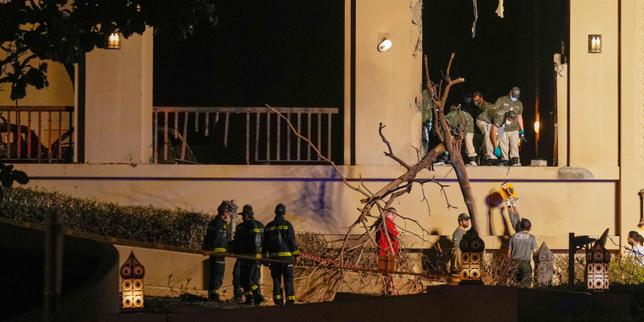
The geopolitical equilibrium of the Persian Gulf has shifted from a state of managed friction to a high-velocity kinetic exchange. Following unverified reports concerning the death of Iranian Supreme Leader Ali Khamenei, the regional security architecture has buckled under two simultaneous pressures: a definitive command-and-control crisis in Tehran and the transition of Iranian-aligned operations from proxy skirmishes to direct strategic strikes against global financial hubs like Dubai and Abu Dhabi. This is not a localized flare-up; it is the physical manifestation of a "decapitation uncertainty" that forces every regional actor into a defensive crouch while testing the limits of integrated missile defense systems.
The Mechanics of Decapitation Uncertainty
In highly centralized autocratic systems, the health of the sovereign is the primary variable in the state’s stability function. When Donald Trump publicly asserts the death of Ali Khamenei while Tehran maintains a communicative silence, it creates an information asymmetry that triggers specific institutional behaviors. For another view, check out: this related article.
- The Transition Friction: The Assembly of Experts in Iran is designed for a methodical succession. However, an unconfirmed death creates a "liminal power state" where the Islamic Revolutionary Guard Corps (IRGC) typically moves to secure physical infrastructure and telecommunications to prevent internal dissent.
- The Credibility Gap: Tehran’s failure to immediately provide proof of life—such as a dated video address—indicates either a genuine medical crisis or a severe internal debate regarding the succession hierarchy. In intelligence terms, silence is a signal of paralysis.
- Aggression as Signaling: Historically, when an autocratic regime feels internally fragile, it externalizes its defensive posture. The strikes on the United Arab Emirates (UAE) serve as a "dead hand" signal, intended to demonstrate that Iranian military capabilities remain autonomous from the physical status of the Supreme Leader.
Strategic Logic of the UAE Strikes
The selection of Dubai and Abu Dhabi as targets represents a calculated shift in the Iranian targeting matrix. While previous escalations focused on the Strait of Hormuz or Saudi oil infrastructure (Aramco), hitting the UAE’s urban centers targets the region’s primary nodes of global capital and logistics.
The Economic Kill Chain
The UAE functions as the "Safe Haven" of the Middle East. By landing kinetic strikes on these cities, the IRGC aims to break the perception of security that sustains the Emirati economy. The logic follows a three-step erosion: Further coverage on this matter has been published by NBC News.
- Capital Flight: Immediate liquidation of local assets by expatriate investors.
- Insurance Inflation: A vertical spike in maritime and aviation insurance premiums, effectively placing a tax on every barrel of oil and container ship passing through the region.
- Logistics Displacement: The redirection of global shipping routes away from Jebel Ali, the world’s most significant transshipment hub.
Integrated Air Defense Performance
The efficacy of these strikes depends on the saturation of United Arab Emirates' air defenses, primarily the THAAD (Terminal High Altitude Area Defense) and Patriot systems.
$$P_{interception} = 1 - (1 - p)^n$$
In this probability model, $p$ is the kill probability of a single interceptor and $n$ is the number of interceptors fired. If Iran utilizes a swarm tactic—launching low-cost Shahed-series loitering munitions simultaneously with high-velocity ballistic missiles—the defense system reaches a "saturation floor." At this point, the cost-per-intercept favors the attacker by a factor of 10:1 or higher, making prolonged defense economically unsustainable.
The Trump Factor and Information Warfare
The intervention of a former U.S. President into the narrative serves as a force multiplier for chaos. In the current global media environment, a statement of this magnitude bypasses traditional diplomatic channels and interacts directly with algorithmic trading bots and regional military commanders.
The "Trump Assertion" creates a feedback loop. If regional commanders in the IRGC believe their central authority is gone, they may revert to "pre-authorized kinetic protocols." These are standing orders to strike specific targets in the event of a decapitation strike or total communications blackout. This explains the timing of the strikes on Dubai: they may not be a top-down order from a living leader, but an automated response from a system that believes it has been orphaned.
The Three Pillars of Regional Response
Regional and global powers are currently operating within three distinct frameworks to contain the fallout.
1. The Deterrence Framework (USA/Israel)
The primary objective is to prevent a wider conflagration while Iran remains in a state of leadership flux. This involves the deployment of carrier strike groups to the North Arabian Sea to provide a secondary layer of missile defense for the GCC (Gulf Cooperation Council) states. The logic here is "defensive escalation"—showing enough force to discourage Iran from a full-scale regional war while the succession crisis resolves.
2. The Stabilization Framework (China/Qatar)
China, as the primary purchaser of Iranian crude, has the most to lose from a prolonged closure of the Persian Gulf. Beijing’s strategy focuses on backchannel diplomacy to verify the status of Khamenei. If he is indeed incapacitated, China’s role shifts to ensuring the IRGC remains unified, as a fragmented IRGC with control over a nuclear program is a global nightmare scenario.
3. The Economic Continuity Framework (UAE/Saudi Arabia)
For the UAE, the priority is "Narrative Management." To prevent a total market collapse, the government must project an image of operational normalcy despite the kinetic impacts. This requires high-speed damage control, both physical and digital, to convince global markets that the strikes were "anomalies" rather than the "new normal."
Operational Bottlenecks in Tehran
The IRGC is not a monolithic entity. It is composed of the Aerospace Force, the Navy, and the Quds Force, each with overlapping but distinct interests. In the absence of a Supreme Leader, the internal competition for resources and political legitimacy becomes a bottleneck for coherent foreign policy.
The Quds Force, which manages proxies like the Houthis and Hezbollah, may favor continued escalation to maintain their relevance. Conversely, the regular Iranian military (Artesh) may favor a de-escalation to prevent a devastating retaliatory strike from the United States or Israel. This internal tension increases the risk of "accidental war," where a mid-level commander makes a tactical decision—like a missile launch—that has irreversible strategic consequences.
Structural Vulnerabilities in Global Energy Markets
The immediate reaction of Brent Crude prices highlights the fragility of the global energy supply chain. A "Death of the Leader" scenario in Iran, coupled with strikes on UAE soil, creates a risk premium that is difficult to quantify.
- The Hormuz Bottleneck: Approximately 20% of the world’s petroleum passes through the Strait of Hormuz. A kinetic environment in the UAE makes the entire strait a high-risk zone.
- The Spare Capacity Myth: While Saudi Arabia maintains spare production capacity, that capacity is irrelevant if the shipping lanes required to export it are under constant missile threat.
The current situation reveals that the global economy is decoupled from the reality of Middle Eastern kinetic risks. We have spent a decade treating these tensions as "noise"; the strikes on Dubai have effectively turned that noise into a "signal" that the market can no longer ignore.
Strategic Recommendation for Global Actors
The immediate requirement is the establishment of a "Verification Corridor." This is a diplomatic and intelligence effort to confirm the status of the Iranian leadership through neutral intermediaries. Until the "Khamenei Variable" is solved, all military actions in the region must be viewed through the lens of institutional panic rather than calculated statecraft.
Financial institutions should immediately trigger "Geopolitical Stress Tests" on assets located within 500 kilometers of the Iranian coast. The assumption that the UAE remains a "neutral green zone" is no longer valid. The operational play is to move from a "Just-in-Time" logistics model to a "Just-in-Case" model, diversifying storage and transit points away from the Persian Gulf until a clear successor is named in Tehran and a ceasefire is brokered in the UAE. Failure to do so exposes capital to a volatility event that no standard hedging strategy can mitigate.


