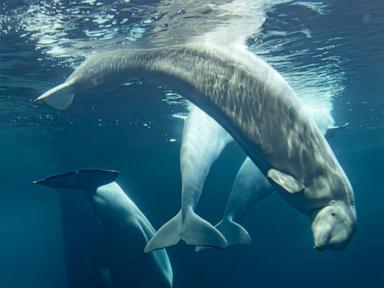
The headlines write themselves. Another beluga passes away at a major aquarium. The internet erupts. Activists demand empty tanks, immediate sanctuary releases, and a complete cessation of captive marine mammal care. The lazy consensus is comfortable, emotionally resonant, and entirely divorced from biological reality.
Everyone wants to point a finger at concrete walls and chlorinated water. Nobody wants to look at the casualty rate of the alternative.
I have spent two decades advising marine facilities, tracking animal welfare metrics, and watching well-meaning conservation groups sign death warrants under the banner of liberation. We are letting public relations dictate veterinary science. The result is a body count that makes aquarium mortality look like a rounding error.
Let us dismantle the sanctuary myth right now.
The Geography of Guilt
When a beluga dies in a facility, it triggers an inquest. Pathologists run slides, toxicology reports clear, and public relations teams scramble. When a beluga dies during an ill-conceived ocean rescue, transfer, or net-pen relocation, it gets buried in an environmental impact statement.
Take the recent Canadian rescues that dominated the news cycle. Animals pulled from compromised estuarine environments, tagged, trucked, and thrust into temporary sea pens or unfamiliar aquatic networks. The public sees a triumphant release into the open ocean. The veterinarians see severe capture myopathy, cortisol spikes that shut down immune systems, and sudden pathogen exposure from wild populations to which captive-raised or long-captive individuals have zero adaptive immunity.
Immunologically naive animals do not survive the open ocean. They drown in bacteria, starve because they lack local foraging maps, or succumb to thermal shock.
The mainstream narrative treats aquariums as prisons and the wild as a pristine Eden. Both premises are false. The wild for these specific cetaceans is a brutal, noisy, polluted gauntlet of industrial shipping lanes, shifting food webs, and warming waters. Captive habitats are artificial, yes, but they offer stable parameters, 24-hour veterinary oversight, and a guaranteed caloric intake.
Trading a filtered pool for an unmanageable ocean bay to appease Twitter moralists is not conservation. It is animal cruelty disguised as ethics.
The Veterinary Mathematics Nobody Wants to Read
Let us look at the pathology of marine mammal longevity. Cetaceans in managed care live longer, healthier lives on average than their wild counterparts. This is not corporate propaganda; it is standard demographic data across multiple accredited zoological institutions. Wild belugas face predation by orcas, parasitic load, ice entrapment, and anthropogenic acoustic trauma. Their median lifespan in the wild is frequently truncated by factors that do not exist inside a filtration loop.
When a geriatric animal passes in a facility, activists treat it as proof of systemic failure. If a human dies in a hospital at ninety, we do not tear down the hospital. We acknowledge that life has a hard ceiling. Yet every time an older marine mammal reaches the end of its biological rope, critics scream for the total dismantling of the institution.
Imagine a scenario where every aquarium closes tomorrow. Where do the thousands of rehabilitated seals, sea turtles, manatees, and cetaceans go? There is no magical ocean sanctuary waiting with open gates and floating hospitals. They die.
The anti-captivity lobby has built an empire on an impossible promise: that every marine mammal can be successfully un-domesticated and returned to the deep blue. Biology does not care about your cinematic tropes. Once an animal has spent years relying on human provision and veterinary medicine, its survival software is overwritten.
The Economics of Outrage
Why do mainstream outlets double down on the captive cruelty narrative? Because outrage scales. A headline about a sanctuary rescue failing does not generate ad revenue. A headline pointing out that wild conservation is a messy, bloody business of triage does not fit on a protest sign.
We have created an ecosystem where public ignorance dictates animal husbandry policy. Regulators bend to social media pressure, forcing premature transfers and experimental releases that violate basic veterinary prudence.
I have watched facility directors panic-ship animals to sea pens they knew were inadequate simply because the PR storm of keeping them in a concrete habitat became politically untenable. The animals died within months. The activists celebrated the release. The directors kept their jobs. The belugas paid the price.
We need to stop evaluating marine mammal welfare through the lens of theatrical ethics and start looking at hard mortality data.
What Actually Works
If we genuinely care about cetacean survival, we have to abandon our romanticized view of nature and our visceral hatred of engineered environments.
- Stop forced releases. If an animal cannot survive independently, stop pretending a sea pen is a stepping stone to freedom. Accept managed care as a permanent, dignified sanctuary for non-releasable wildlife.
- Fund the infrastructure. Instead of forcing aquariums to cut corners due to constant harassment, demand higher engineering standards, larger filtration footprints, and expanded veterinary budgets.
- Prosecute bad actors, not all actors. Distinguish between roadside attractions exploiting animals for profit and accredited research institutions advancing comparative physiology, acoustics, and reproductive biology.
The next time a beluga passes away in a facility, resist the urge to demand its closure. Look closer at the alternative. The ocean is not waiting to welcome them home. It is waiting to finish them off.