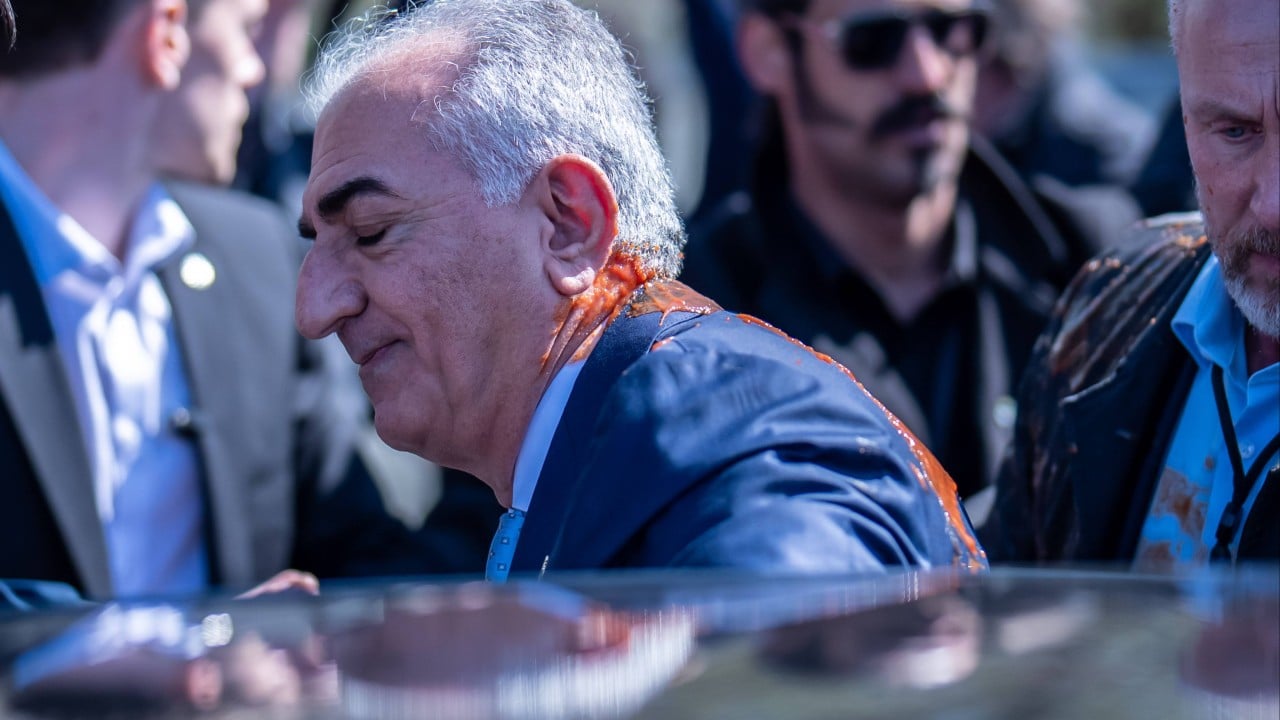
Exiled Iranian Crown Prince Reza Pahlavi just found out how volatile the streets of Europe can be. During a visit to Berlin, an activist lunged forward and splashed the royal with a red substance, widely reported as red paint or juice. It happened fast. Security scrambled. The message, however, stayed behind long after the liquid was wiped away. This wasn't just a random act of vandalism or a simple protest. It highlights a massive, jagged rift within the Iranian diaspora that most Western observers simply don't understand.
You see the photos and you think it’s just one angry person. It’s not. Berlin has become the unofficial capital of the Iranian resistance in exile. When things go south there, they go south for a reason.
Why Berlin became a flashpoint for the Pahlavi visit
Berlin isn't just any European city. It holds the largest concentration of the Iranian diaspora in Germany, a group that is notoriously fragmented. You’ve got monarchists who want the Pahlavi family back in power. You’ve got leftists who remember the 1979 revolution differently. Then you’ve got the younger generation who just want the current Islamic Republic gone and don’t care about the crown.
When Pahlavi arrived, he wasn't met with universal cheers. The red substance symbolizes blood. To his detractors, it’s a reminder of the human rights record of his father’s regime before 1979. To his supporters, the attack was a cowardly move orchestrated by agents of the current Tehran government or radical fringe groups.
The police in Berlin are used to protests, but this caught them off guard. Pahlavi has been positioning himself as a diplomat-in-waiting, meeting with European officials to push for "maximum pressure" on the Iranian government. This incident threatens that polished image. It suggests that he can’t even unify his own people in the streets of a safe democratic city like Berlin.
The internal war for Irans future
The red paint is a physical manifestation of a digital war. If you spend five minutes on Iranian Twitter or Telegram, you'll see a level of vitriol that would make most political debates look like a tea party.
On one side, the "Pahlavists" see the Crown Prince as the only person with enough name recognition and international clout to lead a transition. They point to the "Woman, Life, Freedom" movement and argue that his leadership provides the stability Iran needs to avoid becoming another Syria or Libya.
On the other side, a diverse coalition of activists fears a return to autocracy. They argue that replacing a religious dictatorship with a hereditary monarchy is a step backward. When that red liquid hit Pahlavi, those activists saw it as a "check" on his perceived arrogance. Honestly, it’s a mess.
Security failures and the optics of exile
How does a high-profile figure like Pahlavi get hit in broad daylight? His security detail is supposed to be top-tier. Berlin’s local police also provide a perimeter. The fact that someone got close enough to land a direct hit is a massive embarrassment. It raises questions about his safety as he continues his European tour.
If he can't be protected in Berlin, can he be protected in Paris? Or London? This wasn't a bullet, but it could have been. The psychological impact of being "marked" in public shouldn't be underestimated. It forces a leader to retreat behind bulletproof glass and heavy cordons, which separates them from the very people they claim to represent.
What this means for Western policy
European leaders are watching this. They're trying to figure out if Pahlavi is a viable partner. When they see him getting splashed with red paint by his own countrymen, it gives them pause. It makes the "regime change" argument look a lot more complicated.
If the opposition can't agree on a guy in a suit in Berlin, how are they going to run a country of 85 million people?
The Islamic Republic’s state media, of course, had a field day with this. They used the footage to show that the "monarchist project" is a failure. They want the world to see the opposition as a group of squabbling, violent children. In that sense, the person who threw the red substance might have unintentionally handed a win to Tehran.
The grit of the Iranian diaspora
You have to look at the numbers. In 2022 and 2023, Berlin saw rallies with over 80,000 Iranians. That is a staggering amount of political energy. But energy without a single direction usually ends in friction. This incident is that friction.
- Most protesters want a secular democracy.
- Some want a constitutional monarchy.
- A few still hold onto Marxist or MEK ideologies.
- All of them hate the current regime.
That last point is the only thing they agree on. The moment someone tries to lead, the knives (or the paint buckets) come out.
Moving beyond the paint
If you’re following the Iranian struggle, don’t get distracted by the spectacle. The red paint is a headline, but the real story is the struggle for a unified transition council. Pahlavi has been trying to form a "solidarity council" for a while now, and it keeps falling apart.
This Berlin incident will likely harden the hearts of his supporters. They’ll see it as a "baptism by fire" that proves he’s a threat to the status quo. His critics will see it as a sign that he’s not welcome.
Watch the next few weeks closely. Pahlavi’s response will dictate his political survival. If he hides, he loses. If he uses this to show he can take a hit and keep talking, he might actually gain some ground with the moderates who are tired of the drama.
Don't expect an apology from the activists. They don't want a king. They want a vote. And until the opposition figures out how to talk to each other without throwing things, the regime in Tehran will keep sleeping soundly. Keep an eye on the German federal police reports; the identity of the attacker will tell us exactly which faction is feeling the most desperate. If it's a lone wolf, it's a security lapse. If it's a coordinated group, it's a declaration of war within the diaspora.
Stop looking for a simple hero in this story. There isn't one. There's just a lot of old trauma, new blood, and a very expensive suit covered in red liquid.