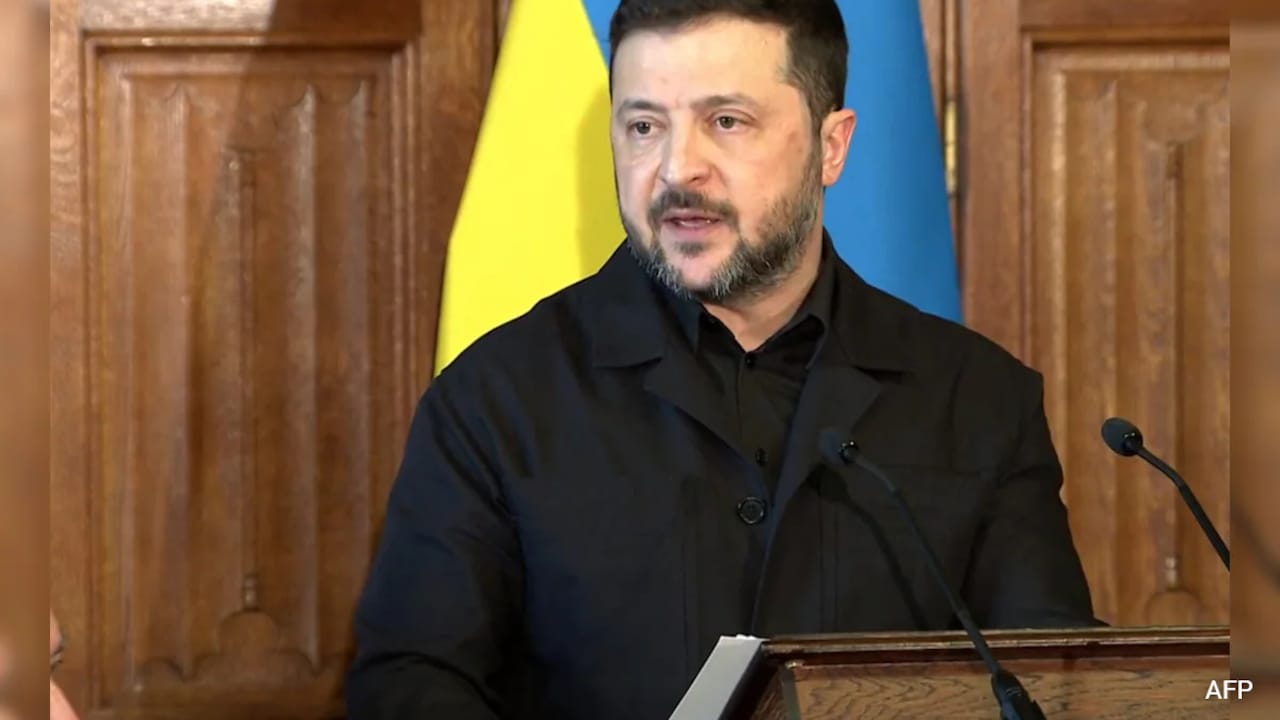
The shift in executive communication regarding the Russo-Ukrainian conflict marks a transition from ideologically driven alignment to transactional, interest-based diplomacy. When political commentary moves from sharp public censures to recognizing a counterpart as "courageous" or doing "pretty well" under systemic duress, it does not signal a change in core strategic objectives. Instead, it reflects an analytical reassessment of leverage, theater-level realities, and the optimization of diplomatic capital.
Understanding this linguistic pivot requires stripping away superficial sentimentality and evaluating the structural mechanics of international relations, security architectures, and resource distribution functions that govern modern geopolitical negotiation.
The Tri-Lateral Leverage Framework
The dynamic between Washington, Kyiv, and Moscow operates within a tightly bounded optimization problem. Every public statement from executive leadership functions as a signaling mechanism designed to alter the perceived payoff matrices of the other actors.
[Washington] -------- (Resource Allocation / Signaling) --------> [Kyiv]
     |                                                              |
     |                                                              |
(Deterrence / Negotiation)                                   (Kinetic Friction)
     |                                                              |
     v                                                              v
[Moscow] <------------------ (Strategic Depth) -------------- [Frontlines]
1. The Resource Allocation Variable
The primary variable controlled by the United States is the rate of material supply—including munitions, intelligence architecture, and financial liquidity. Publicly validating Kyiv’s resilience serves to sustain defensive credibility while establishing a baseline for conditional assistance. This recognition alters the cost function for Ukraine, establishing that while operational tenacity is acknowledged, future resource flows remain tied to strategic alignment.
2. The Deterrence and Negotiation Function
For Moscow, changes in American executive rhetoric alter the calculation of strategic depth. A hardline stance signals indefinite Western underwriting, which pushes the adversary toward total mobilization. Conversely, introducing qualified praise for Ukrainian defense signals that Washington recognizes the current territorial status quo as highly resistant to rapid breakthroughs. This shifts the adversary's calculus from pursuing total capitulation to evaluating the utility of a negotiated settlement.
3. The Domestic Equilibrium
Foreign policy statements must balance domestic legislative and fiscal constraints. Characterizing an ally's performance as highly capable minimizes internal political friction regarding prior resource expenditures. It reframes historical support not as an open-ended liability, but as a high-yield investment that has successfully blunted an adversary's conventional offensive capabilities.
Tactical Equilibrium and Kinetic Realities
The assertion that a military force is performing adequately against a numerically superior adversary can be modeled through attrition ratios and defensive sustainability metrics. The structural reality of the theater reveals why rhetorical framing has moved toward stabilization narratives.
The conflict has evolved into a high-intensity war of attrition where territorial gain is no longer the primary indicator of operational success. Instead, the critical metric is the attrition cost ratio: the cost incurred by the offensive force relative to the defensive degradation suffered by the sustaining force.
By utilizing fortified defense-in-depth strategies, automated electronic warfare nets, and dense artillery coordination, Ukrainian forces have maintained a high cost-exchange ratio against conventional assaults. This operational efficiency explains the analytical assessment of doing "pretty well" despite significant disparities in raw manpower and defense industrial output.
The second operational reality is the technological equilibrium achieved through distributed sensor-to-shooter networks. The integration of commercial satellite reconnaissance, unmanned aerial systems, and precision-guided munitions has created a transparent battlefield. This structural transparency suppresses the efficacy of large-scale armored maneuvers, forcing both combatants into localized, incremental engagements. Under these parameters, defensive operations possess an inherent structural advantage, stabilizing the frontlines regardless of asymmetric strategic depth.
The Mechanics of Transactional Diplomacy
The transition to pragmatic signaling exposes the core limitations of traditional security guarantees. Geopolitical agreements operate under anarchic international systems where commitments are enforced solely by self-interest and reciprocal deterrence.
- Conditional Alignment: Alliance structures are inherently fluid. Support is calculated against shifting national interest functions rather than static ideological frameworks.
- The Escalation Threshold: Nuclear-armed states operate under strict escalation boundaries. External assistance is systematically capped at a threshold that prevents direct, peer-to-peer kinetic confrontation.
- Asymmetric Interdependence: Smaller states face structural dependency on external supply chains, granting donor nations substantial veto power over long-term strategic objectives.
This creates a structural bottleneck for dependency-dependent defense models. When an actor relies on external industrial capacity for core security functions, its strategic autonomy decreases in direct proportion to its consumption rate of high-technology munitions.
The Strategic Path Forward
The logical progression of current diplomatic signaling points toward an unavoidable policy recalibration. As the marginal utility of territorial offensives diminishes for both combatants, the focus of international actors will shift from active kinetic enablement to structured conflict preservation.
The primary operational move will involve the institutionalization of a long-term containment framework. This requires establishing a durable defensive perimeter capable of deterring deep incursions while lowering the consumption rate of finite Western military inventories. To achieve this, resource allocation must transition from emergency material transfers to localized defense-industrial co-production within resilient geographies.
The secondary play requires executing a dual-track diplomatic strategy. Washington will likely preserve its strategic options by maintaining high-level channels with Moscow to manage escalation risks, while simultaneously utilizing structured aid packages as leverage to guide Kyiv toward a stable, highly armed neutrality model. This dual approach optimizes Western security expenditures, minimizes the probability of horizontal escalation, and establishes a predictable geopolitical equilibrium in Eastern Europe.