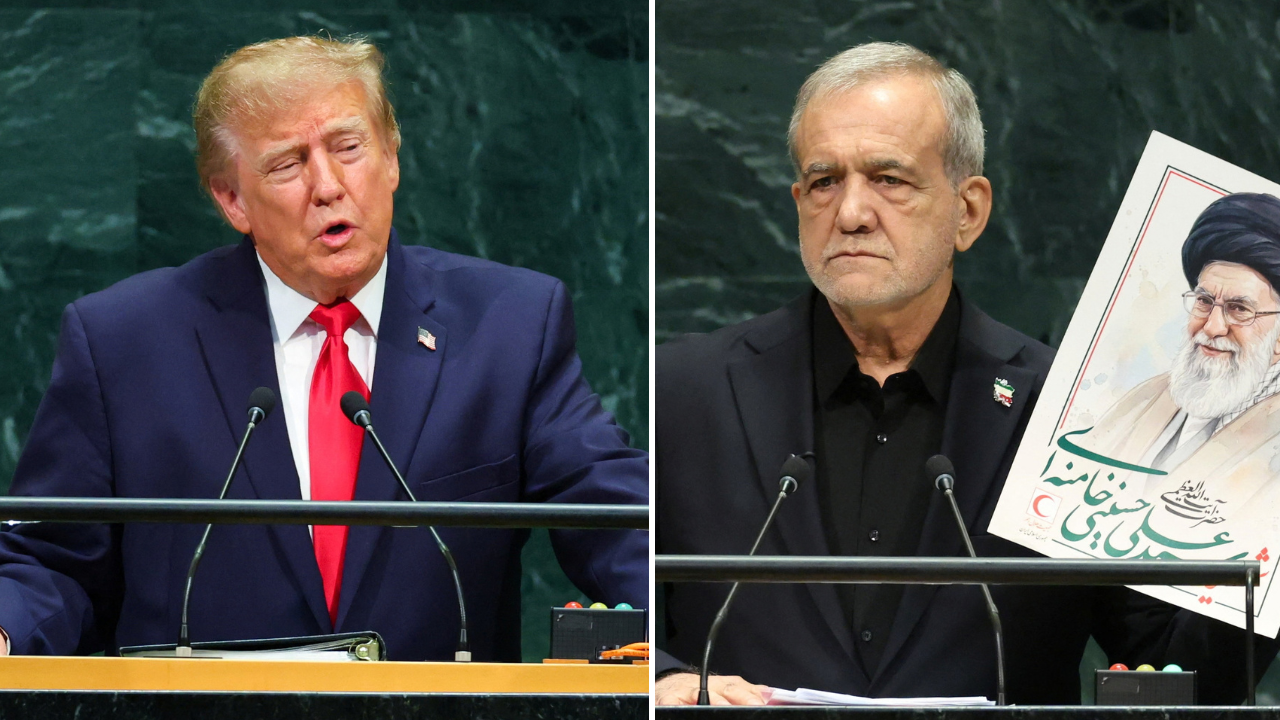
International diplomacy functions as an arena of asymmetric signaling where leaders leverage multilateral forums to alter domestic legitimacy and external deterrence. When Iranian President Masoud Pezeshkian addressed the United Nations General Assembly regarding the dichotomous framing of regional actors as either legitimate state defense forces or state-sponsored belligerents, he engaged in a high-stakes struggle over semantic definitions. This tactical maneuver highlights how global forums serve less as deliberative bodies and more as acoustic chambers for state-level strategic messaging.
The geopolitical contest hinges on a fundamental struggle over nomenclature. States locked in asymmetric conflicts systematically attempt to capture the high-value signifiers of international law. To understand this dynamic, we must deconstruct the operational architecture of state rhetoric during multilateral summits into three distinct strategic layers: narrative appropriation, domestic consolidation, and deterrence signaling. Expanding on this theme, you can find more in: Measuring Coercion Mechanics Why Electoral Turnout Metrics Fail Under Autocratic Stress.
The Mechanics of Semantic Inversion
In diplomatic discourse, semantic inversion occurs when a state under intense international sanction or military pressure recontextualizes its proxy network as an anti-hegemonic resistance movement, while recasting defensive actions by adversary states or coalitions as acts of state terrorism. Pezeshkian’s rhetorical engagement with United States foreign policy at the United Nations General Assembly illustrates this inversion framework.
By challenging the monopoly on the term terrorist, Tehran seeks to achieve three specific outcomes. First, it attempts to shift the burden of proof regarding regional destabilization back onto Washington and its regional allies. Second, it creates ideological alignment across the "Axis of Resistance," providing uniform talking points for non-state actors operating in Lebanon, Yemen, Iraq, and Syria. Third, it appeals directly to Global South constituencies that harbor historical skepticism toward Western interventionism and unipolar security architectures. Experts at NPR have shared their thoughts on this situation.
The friction point in this strategy lies in the verifiability of state control versus plausible deniability. While official statements emphasize sovereignty and self-defense, intelligence assessments from Western and regional capitals track the physical transfer of precision-guidance components, financial underwriting, and strategic synchronization. The analytical error in taking such rhetoric at face value is confusing the declarative policy of a regime with its operational doctrine. Rhetoric is designed for horizontal consumption across international audiences; operational doctrine is built for vertical command and control over kinetic assets.
The Domestic Cost Function
For an administration operating under severe economic sanctions and internal social friction, international appearances carry a domestic imperative. Pezeshkian represents a reform-adjacent faction within Iran's political structure, tasked with managing public expectations regarding economic relief while maintaining ideological fidelity to core revolutionary principles established by the clerical establishment.
When a leadership faction addresses a global audience, the domestic audience is always the primary target. The cost function of such speeches is calculated through internal political survival. By adopting a defiant yet measured posture against the United States—typified by the direct rhetorical challenge to Western policy frameworks—the administration shores up support from hardline security apparatuses, notably the Islamic Revolutionary Guard Corps. Simultaneously, it signals to moderate domestic constituencies that it is attempting to manage foreign relations through diplomatic engagement rather than unyielding isolation.
This dual-track messaging creates a permanent equilibrium of ambiguity. External observers look for signs of moderation or capitulation, while internal factions look for steadfastness against external pressure. The result is a diplomatic posture that appears contradictory to Western analysts who apply linear strategic models to non-linear governance structures.
Systemic Implications for Multilateral Forums
The United Nations General Assembly has evolved from a parliamentary body designed to codify international norms into a theater for performative diplomacy. When state actors use the podium to contest foundational definitions of international law, the institutional integrity of multilateral frameworks erodes.
When a state can effortlessly pivot between diplomatic engagement and proxy warfare while utilizing the General Assembly to legitimize both, the deterrent value of international sanctions and censure diminishes. Multilateral institutions lack enforcement mechanisms capable of imposing costs on states that master the art of rhetorical deflection. Consequently, declarations made at high-level general debates rarely alter tactical calculations on the ground. They merely codify existing adversarial positions into formal diplomatic records.
Strategic Forecast
The confrontation between Tehran and Washington at multilateral summits will continue to pivot on strategic ambiguity and asymmetric deterrence. As economic pressures evolve and regional realignments shift, future diplomatic engagements will rely increasingly on wedge politics designed to exploit fractures between the United States and its European or regional partners.
The analytical takeaway is clear: do not measure the efficacy of such speeches by their ability to generate immediate policy concessions. Measure them by their capacity to sustain domestic political stability, maintain external alliances of convenience, and successfully contest the international vocabulary of legitimacy.