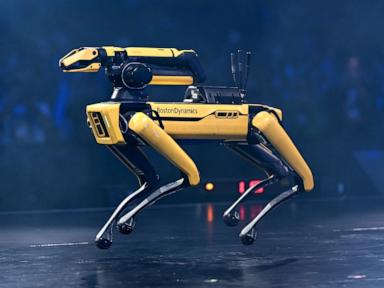
Every time a government agency buys a piece of shiny hardware, the public loses its collective mind. Headlines scream about dystopian nightmares, privacy advocates clutch their pearls, and taxpayers assume a sci-fi invasion has arrived at the frontier. The recent buzz surrounding immigration enforcement acquiring robotic quadrupeds for field operations is a masterclass in this predictable outrage cycle.
People think these mechanical hounds represent an automated Gestapo marching across the desert. They are wrong.
Strip away the sleek black chassis and the terrifying optics, and you are left with an expensive, over-engineered piece of remote-controlled surveillance gear. I have spent years watching defense contractors and federal procurement offices marry convenience to theater. This deployment is not a terrifying leap forward in artificial intelligence or autonomous oppression. It is a symptom of institutional laziness, buying gadgets to look futuristic while the foundational infrastructure rots from the inside out.
The Myth of Autonomous Enforcement
Let us correct a fundamental misunderstanding right now. When the media writes about robot dogs in the field, they imply autonomy. They imply a machine making independent decisions about human movement, threat levels, and tactical engagement.
That is pure fiction.
The current generation of quadrupedal robots—whether built by Boston Dynamics or its competitors—runs on pre-programmed pathways, remote pilot controls, and heavily limited sensor suites. They trip over dense brush. Their batteries die after a few hours of aggressive movement in extreme heat. They cannot climb a steep, loose-gravel arroyo any better than a ruggedized all-terrain vehicle, and they certainly cannot replace a human agent who can actually talk, assess context, and exercise discretion.
Imagine a scenario where an enforcement agency deploys a mechanical quadruped into a rocky, remote border corridor. The temperature hits 105 degrees Fahrenheit. The thermal throttling kicks in within forty minutes. The satellite link drops because of a canyon ridge, rendering the multi-thousand-dollar asset a stationary paperweight until a human agent walks over, picks it up, and drags it back to the truck.
That is not high-tech tyranny. That is an expensive paperweight with legs.
Why the Agency Actually Bought Them
Follow the money. Federal procurement operates on a use-it-or-lose-it budget cycle, combined with an insatiable appetite for looking technologically modern to congressional oversight committees.
I have watched government contractors pitch redundant hardware to bureaucrats who wouldn't know a neural network from a fishing net. The pitch is always the same: buy this cutting-edge platform to reduce agent risk. It sounds noble. Who wants officers walking into dangerous terrain?
Except the real risk reduction isn't happening on the ground. The real motivation is political insulation. When an agency faces intense scrutiny from both political extremes, nothing diffuses criticism quite like leaning into a sci-fi aesthetic. Critics on one side attack the agency for being too harsh; critics on the other attack it for being incompetent. Introduce a robot dog, and suddenly the conversation shifts from systemic policy failures to debate over whether the future has arrived. It is a brilliant, cynical diversion.
The hardware is a distraction. While everyone is arguing over whether a mechanical dog violates civil liberties by walking down a dry riverbed, the agency's antiquated database architecture continues to drop records, paper processing delays stretch into months, and frontline personnel remain bogged down by administrative sludge.
The Real Danger Is Human, Not Mechanical
The panic over robotic enforcement misses the actual threat entirely. We are so transfixed by the metal that we ignore the software.
The true expansion of automated border control isn't happening via four-legged robots carrying cameras; it is happening through silent, invisible algorithmic sorting in server rooms. Automated license plate readers, facial recognition databases, predictive threat-scoring models, and data-broker harvesting are expanding exponentially. These systems dictate who gets flagged, who gets detained, and who gets tracked long before any physical agent—or any robot dog—ever arrives on the scene.
A robot dog is visible. You can film it. You can write think pieces about it. You can paint it as the herald of an authoritarian tomorrow.
Algorithmic bias hidden inside a federal database cannot be filmed. It cannot be tripped up by a patch of rough terrain. It quietly scales discrimination and administrative error millions of times faster than any physical patrol unit ever could. By hyper-focusing on the visible hardware, critics are playing right into the hands of the bureaucrats who prefer you look at the shiny toy instead of the ledger.
Stop Fighting the Wrong Battle
If you want to reform immigration operations, stop protesting the deployment of remote-controlled toys. You are wasting your political capital on a tactical non-issue.
The agency wants you to scream about the robot dogs because every hour spent debating quadrupedal mobility is an hour not spent auditing multi-billion-dollar IT contracts, demanding transparency in predictive policing algorithms, or fixing the clogged administrative courts that create the backlog in the first place.
The mechanical hound is a distraction dressed up as a menace. Treat it like one. Stop taking the bait, stop writing the dystopian fan fiction, and start looking at the spreadsheets where the real damage is being done.