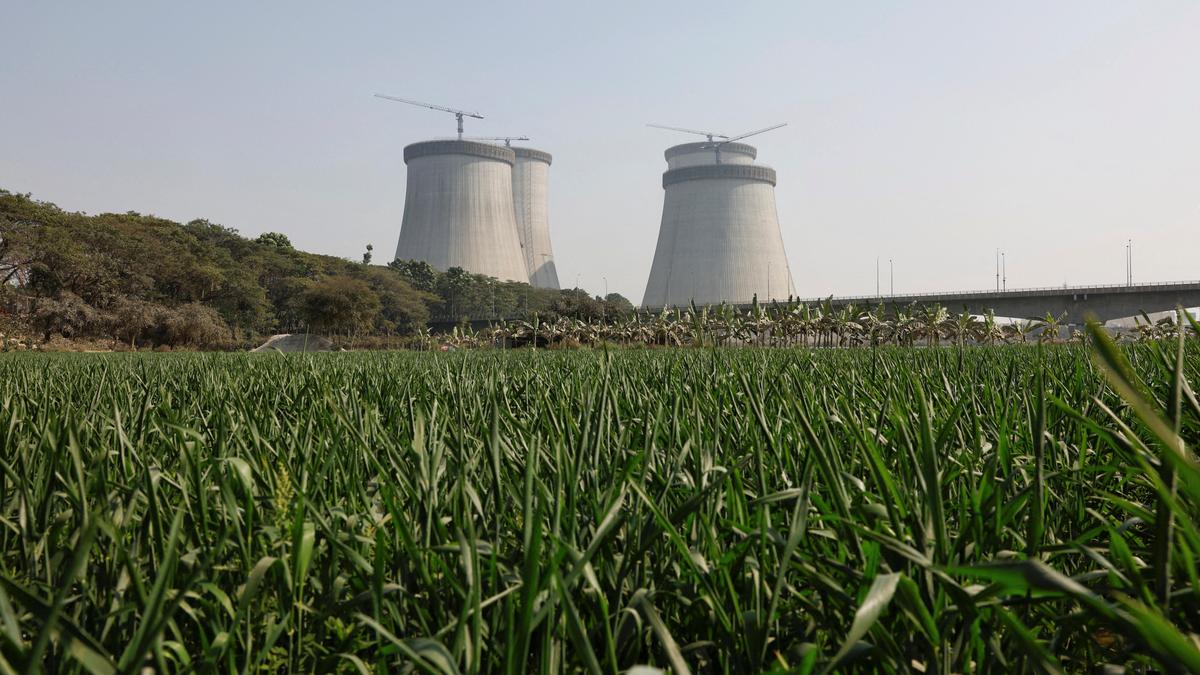
The press releases read like a victory lap. Bangladesh has received its first shipment of uranium from Russia. The Rooppur Nuclear Power Plant is officially "fuelled." The narrative is predictable: a developing nation leaps into the atomic age, secures its energy independence, and flips the switch on a carbon-free future.
It is a beautiful story. It is also a fiscal and geopolitical hallucination.
While mainstream analysts applaud the "milestone," they ignore the reality of a country tethering its entire economic spine to a single, massive, foreign-controlled point of failure. We aren't looking at an energy solution. We are looking at a $12.65 billion debt trap disguised as a cooling tower.
The Myth of Energy Independence
The most exhausting argument for Rooppur is that it grants Bangladesh "sovereignty" over its power grid. This is a fundamental misunderstanding of how nuclear logistics work.
Energy independence requires two things: domestic control of the fuel source and domestic mastery of the technology. Bangladesh has neither. The VVER-1200 reactors are Russian designs. The fuel is Russian uranium. The technicians managing the early stages are Russian. The credit used to build the thing is a Russian loan covering 90% of the cost.
Imagine a scenario where a country builds a state-of-the-art skyscraper but doesn't own the elevator parts, the steel, or the blueprint, and owes the architect a lifetime of interest. If Moscow decides to turn the tap—or if international sanctions make servicing Russian debt a legal minefield—the lights in Dhaka don't stay on because of "sovereignty." They stay on at the pleasure of a foreign power.
True independence would have been a distributed grid. Instead, Bangladesh has centralized its risk. If Rooppur goes offline for maintenance or a technical glitch, 2,400 megawatts vanish from the grid instantly. In a country already struggling with load-shedding, that isn't a safety net. It is a guillotine.
The 13 Billion Dollar Math Problem
The price tag is often cited as a necessary investment. It isn't. It is an astronomical gamble on a technology that is notoriously prone to "megaproject creep."
Bent Flyvbjerg, the world’s leading expert on megaprojects at Oxford, has documented that nuclear power has the highest cost-overrun risk of almost any infrastructure type. Rooppur is already one of the most expensive projects in the nation’s history. But the $12.65 billion is just the entry fee.
We need to talk about the Levelized Cost of Energy (LCOE). While solar and wind prices have plummeted over the last decade, nuclear costs have remained stagnant or increased due to tightening safety regulations and specialized supply chains. By the time Rooppur is fully operational, the price per kilowatt-hour will likely be significantly higher than if the same capital had been deployed into a mix of modular renewables and grid-scale storage.
We are subsidizing a 20th-century solution with 21st-century debt.
The Geography of Risk
Proponents point to the safety of the VVER-1200 "Generation 3+" design. They talk about "passive safety systems" and "core catchers." They are technically correct. The Russian hardware is solid.
But hardware doesn't exist in a vacuum. It exists in the Ganges Delta.
Bangladesh is one of the most climate-vulnerable nations on earth. Rooppur sits on the banks of the Padma River. Nuclear plants require staggering amounts of water for cooling. In a region defined by shifting riverbeds, extreme monsoons, and the constant threat of siltation, the hydrologic stability required for a 60-year plant life is not guaranteed.
Then there is the waste. The agreement states Russia will take back the spent fuel. This is often framed as a "problem solved." In reality, it is a permanent tether. Every ounce of radioactive waste generated in Pabna becomes a bargaining chip for the next sixty years. If the geopolitical winds shift, where does that waste go? Bangladesh has zero infrastructure for long-term geological storage.
The Opportunity Cost of the Atomic Ego
Why did we do this? Because nuclear power is the ultimate status symbol for a rising nation. It says, "We have arrived." It’s an ego-driven procurement strategy.
I have seen governments sink billions into "prestige tech" while their primary distribution networks are held together by duct tape and hope. The $13 billion spent on Rooppur could have revolutionized the entire Bangladeshi national grid. It could have funded a complete overhaul of the inefficient, aging transmission lines that currently lose massive amounts of power before it ever reaches a lightbulb.
Instead of fixing the pipes, we bought a more expensive faucet.
The industry insiders won't tell you this because there is too much money in the concrete. Thousands of consultants, contractors, and bureaucrats are feeding at the trough of a $12 billion project. Small-scale, decentralized energy doesn't offer the same opportunities for massive, centralized "disbursements."
The False Promise of "Baseload"
"But we need baseload power!" the critics shout.
This is a tired 1990s talking point. The concept of "baseload" is being dismantled by the rise of "flexible" grids. Modern energy systems don't need a single giant engine running at 100% all the time. They need a symphony of diverse sources—wind, solar, hydro, and increasingly, battery storage—managed by smart software that can balance load in real-time.
Nuclear is the opposite of flexible. You cannot simply "ramp up" a nuclear reactor when everyone turns on their air conditioners at 2:00 PM and "ramp it down" at night. It is a blunt instrument. In a world moving toward agility, Bangladesh just bought a lead weights for its ankles.
Realities of the Russian Partnership
We must address the elephant in the room: the supplier.
Russia’s Rosatom is currently the only global player willing to offer "cradle-to-grave" financing and fuel services. They are the Amazon of nuclear power. But that convenience comes with a cost that isn't listed in the contract.
By choosing Rosatom, Bangladesh has effectively locked itself into a decades-long marriage with a state that is increasingly isolated from the Western financial system. This creates a nightmare for spare parts, technical upgrades, and financial transfers. We are seeing this play out in real-time in other sectors; why would we think nuclear is immune to the friction of global sanctions?
If a specialized valve breaks in 2035 and the manufacturer is under an export ban, Rooppur becomes the world's most expensive museum.
Stop Applauding and Start Auditing
The arrival of uranium is not a "new era." It is the closing of a trap.
We need to stop treating nuclear power as a magical shortcut to development. It is a slow, expensive, and rigid technology that creates massive foreign dependency. The smart move for a country like Bangladesh was never a single 2.4 GW monster. It was 2,400 smaller, faster, cheaper wins.
The "lazy consensus" says this is progress. The data says this is a mortgage on the future of the Bangladeshi taxpayer, paid to a foreign power for a product that is becoming obsolete before the first rod is even spent.
Put down the champagne. The bill hasn't even arrived yet.