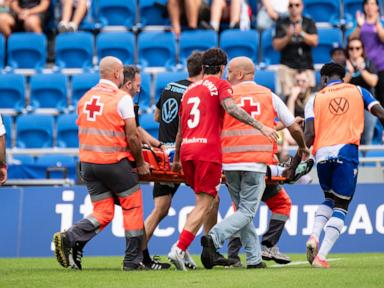
Spanish police routinely open formal investigations whenever a soccer player dies following an on-field collision to determine whether the fatal impact was an unavoidable sporting accident or the result of criminal negligence. Under Spanish law, sudden deaths at public sporting events trigger an automatic judicial inquiry—known as diligencias previas—to examine medical response times, facility safety compliance, and the physical conduct of the players involved.
Tragedies on the pitch rarely stay confined to the touchline. When a player collapses and dies after a collision during a match in Spain, the grief of teammates and spectators quickly collides with the cold machinery of the Spanish judicial system. Reporters covering the beat see the same sequence unfold every time. First comes the shock of the impact, then the frantic waving of players toward the bench, followed by the arrival of local police and forensic investigators who treat the penalty box like a potential crime scene.
Most fans assume a collision during a sanctioned match is automatically immune from legal scrutiny. That assumption is wrong. While sports carry inherent physical risks, Spanish jurisprudence draws a sharp line between accepted athletic contact and reckless disregard for human life.
Why Spanish Law Demands a Police Investigation
In Spain, any violent or unexpected death outside of a hospital setting requires the intervention of an investigative judge (Juez de Instrucción) and the judicial police. An on-field collision that results in a fatality falls squarely into this category, even when hundreds of witnesses saw the exact moment of impact.
The police are not necessarily looking for a murderer. They are building a factual record to answer three specific legal questions for the presiding magistrate:
- Was the collision within the rules of the game? Investigators review match footage, interview the referee, and take statements from players to determine if the challenge was a standard play on the ball or an intentional, malicious assault disguised as a tackle.
- Did the medical response meet statutory requirements? Police inspect ambulance logs, verify the presence of working automated external defibrillators (AEDs), and check whether qualified medical personnel were physically present at the stadium as mandated by regional sports regulations.
- Were facility hazards a contributing factor? In lower-division and youth matches across Spain, perimeter walls, concrete drainage channels, and unpadded metal goalposts sit dangerously close to the touchline. If a collision sends a player headfirst into an unapproved structural hazard, liability shifts rapidly toward venue operators and municipal authorities.
The Autopsy and Forensic Timeline
Before a single charge is considered—or before the case is quietly shelved as a tragic accident—the body is transferred to the local Institute of Legal Medicine (Instituto de Medicina Legal). Forensic pathologists must separate the immediate trauma of the collision from underlying, undiagnosed medical conditions.
A hard blow to the chest or head can trigger fatal events that look identical from the stands. Pathologists look for commotio cordis, a rare disruption of heart rhythm caused by a blunt, non-penetrating blow to the chest at a precise millisecond during the cardiac cycle. They also check for traumatic brain hemorrhages, ruptured spleens, or pre-existing hypertrophic cardiomyopathy that happened to manifest at the exact moment of physical contact.
Until the toxicology and histopathology reports return to the judge, the police file remains open. For the families and the opposing player involved in the collision, that bureaucratic limbo can stretch for months.
The Anatomy of High-Impact Collisions on the Pitch
Soccer is not a collision sport in the mold of American football or rugby, yet the mechanics of certain plays generate violent, unprotected kinetic energy. Players wear no helmets, no shoulder pads, and no torso protection. When two athletes sprint toward a 50-50 ball at 20 miles per hour, the resulting deceleration forces are severe.
Goalkeepers and incoming strikers represent the highest-risk pairing on the field. In a hypothetical example of a classic one-on-one breakaway, a striker keeps their eyes locked on a bouncing through-ball while a goalkeeper dives headfirst toward the attacker's feet. Neither player sees the other until milliseconds before contact. A knee to the temple or a hip to the sternum occurs at full velocity, with zero bracing from the receiving player.
Aerial duels carry a different kind of danger. Two defenders jumping backward or sideways to clear a corner kick often clash heads at the peak of their leap. The primary impact happens in the air, knocking one or both players unconscious before they even hit the turf. The secondary impact—an uncontrolled, limp fall onto hard ground—frequently causes more severe cranial trauma than the initial clash of skulls.
The Lower-Division Medical Gap
Walk into the Santiago Bernabéu or Camp Nou, and you will find full trauma teams, parked intensive-care ambulances, and specialized sports cardiologists sitting yards from the technical area. Step down to the regional tiers of Spanish football—Tercera Federación, Preferente, or youth academies—and the safety net thins out dramatically.
Financial reality dictates compliance. Thousands of amateur and semi-professional matches take place every weekend across Spain's autonomous communities. While the Royal Spanish Football Federation (RFEF) and regional federations mandate basic safety protocols, enforcement across remote municipal fields remains uneven.
| Safety Element | Top-Flight Professional (La Liga) | Regional & Amateur Tiers |
|---|---|---|
| On-Site Medical Staff | Dedicated team doctors + stadium trauma crew | Often a single physiotherapist or basic first-aider |
| Ambulance Presence | Mandatory ICU ambulance inside stadium perimeter | Frequently on-call via public 112 emergency dispatch |
| Defibrillator (AED) Access | Multiple pitch-side units with trained operators | Required by law, though battery/pad maintenance varies |
| Perimeter Clearance | Strict FIFA/UEFA buffer zones with padded boards | Concrete walls or metal fences often 1-2 meters from line |
When a catastrophic collision happens at a small municipal ground, those differences cease to be administrative footnotes. They become the central focus of the police investigation. If a stadium's lone defibrillator was locked inside a clubhouse office because the groundsman went home at halftime, investigators will document that failure. If an ambulance took 18 minutes to navigate narrow village streets because no unit was stationed at the venue, the inquiry will examine whether regional federation rules required one to be there.
Criminal Liability vs. Sporting Risk
A question hangs over every fatal on-field collision: Can a soccer player go to prison for a tackle?
Under Spanish criminal law, the doctrine of assumed risk (riesgo permitido) protects athletes from prosecution for injuries inflicted during normal play. When you step onto a pitch, you legally consent to the physical contact inherent to the sport—shoulder charges, sliding tackles, and aerial jostling. Even a foul that earns a red card rarely crosses the threshold into criminal territory.
Prosecutors look for dolo (intent) or imprudencia grave (gross negligence). To bring criminal charges against an opposing player, police investigators would need overwhelming video and witness evidence showing that the tackle had nothing to do with playing the ball—for instance, a player charging across the field after the whistle had blown to strike an opponent in the head.
In the vast majority of fatal on-field collisions, the surviving player is cleared of any legal wrongdoing. The police report confirms what the referee saw: two athletes competing for a ball, an unfortunate angle of impact, and a devastating outcome. Yet clearing a player's name in a court file does nothing to erase the psychological trauma of having been the other half of a fatal collision. Many amateur and semi-professional players involved in such incidents never step onto a pitch again.
What Investigators Examine in the First 48 Hours
When local police or the Guardia Civil arrive at a stadium following a fatal collapse, their standard operating procedure moves quickly before evidence disappears or memories blur.
- Securing Video Footage: Beyond official broadcast feeds (which rarely exist below the third tier), officers collect mobile phone videos from spectators, tactical camera footage from team analysts, and stadium CCTV recordings.
- Inspecting the Match Ball and Turf: Investigators photograph the exact spot on the pitch where the collision occurred, noting field conditions, wet patches, or exposed sprinkler heads that might have caused a player to slip into an awkward impact.
- Seizing Medical Logs and Equipment: The venue's AED unit is often confiscated so technicians can download its internal electronic data log. Modern defibrillators record exact timestamps of when the device was powered on, when pads were applied, and whether a shock was advised or delivered.
- Taking the Referee's Match Report (Acta Arbitral): The referee's official post-match report serves as a primary legal document. Investigators cross-reference the referee's description of the collision and the exact minute of stoppage against emergency call timestamps from Spain's 112 dispatch center.
The Structural Blind Spots in Grassroots Safety
Every time a tragedy like this makes national headlines in Spain, sports federations issue statements mourning the loss and promising to review safety protocols. Weeks later, the news cycle moves on, and thousands of youth and amateur teams return to the exact same municipal pitches.
Money is the quiet obstacle nobody in regional administration wants to confront directly. Mandating a fully staffed, advanced life-support ambulance at every single weekend match across Spain would bankrupt hundreds of small neighborhood clubs that survive on €150 annual player dues and local bar sponsorships. Regional governments own most of the stadiums, yet municipal budgets are chronically stretched, leaving perimeter padding torn and medical rooms under-equipped.
Even cardiac screening—which catches structural heart defects before a collision can trigger a fatal arrhythmia—remains inconsistent at the grassroots level. While federated players in Spain must undergo periodic medical checkups (reconocimientos médicos) to receive their playing licenses, many basic exams consist of little more than listening to a heartbeat with a stethoscope and checking blood pressure. Electrocardiograms (ECGs) and echocardiograms catch far more silent anomalies, yet they remain expensive and logistically difficult to administer to hundreds of thousands of amateur players every season.
Where Accountability Actually Lands
The public often wants a clear villain when a young, healthy athlete dies doing something as ordinary as chasing a soccer ball. Police investigations rarely deliver one.
Instead, these inquiries expose the thin margin separating routine athletic collisions from irreversible tragedy. They reveal how heavily amateur sports rely on luck—luck that a collision hits a shoulder instead of a temple, luck that an off-duty nurse happens to be sitting in the bleachers, luck that the stadium defibrillator has a charged battery. When that luck runs out, police detectives are left to piece together the final seconds of a match, measuring response times in minutes and seconds while a community tries to make sense of a game that never finished.