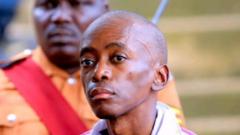
Ryan Wesley Routh will never see the outside of a federal cell again. On February 4, 2026, U.S. District Judge Aileen Cannon punctuated a chaotic legal saga by sentencing the 59-year-old to life plus 84 months in prison. The sentence followed a conviction on five federal counts, including the attempted assassination of Donald Trump at his West Palm Beach golf club in September 2024. For a man who spent months scoping out fairways and drafting manifestos to "finish the job," the courtroom finale was as volatile as the crime itself, featuring a botched self-harm attempt and a legal defense that veered into the absurd.
This was not merely a case of a trespasser with a rifle. Federal prosecutors painstakingly reconstructed a timeline of obsession that began long before Routh set foot in Florida. By the time he was spotted by a Secret Service agent in the shrubbery of the sixth hole, Routh had already authored a book urging foreign entities to take the shot and had delivered a "Dear World" letter to a witness, apologizing in advance for his failure. The court heard how Routh’s radicalization was not a sudden break but a slow, documented descent into a self-styled role as a global vigilante.
The Sniper Hide and the Scrawled Manifesto
The physical evidence presented during the two-week trial in Fort Pierce painted a picture of a man caught between meticulous planning and staggering incompetence. Law enforcement recovered a Norinco SKS rifle equipped with a scope that was, in a bizarre detail, attached using a combination of tape and glue. Along with the weapon, investigators found steel armor plates and a camera affixed to the fence, positioned to record the planned execution.
Routh’s "Dear World" letter served as the prosecution’s smoking gun. In it, he offered a $150,000 bounty to anyone who could succeed where he might fail. This was not the work of a man acting on impulse. He had traveled to the West Palm Beach area at least 17 times to scope out the golf course, using a dozen burner phones to mask his movements. The prosecution argued that Routh viewed himself as a historical protagonist, a delusion that persisted even after his capture on I-95.
A Courtroom Farce
The trial itself threatened to dissolve into a circus when Routh fired his public defenders to represent himself. Lacking any formal legal training, his filings became a matter of public fascination and concern for the court’s dignity. In one widely reported motion, Routh suggested the entire case be settled via a golf match. His terms were simple: if he won, he would become president; if he lost, he would accept execution. He even requested a putting green in his cell for practice and specified that "female strippers" be present during the proceedings.
Judge Cannon, who has faced intense scrutiny for her handling of separate cases involving the former president, had little patience for Routh’s attempts to turn the courtroom into a stage for his "musings on human existence." She repeatedly steered him back to the evidence, though Routh’s cross-examinations often devolved into philosophical ramblings. When the jury eventually returned a guilty verdict on all counts, Routh’s composure finally shattered. He reportedly attempted to stab himself in the neck with a pen before being tackled by U.S. Marshals and dragged from the room.
The Intelligence Gap
While the sentencing provides a legal conclusion, it leaves open questions about the security failures that allowed Routh to get within 400 yards of his target. Because Trump was not a sitting president at the time, the perimeter of the Trump International Golf Club was not fully secured. It was only the sharp eye of Secret Service Special Agent Robert Fercano, who was patrolling one hole ahead of the former president, that prevented a direct engagement.
Routh had been on the radar of federal authorities as early as 2023. A woman named Kathleen Shaffer had reported him to the FBI after his behavior became increasingly erratic following his failed attempts to recruit foreign mercenaries for the war in Ukraine. Despite his lengthy criminal history—spanning over 100 prior offenses in North Carolina—Routh had consistently avoided prison time, receiving probation for crimes ranging from possession of stolen goods to a three-hour standoff with police involving a fully automatic weapon in 2002.
The Final Reckoning
The life sentence issued this year is intended to serve as a "resounding rejection of political violence," according to Assistant Attorney General John A. Eisenberg. However, the case also highlights a growing trend of individuals who believe their personal political grievances justify lethal force. Routh did not see himself as a criminal, but as a martyr for a global cause, a sentiment echoed in his self-published book where he took personal blame for the 2016 election results.
Routh is now housed at the United States Penitentiary in Victorville. His legal team has indicated they will appeal the sentence, but with a mountain of DNA evidence, a hand-written confession, and a civilian witness who identified him fleeing the scene, the path to a reversal is non-existent. The man who wanted to change the course of history through a rifle scope is now a permanent ward of the state, his legacy defined not by the "gumption" he claimed to possess, but by the devastating brain damage suffered by a six-year-old girl injured in a car crash during the high-speed pursuit that led to his arrest.
The gavel has fallen, yet the environment that produced Ryan Routh remains largely unaddressed. Political violence is a symptom of a deeper fracture, one that a life sentence can punish but cannot heal.