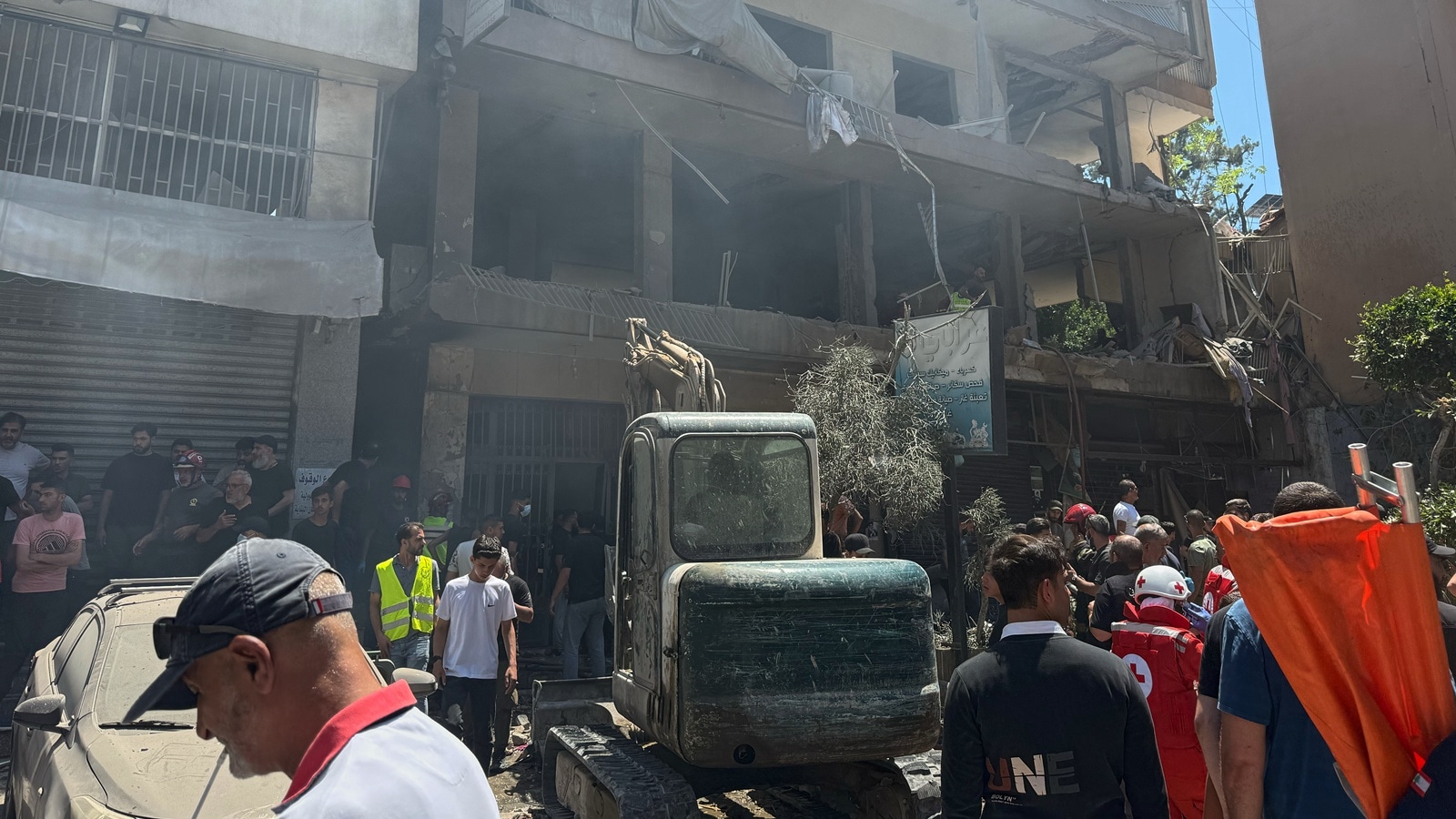
An Israeli airstrike collapsed a five-story residential building in the Ghobeiry neighborhood of southern Beirut today, exposing the severe friction between regional military operations and international diplomacy. The strike occurred just as U.S. President Donald Trump and Pakistani negotiators claimed a comprehensive U.S.-Iran peace deal was ready for signature. It also highlighted a significant strategic division: the White House is rushing to finalize an electronic ceasefire to reopen the blockaded Strait of Hormuz, while the Israeli security cabinet is actively working to prevent an agreement that leaves Iran’s regional proxy network intact.
By reducing the bottom two floors of a crowded apartment complex to concrete dust, Israel signaled that it will not be bound by a diplomatic framework negotiated in its absence. The immediate justification from Prime Minister Benjamin Netanyahu’s office was tactical retaliation for three cross-border projectiles launched by Hezbollah into northern Israel earlier in the day.
The broader strategic reality is far more complex. This strike was a deliberate exercise in diplomatic sabotage, designed to test the limits of American pressure and force Iran’s hardline factions to walk away from the negotiating table.
The Illusion of a Signed Sunday Deal
For days, political messaging from Washington and Islamabad suggested an imminent diplomatic breakthrough. Proponents of the deal outlined a 60-day interim framework intended to halt hostilities, initiate technical talks on Iran's nuclear enrichment levels, and immediately reopen the Strait of Hormuz to stabilize global energy markets. Donald Trump went so far as to declare that the historic accord would be finalized on Sunday, predicting the beginning of a beautiful peace.
The view from Tehran and Jerusalem, however, was entirely different.
- The Iranian Hesitation: Hours before the Beirut bombardment, Iranian Foreign Ministry spokesperson Esmail Baghaei and local state media clarified that no final decision had been reached. A Qatari delegation was actively huddling in Tehran, trying to convince skeptical Iranian officials to accept a text that fails to resolve billions of dollars in frozen assets or provide concrete relief from international sanctions.
- The Israeli Exclusion: The Israeli government has been entirely sidelined during these talks, which were mediated largely by Pakistani Prime Minister Shehbaz Sharif. Netanyahu and Defense Minister Israel Katz have made it clear that they do not view American diplomatic arrangements as binding on Israel's national defense strategy.
The strike on Beirut’s southern suburbs targeted what Israel classified as a Hezbollah command center. In reality, it struck the fragile foundation of the proposed peace deal itself.
Immediately following the attack, Iran’s chief negotiator questioned the utility of continuing talks with a superpower that cannot or will not restrain its closest regional ally. Mohammad Jafar Assadi, a senior Iranian military official, quickly vowed that the assault would not go unanswered.
Why the Current Peace Framework is Structurally Flawed
The fundamental flaw of the current Washington-led diplomacy is its attempt to decouple the U.S.-Iran conflict from the ground realities in Lebanon. American negotiators have prioritized a rapid, short-term stabilization package to ease global economic pressures, leaving the long-term status of regional armed groups unresolved.
+------------------------------------+------------------------------------+
| Washington's Diplomatic Goals      | Jerusalem's Security Imperatives   |
+------------------------------------+------------------------------------+
| • Immediate reopening of the       | • Total dismantlement of Hezbollah |
|   Strait of Hormuz                 |   infrastructure south of the      |
| • A 60-day freeze on Iranian       |   Litani River                     |
|   nuclear enrichment technicalities | • Permanent elimination of long-   |
| • Rapid reduction of direct U.S.   |   range precision missile threats  |
|   military engagements             | • Absolute refusal to accept a     |
|                                    |   status quo ante bellum           |
+------------------------------------+------------------------------------+
This structural disconnect explains why Israel chose to ignore direct requests from Washington to refrain from striking the Lebanese capital. For the Israeli defense establishment, a ceasefire that permits Hezbollah to survive, regroup, and maintain its positions along the northern border is an existential failure. Over 3,500 people have been killed in Lebanon since this phase of the conflict erupted in March, and Israeli forces have seized roughly one-fifth of southern Lebanese territory.
Netanyahu’s political survival depends on achieving a decisive victory rather than accepting a managed truce.
The Strategic Lever of Kharg Island
To understand the desperation behind the current diplomatic push, one must look at the immense economic pressure built up over the last several months. Just twenty-four hours before the latest Beirut airstrike, Washington increased its diplomatic leverage by threatening to expand airstrikes and seize direct control of Iran’s primary oil export hub on Kharg Island in the Persian Gulf.
This threat was intended to force Tehran's hand, but it also raised the stakes for Israel. If the United States successfully coerces Iran into a partial agreement through economic blackmail, the international political will to sustain a costly military campaign in Lebanon will evaporate.
By striking Dahiyeh without warning, Israel effectively forced a counter-escalation. The Israel Defense Forces immediately announced they were preparing for retaliatory rocket and drone fire in the coming hours, ensuring that the regional environment remains hot enough to disrupt any imminent electronic signing ceremonies.
A Flawed Status Quo
The Trump administration’s public reaction to the strike highlights its growing frustration with Jerusalem. In a social media statement, Trump admonished Israel, noting the attack should not have happened on a day when a major peace agreement was within reach. He urged all sides to stand down, insisting that Israel halt its operations throughout Lebanon while Hezbollah simultaneously ceases its strikes on northern Israel.
"This morning's attack on Beirut should not have happened, particularly on a special day when we are so close to a Peace Deal with Iran... Let's not blow it!"
This even-handed rhetoric ignores the intractable reality on the ground. A simple cessation of hostilities does nothing to settle the core disputes of the war.
It does not address the fate of Iran’s advanced centrifuges, it does not disarm the militias entrenched in Lebanese border towns, and it provides no security guarantees for the hundreds of thousands of displaced civilians on both sides of the Blue Line. It is an attempt to impose a diplomatic band-aid on an open wound.
As smoke continues to rise over Ghobeiry and residents once again flee the southern suburbs of Beirut, the limits of Western diplomatic leverage are fully exposed. You cannot broker a durable peace for a multi-front war by negotiating with only one of the combatants.
Until Washington addresses Israel's core security requirements, any electronic document signed with Tehran will remain a piece of paper, entirely disconnected from the actual batteries firing missiles across the Middle East.