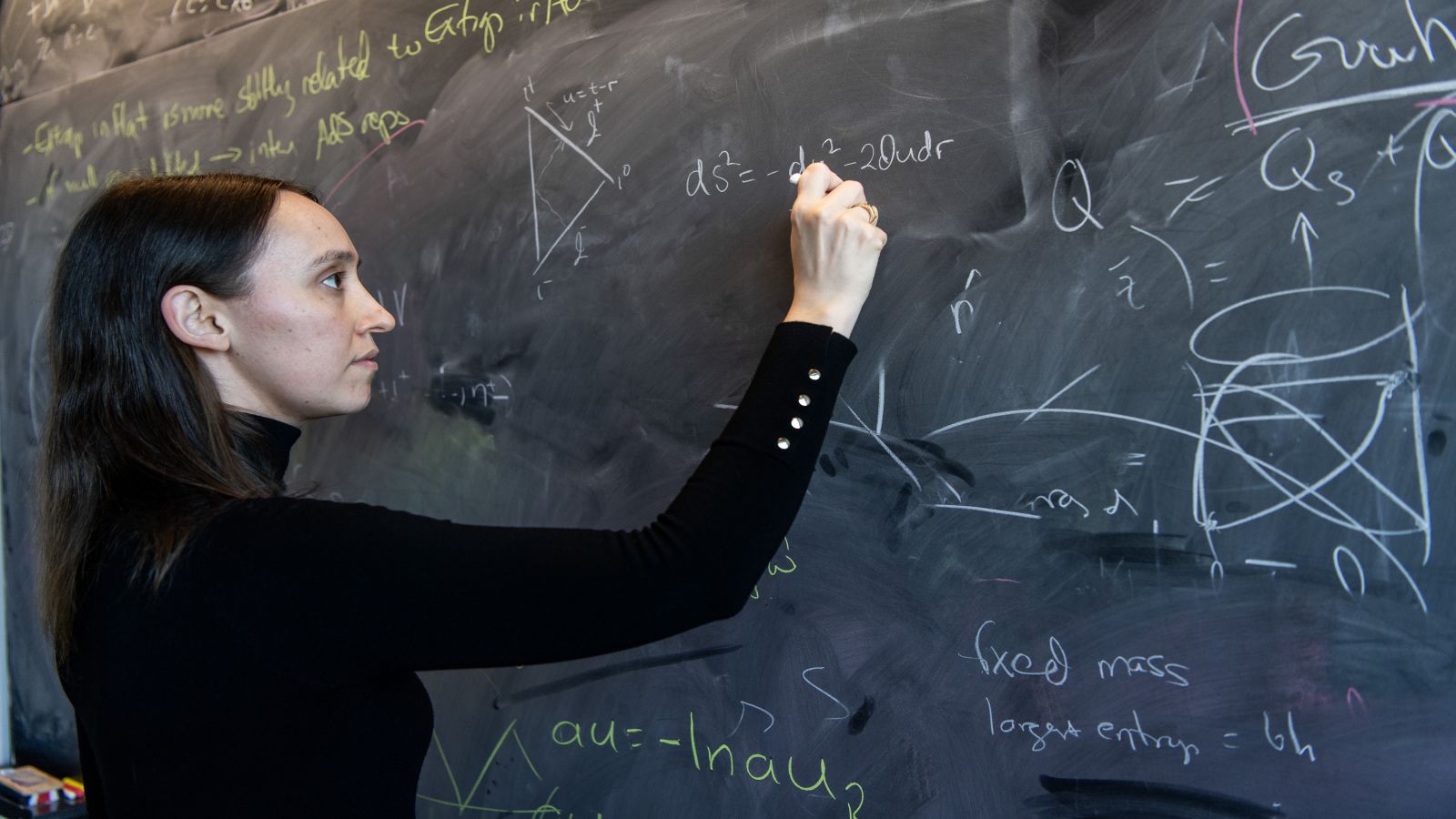
Calling Sabrina Gonzalez Pasterski the "next Einstein" sounds like great clickbait. Honestly, it does her real work a disservice.
Einstein reshaped classical physics by overturning Newton's ideas of space, time, and gravity. Pasterski isn't repeating that exact trick. She's working on a completely different bottleneck: trying to reconcile quantum mechanics with general relativity inside spacetimes that look flat from afar, through a framework called celestial holography.
If you've seen viral posts about a teenage pilot who graduated from MIT, earned a Harvard PhD, and now leads research at the Perimeter Institute for Theoretical Physics, you already know the highlight reel. What most hype pieces skip is the messy, deeply technical math behind those headlines—and the very real open questions about whether celestial holography will crack quantum gravity or hit dead ends.
Why the Einstein Comparison Misses the Mark
Media outlets love a tidy lineage of geniuses. Put a prodigy in front of a chalkboard, mention black holes and spacetime, and someone writes "the new Einstein."
It's lazy shorthand. Einstein worked at a moment when experimental puzzles—like the Michelson-Morley experiment and the orbit of Mercury—demanded a new classical framework. Today's theoretical physicists don't lack cleverness; they face a brutal shortage of direct high-energy experiments at the Planck scale where quantum gravity lives.
Pasterski herself has focused on building mathematical bridges rather than playing a pop-culture role. Born in Chicago in 1993, she went from building and flying a kit aircraft as a teenager to studying at MIT and earning her physics PhD from Harvard in 2019. Later, she joined the Perimeter Institute in Waterloo, Ontario, where she founded and leads the Celestial Holography Initiative and serves as deputy director of the Simons Collaboration on Celestial Holography.
Those credentials are remarkable on their own terms. You don't need a recycled Einstein label to make them matter.
What Celestial Holography Actually Tries to Do
At its core, quantum gravity asks how quantum mechanics—which governs particles, probabilities, and discrete states—coexists with general relativity, which describes gravity as the curvature of spacetime. For decades, physicists have found that standard ways of quantizing gravity run into nasty infinities that refuse to behave cleanly.
One major breakthrough in past decades was AdS/CFT correspondence, a holographic duality that links gravity in anti-de Sitter space (a negatively curved spacetime) to a quantum field theory without gravity on its boundary. That worked brilliantly as a theoretical laboratory. There's just one catch: our observable universe at large scales doesn't look like anti-de Sitter space.
Celestial holography aims at asymptotically flat spacetimes—spacetimes that look flat far away from gravitating sources, closer to the setting used when modeling particle scattering and gravitational radiation. According to Perimeter Institute's research framework, celestial holography maps four-dimensional scattering amplitudes (known as S-matrix elements) to correlators in a two-dimensional conformal field theory living on the celestial sphere—essentially the sky at infinity.
Let's translate that out of jargon without faking precision. Instead of tracking particle collisions solely inside a four-dimensional bulk picture, theorists recast scattering data onto a two-dimensional celestial sphere using conformal symmetries. If the dictionary holds up, questions about bulk gravity and infrared physics can be studied using tools from two-dimensional conformal field theory and bootstrap methods.
Symmetries and the Spin Memory Effect
Before leading the Celestial Holography Initiative, Pasterski made waves for work connected to soft theorems, asymptotic symmetries, and gravitational memory. Alongside Andrew Strominger and Alexander Zhiboedov, she co-authored "New Gravitational Memories," published in the Journal of High Energy Physics in December 2016, which predicted a spin memory effect tied to angular momentum and gravitational radiation.
That detail gets mangled online all the time, so let's be crystal clear: the 2016 paper made a theoretical prediction. It did not announce a detector discovery. Gravitational-wave observatories like LIGO have opened a whole new observational window into merging black holes and neutron stars, while theorists work out every subtlety of memory effects and soft charges in real astrophysical signals.
Common Myths and What Skeptics Point Out
Whenever a physicist gets viral coverage, three misconceptions tend to show up right away.
- Myth 1: She already solved quantum gravity. Nobody has. Quantum gravity remains one of the hardest unsolved problems in physics, and celestial holography is an active research program, not a finished theory of everything.
- Myth 2: The holographic universe means reality is a sci-fi projection. In physics, "holography" is a mathematical correspondence between descriptions in different dimensions. It doesn't mean someone is running a stage hologram over your coffee mug.
- Myth 3: A single prodigy carries the entire subfield. Modern theoretical physics is collaborative and heavily technical. Even Pasterski has noted that only a relatively small specialist community works directly on the nuts and bolts of celestial amplitudes, working alongside broader efforts in string theory, scattering amplitudes, and the conformal bootstrap.
There are also genuine open debates in the field. Researchers are still working through how flat-space holography handles loop corrections, massless versus massive particles, cosmological horizons, and whether a full, self-consistent two-dimensional celestial dual exists with all the properties needed to describe quantum gravity in our universe. Being honest about those hurdles doesn't weaken the science. It's the whole point of doing foundational research.
How to Follow Her Research Without the Hype
If you actually want to understand what Pasterski and her collaborators are building, skip the recycled listicles and go straight to primary sources.
- Read seminar abstracts and lecture notes. Check her faculty profile at the Perimeter Institute or browse open-access preprints on arXiv—such as her 2021 review Lectures on celestial amplitudes—to see how theorists frame scattering on the celestial sphere.
- Learn the prerequisites in layers. You don't need a PhD to get the intuition, though the full math is steep. Brush up on special and general relativity first, then get comfortable with quantum mechanics, symmetries, and basic quantum field theory before tackling conformal field theory.
- Track how the subfields connect. Pay attention to how celestial holography interacts with scattering amplitudes, soft theorems, and black hole physics rather than treating it as an isolated buzzword.
Big physics takes decades of patient calculation, dead ends, and quiet breakthroughs. Watching a young theorist push on one of the hardest problems in science is plenty compelling—no fake Einstein crown required.


