Sleep is the baseline of human stability. Without it, cognition frays, immune systems collapse, and children fall behind before they ever learn how to read. Yet, hundreds of thousands of children in the United States sleep on hardwood floors, carpeted patches, or shared mattresses because their families cannot afford basic bedroom furniture.
This crisis of sleep poverty has birthed an entire parallel infrastructure of grassroots charity, most notably exemplified by Sleep in Heavenly Peace, an organization that grew from a single father building a bunk bed on his garage floor in 2012 into a massive national network that has delivered hundreds of thousands of beds to children in need. For a deeper dive into this area, we suggest: this related article.
The story of how one man building a wooden frame in Idaho scaled into an operation delivering nearly 400,000 beds is a testament to human empathy. It is also an indictment of a broader social failure. When volunteer-driven workshops have to step in to provide the bare physical necessities for children to rest, it reveals a profound systemic vacuum where the social safety net has torn apart.
The Anatomy of Sleep Poverty
For decades, the public imagination associated child poverty with empty refrigerators and tattered clothing. Bedlessness remained invisible. Children who sleep on floors rarely talk about it at school; shame keeps them quiet. Teachers notice the chronic exhaustion, the inability to focus during morning math lessons, and the behavioral outbursts that stem from night after night of disrupted sleep. For broader information on the matter, extensive analysis can be read at Al Jazeera.
Medical researchers have quantified what common sense already tells us. Children need deep, uninterrupted rest for brain development and physical growth. When a child sleeps on a cold floor or shares a crowded, bug-infested pallet with three siblings, their cortisol levels remain elevated. They exist in a state of perpetual low-grade emergency.
When volunteer groups step into living rooms to deliver twin frames, mattresses, and bedding, they are treating a symptom of chronic economic distress. The demand does not shrink. It expands. Every chapter opened across the country finds immediate backlogs of families waiting months for a simple wooden frame and a foam mattress. The sheer persistence of this demand exposes the widening chasm between rising housing costs and stagnant working-class wages.
Grassroots Logistics Versus State Failure
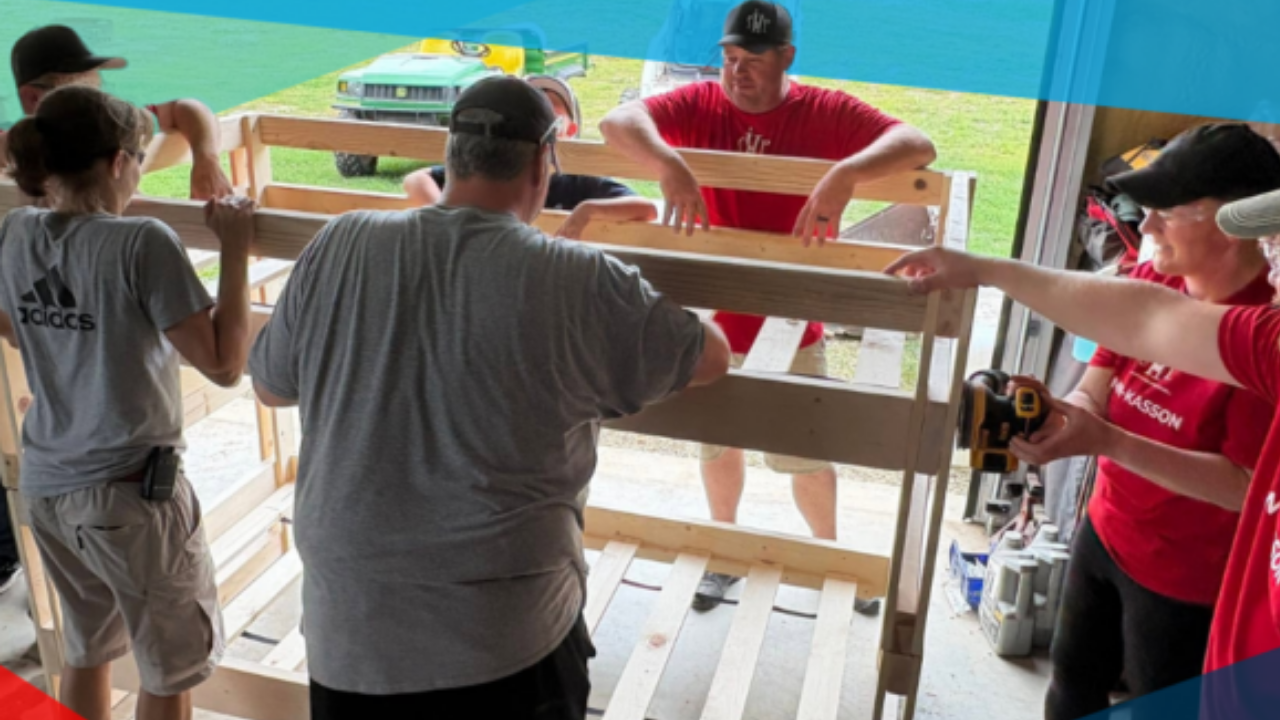
Building beds by hand is hard work. Doing it across hundreds of chapters requires industrial-scale volunteer coordination, corporate timber donations, and local fundraising drives. Sleep in Heavenly Peace operates less like a traditional charity and more like a decentralized manufacturing network. Local chapters source lumber, organize community build days where volunteers sand and stain pine boards, and coordinate deliveries directly to homes.
There is deep nobility in this labor. Neighbors helping neighbors embodies a core American value of mutual aid. But looking at the operation through an analyst's lens uncomfortably highlights the limits of charity in addressing structural poverty.
Charity scales linearly. The systemic drivers of poverty scale exponentially.
When a family spends seventy percent of their monthly income on rent in a depressed rural county or an overpriced metropolitan suburb, furniture becomes an impossible luxury. Choosing between a security deposit and a child's bed is not a choice at all. While volunteers provide the physical remedy of a mattress, the root cause remains untouched. Landlords raise rents, inflation erodes purchasing power, and public housing waiting lists stretch into decades.
The Psychological Weight of Ownership
To understand why a bed matters beyond physical comfort, one must talk to the families who receive them. For a child who has spent their entire life curled up on a laundry pile or a living room rug, receiving a dedicated bed is an assertion of dignity.
It is a designated space that belongs entirely to them. In households crowded into cramped apartments where privacy is nonexistent, a twin bed provides a psychological boundary. Social workers have noted that academic performance and emotional regulation often improve rapidly within weeks of a delivery, not solely because of better physical rest, but because the child finally feels seen by the world outside their door.
This emotional resonance is precisely why the model succeeds in mobilizing thousands of donors. People can visualize a child sleeping on a hard floor. It evokes an immediate, visceral response. It is clean, direct, and actionable. You donate fifty dollars, you buy a mattress, you watch a smiling kid climb onto clean sheets.
The Uncomfortable Horizon
As these grassroots organizations push past the milestone of 380,000 and 400,000 deliveries, the leadership faces a sobering reality. The workshops are busier than ever. The waiting lists are longer than they were five years ago.
This is the paradox of successful modern charity. The better organizations become at treating the outcome, the more clearly they illuminate the failure of the inputs. We live in an economy where full-time employment frequently fails to cover the basic costs of domestic stability. Until housing and wage policies catch up to the cost of living, warehouses will continue to buzz with volunteers cutting pine boards, sanding edges, and staining frames for children who should already have a place to sleep.
The next time a local chapter gathers in a suburban parking lot to build fifty beds in a single Saturday, celebrate the community spirit that made it happen. But remember that every single finished frame represents a failure of the housing market, a failure of the wage structure, and a society that decided charity should replace a floor under a child's head.