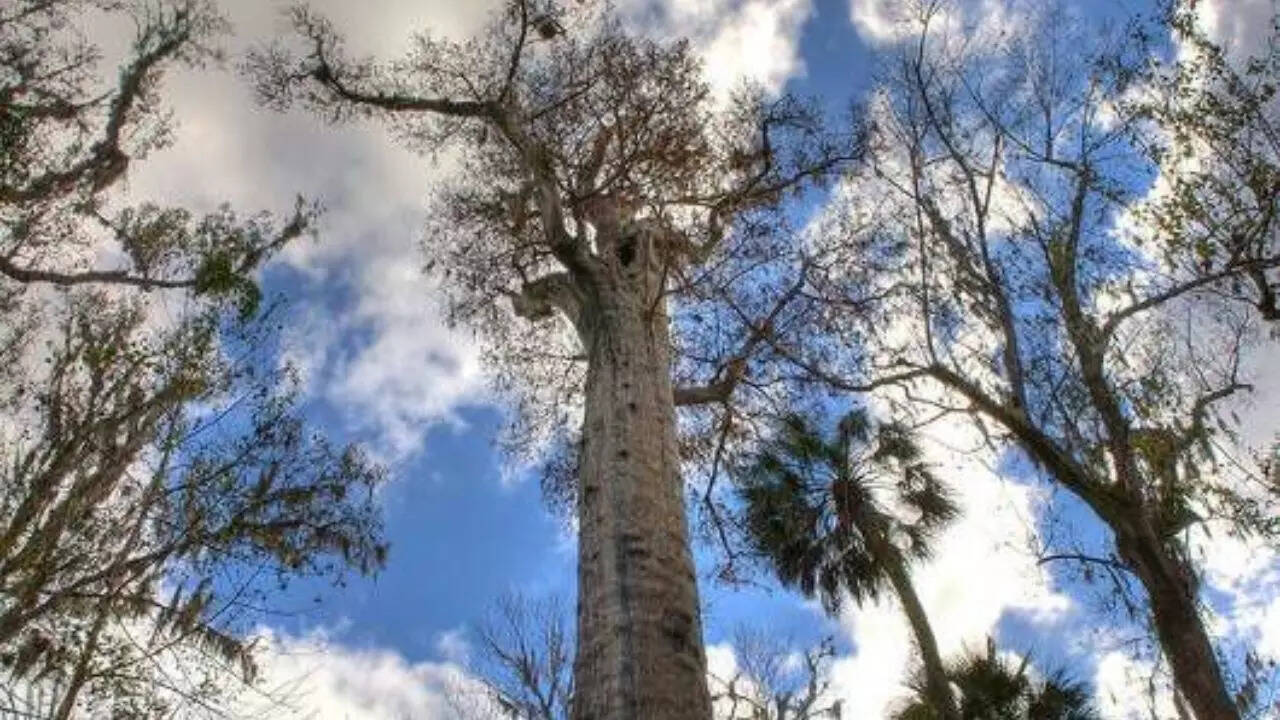
Most people look at a tree and see a trunk, some branches, and maybe a few leaves. When you're staring at the Great Basin Bristlecone pines in the White Mountains of California, you're looking at history that predates the Pyramids of Giza. We’ve known for decades that Methuselah, a bristlecone pine, has been alive for over 4,800 years. But researchers recently stopped looking at the bark and started looking at the dirt. What they found beneath the world’s oldest trees isn't just a root system. It's a massive, thriving, and surprisingly aggressive microbial community that might be the actual reason these trees refuse to die.
Living things usually follow a predictable arc. They grow, they hit a peak, they decay, and they go away. These trees broke the contract. While the wood on the outside often looks like a twisted, bleached skeleton, the internal vascular tissue remains remarkably youthful. New research into the "rhizosphere"—the thin layer of soil surrounding the roots—shows that the ground beneath these ancients is teeming with life that doesn't exist anywhere else in the surrounding desert.
The Secret Life in the Soil
Scientists used to think the harsh environment of the White Mountains was the only thing keeping these trees alive. The logic was simple. If it's too cold and dry for pests and fungi to survive, the tree stays safe. While that's partially true, it's a lazy explanation. Recent DNA sequencing of the soil reveals a complex network of mycorrhizal fungi and specialized bacteria that act as a biological fortress.
This isn't just a passive group of microbes. These organisms actively mine the dolomite rock for phosphorus and nitrogen, delivering nutrients directly to the tree in exchange for carbon. It's a symbiotic relationship on steroids. In a place where a single inch of rain feels like a miracle, these microbes hold onto every molecule of moisture. They create a "living shield" that protects the roots from the few pathogens that can survive at 10,000 feet.
I've talked to researchers who spent weeks in the high altitudes of the Great Basin. They'll tell you the air is thin enough to make your head spin, yet the soil—if you can call this rocky grit soil—is biologically "hot." We’re talking about a microscopic ecosystem that has evolved alongside a single organism for five millennia. When you stand over these roots, you aren't just standing on dirt. You're standing on a biological backup drive.
Why These Trees Refuse to Age
Biologists have long been obsessed with the concept of senescence. That’s just a fancy word for biological aging. In humans, our cells eventually stop dividing or start making mistakes. Bristlecone pines seem to have found a loophole. Their pollen is just as viable at 4,000 years old as it is at 40. Their seeds still sprout.
The secret lies in the tree's ability to compartmentalize. If a section of the tree gets hit by lightning or a fungus, that specific part dies, but the rest of the tree stays perfectly healthy. It's a "sectored" hydraulic system. Think of it like a submarine with watertight compartments. One leak doesn't sink the ship. But this physical structure is only half the story.
The "living" part discovered beneath the tree includes "endophytes." These are fungi and bacteria that live inside the plant tissues without causing disease. Researchers found that these endophytes produce natural pesticides and fungicides. The tree doesn't just have an immune system; it has an outsourced security team living in its roots and needles. This discovery turns the old "survival of the fittest" trope on its head. It’s actually survival of the most collaborative.
Misconceptions About the Oldest Living Things
You’ll often hear people call Methuselah the oldest "organism" in the world. That's technically wrong. Pando, a massive colony of quaking aspens in Utah, has a root system estimated to be 80,000 years old. But Pando is a clone. It keeps sending up new trunks. The bristlecone is different. The same individual trunk you touch today is the same one that was a sapling when humans were first developing writing.
The Problem With Fame
One of the biggest mistakes the scientific community ever made was being too transparent about where these trees are. Back in the 1960s, a researcher accidentally cut down "Prometheus," a tree that turned out to be nearly 5,000 years old. He didn't know until he counted the rings on the stump. Today, the Forest Service keeps the exact location of Methuselah a secret.
If you go hiking in the Ancient Bristlecone Pine Forest, you’ll see plenty of old trees, but you won't see a sign pointing to the record-breaker. This is for the best. Human feet compact the soil. Remember that "living dirt" I mentioned? It’s fragile. Stepping too close to the trunk can crush the very microbial networks that have kept the tree standing since the Bronze Age.
What This Means for Human Longevity
We shouldn't get ahead of ourselves and think we can just pop a "bristlecone pill" to live forever. But the chemical compounds being isolated from the microbes under these trees are genuinely interesting. We’re seeing molecules that are incredibly stable under UV radiation and extreme desiccation.
Pharmaceutical companies are already looking at these specialized bacteria for clues on how to stabilize sensitive medicines. More importantly, ecologists are realizing that to save old-growth forests, we can't just protect the trees. We have to protect the invisible life in the dirt. If the microbial community dies, the tree follows shortly after, no matter how "tough" its wood is.
The Climate Threat Nobody Talks About
These trees have survived volcanic eruptions, multi-century droughts, and ice ages. But they’ve never seen the pace of change we’re throwing at them now. As the world warms, the "tree line" moves up. Faster-growing trees like limber pines are starting to creep into bristlecone territory.
Usually, the bristlecone wins because it can survive on the crappy dolomite soil where nothing else grows. But if the soil chemistry changes because of increased nitrogen in the rain or shifting microbial populations, the bristlecone loses its competitive edge. It’s a slow-motion invasion. These ancients aren't being killed by heat; they're being crowded out by neighbors that grow faster in the new climate.
If you want to understand the true scale of life, get a permit and go to the White Mountains. Don't look for the biggest tree. The biggest ones are usually younger. Look for the most mangled, twisted, and weathered ones. The ones that look half-dead are often the ones that have seen the most history.
Stop thinking of trees as individuals. They are the visible tip of a massive, underground biological machine. To keep these ancients alive for another five thousand years, we have to leave the dirt alone. Respect the crust on the ground. Stay on the designated trails. The most important part of the world's oldest tree is the part you can't see, and it's far more alive than we ever imagined.