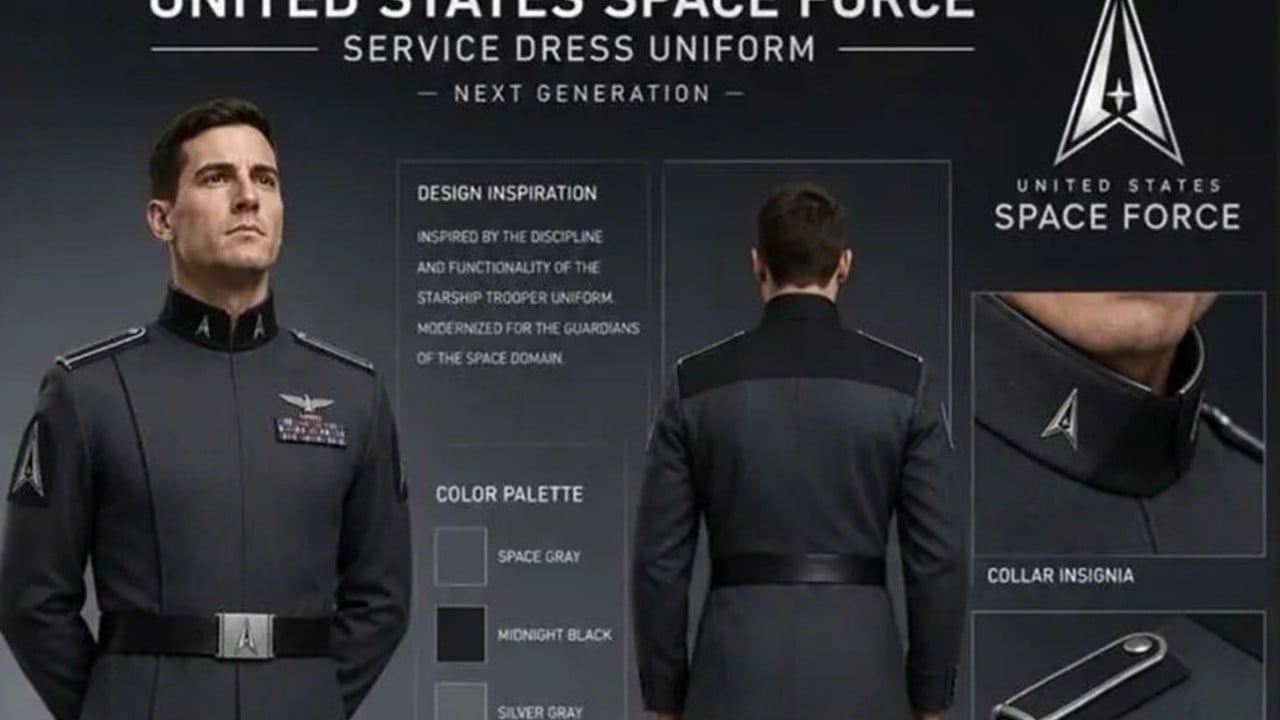
A digital rendering circulated by political channels outlining prospective United States Space Force service dress uniforms exposed a fundamental misunderstanding of military semiotics. The concept art, shared alongside declarations of lunar expansion, leaned directly into aesthetic markers explicitly derived from totalitarian science fiction cinema. Rather than evaluating the functional requirements of service dress within a modern technocratic branch, the proposal prioritized cinematic villainy tropes, demonstrating how superficial theatricality displaces institutional credibility in contemporary governance.
Military uniform design operates as a high-stakes signaling mechanism. Every structural element communicates authority, historical continuity, and operational readiness to both domestic and international observers. When an administration bypasses traditional heraldry in favor of AI-generated concept art modeled after cinematic depictions of interstellar fascism, the error goes deeper than poor taste. It exposes a systemic failure in institutional signaling.
The Three Components of Military Semiotic Failure
1. The Historical Inversion of Cinematic Satire
The proposed aesthetic, characterized by charcoal-and-black palettes, high collars, and heavy structural lines, mirrors the visual language established in mid-century propaganda and later repurposed for cinematic critique. The explicit reference to dystopian science fiction films introduces an unavoidable irony: the original costume designs in those cinematic works were constructed deliberately to evoke historical authoritarian regimes, specifically to signal corruption and moral bankruptcy to the audience. Adopting a visual vocabulary designed to represent cinematic villains creates an immediate cognitive dissonance for a sovereign military force. Instead of projecting defensive capability, the styling projects the visual hallmarks of an occupying antagonist.
2. The Functional Incompatibility of Retro-Futurism
Operational efficiency in space domains demands extreme ergonomic adaptation, thermal regulation, and lightweight material science. The proposed concept relies on heavy jackets, structured belts, rigid caps, and high-altitude leather aesthetics that belong to mid-twentieth-century terrestrial infantry models rather than zero-gravity or modern workstation environments. By prioritizing silhouette over utility, the design violates the core tenet of military outfitting: form must follow function. A service dress uniform must bridge ceremonial presence with the practical realities of administrative and technical personnel operating in high-tech environments.
3. The Erosion of Institutional Legitimacy
A newly established military branch faces a steep uphill battle for cultural permanence and inter-service respect. Traditional branches rely on centuries-old lineages that tie their visual identities to hard-fought campaigns and institutional heritage. Lacking historical depth, a space-focused branch requires a design strategy rooted in clean, forward-looking modernism and technological mastery. Swapping traditional aerospace design language for cinematic pastiche trivializes the branch, reducing a strategic national defense apparatus to a meme generator for digital platforms.
The Cost Function of Aesthetic Populism
The reliance on synthetic media renders for state-level decisions introduces a dangerous feedback loop into policy implementation. When institutional design is outsourced to viral image generators, the decision-making metric shifts from operational utility to short-term algorithmic engagement.
The mechanics of this failure operate on two levels:
- Internal Morale Devaluation: Personnel tasked with complex engineering, orbital mechanics, and strategic defense are forced to internalize an aesthetic identity dictated by pop-culture shock value rather than professional pride.
- External Strategic Misalignment: International competitors evaluate national resolve through the lens of institutional seriousness. A branch costumed like an intergovernmental empire from space opera fiction invites operational dismissal from sophisticated foreign defense ministries.
Deploying satirical fascist iconography as unironic state inspiration signals an internal vacuum where rigorous procurement protocols and historical awareness should reside. Institutional longevity requires an aesthetic rooted in enduring professionalism, not the transient shock value of a weekend digital post.
Integrate strict procurement standards, historical heraldry audits, and ergonomic performance metrics into any future uniform revision cycle to eliminate stylistic drift before concept art reaches public channels.