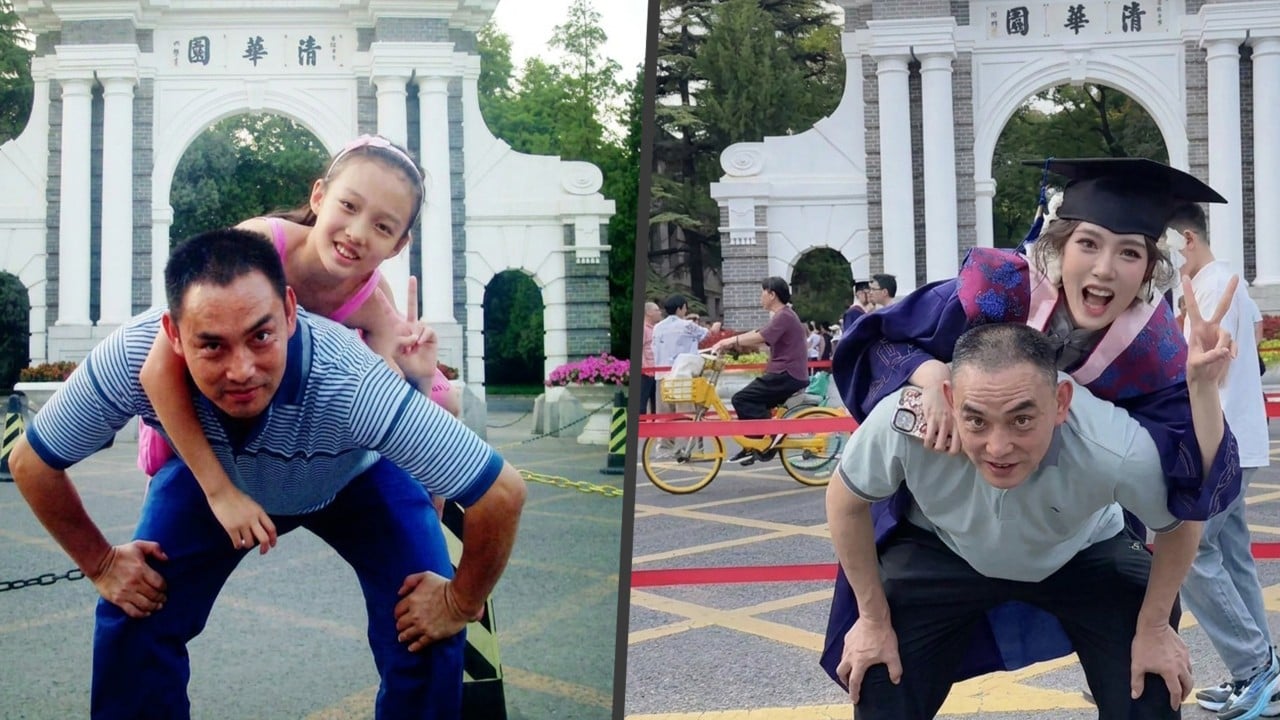
The camera clicks. It is 2009, and the air outside the western gate of Tsinghua University is thick with Beijing summer heat. A nine-year-old girl named Wu Han clings to her father’s back, her small hands flashing a triumphant victory sign. Her father smiles, but his eyes are fixed somewhere past the lens, staring at the grand, historical stone structure that represents the pinnacle of Chinese academic achievement.
He had wanted to walk through those gates himself. Decades earlier, as a fine arts student in Guangdong province, he harbored a quiet obsession with Tsinghua’s Academy of Arts and Design. But life, as it so often does for an ordinary young man navigating the hyper-competitive landscape of late-twentieth-century China, had other plans. The dream was shelved, packed away into the silent, dusty corners of unfulfilled potential.
So, he did what millions of parents do. He passed the brush to his daughter.
By kindergarten, Wu Han was holding a paintbrush, guided by a father who understood the agonizingly thin margin between artistic success and obscurity. He knew that the life of a pure painter was a brutal, uncertain road. He steered her toward design—a discipline where art meets utility, where creativity could buy a future.
Yet, destiny is rarely a straight line.
In high school, Wu Han chose a standard science track before making a jarring, late-stage pivot to sit for China’s art gaokao. It is a grueling, pressure-cooker mechanism that demands flawless academic execution alongside brutal professional art examinations. The stakes are immense, the competition suffocating.
Then came the crash. During her first attempt at the entrance exam, Wu Han’s artwork veered too far from the rigidly assigned theme. The rejection was absolute.
Failure in the gaokao ecosystem is a heavy, public grief. It means an entire year of repeating the same exhausting routines, watching peers move forward while you remain trapped in the same room, staring at the same blank canvases, haunted by the fear that your best will never be enough. It is the moment most people quiet their ambitions and settle for a lesser path.
But the memory of the gate remained.
The following year, she fought her way back. When the acceptance letters were finally released, Wu Han had defied the numbers. The Academy of Arts and Design had accepted only thirteen students from the entirety of Guangdong province. She was one of them.
Getting in was only the prologue. Over the next several years, the girl who once treated painting as a childhood hobby transformed into a scholar. She earned a rare, coveted recommendation to skip the standard postgraduate entrance exams entirely, transitioning directly into a master’s degree program at the elite institution.
Seventeen years after the first photograph, the heat returned to the Beijing air.
In June, Wu Han stood before the exact same Tsinghua gate, draped in the purple academic gown of a master’s graduate. Her father stood beside her, his hair now flecked with gray, his posture bearing the subtle weight of the passing years. She asked him to recreate the picture.
She climbed onto his back. The pose was identical. The victory sign returned.
As the shutter snapped a second time, completing a loop that took nearly two decades to close, her father noted the visceral physics of time. Seventeen years ago, he said, she felt as light as a feather. Now, she felt heavy.
It was not a complaint about physical strain, but a sudden, overwhelming realization of generational transition. The child had grown up. The protector had grown old. But the unfulfilled dream of a young man from 1993 had finally been carried across the threshold, borne on the shoulders of the child he raised to fly past his own horizons.



