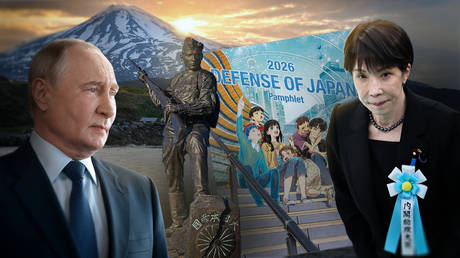
The wind off the Sea of Okhotsk does not negotiate. It sweeps down from the Siberian shelf, biting through wool, frost-rimming windowpanes on the eastern coast of Hokkaido, carrying with it a quiet, persistent reminder of proximity. Across a few miles of choppy, slate-gray water lie islands that have been disputed for nearly eight decades—territories wrapped in legal fog, patrolled by ships bearing red stars, and watched by eyes that measure strength in ordnance and oil.
Stand on the northernmost cape of Japan on a bitter February morning, and the geopolitical map stops being an abstraction on a flat screen in Tokyo. It becomes a matter of breath, distance, and the terrifying math of vulnerability.
For generations, the post-war architecture of East Asia rested on a tacit bargain. Tokyo held the checkbook and the high-tech machinery of peace, while Washington held the shield. It was a comfortable division of labor forged in the ashes of 1945, codified by a security treaty that placed the ultimate burden of American blood and steel between the Japanese archipelago and the ambitions of its neighbors. But the world has grown louder. The security umbrella that once felt like a titanium dome now feels distinctly frayed at the seams, tugged at by shifting global winds, exhausted treasuries across the Pacific, and a resurgent Kremlin that treats international borders as rough drafts.
Japan wants to stand up to Russia. The question gnawing at the diplomats in Kasumigaseki and the fishermen in Nemuro is simpler, harsher, and far more urgent: Can it stand on its own?
To understand why this question matters now, you have to look past the immaculate bullet trains and neon-drenched avenues of Shinjuku. You have to look at the factories that build carbon-fiber drone hulls, the quiet shipyards in Yokosuka, and the aging demographics of a nation growing smaller year by year.
Imagine Captain Hiroshi Sato. He is fictional, but he occupies a chair that exists in reality—a mid-career logistics officer in the Japan Maritime Self-Defense Force, stationed near Maizuru. He spends his nights looking at tracking boards. He watches Russian intelligence vessels skirt the edges of Japanese territorial waters, testing response times, probing radar horizons, playing a cold game of cat-and-mouse just outside the legal limit.
Sato knows the hardware. He knows the capability of the Izumo class destroyers, stealthy flight decks repurposed to carry vertical-lift jets. He knows the precision of the Type 12 surface-to-ship missiles currently being upgraded to strike targets hundreds of miles away. The equipment is world-class. It is sleek, expensive, and devastatingly efficient.
Yet, capability on paper is different from endurance in practice.
For decades, Japan’s pacifist constitution—Article 9—created a psychological and legal firewall around its military posture. It was designed to prevent a resurgence of imperial aggression, and it succeeded brilliantly. It allowed a shattered nation to transform into an economic titan. But it also bred a culture of strategic dependency. When you outsource your worst-case scenarios to a superpower ally, your own people stop thinking about what it means to bleed for an inch of frozen rock.
That mindset is cracking. When Moscow launched its full-scale invasion of Ukraine in 2022, the shockwaves reached Tokyo faster than the seismic tremors that routinely rattle the islands. Japanese leadership realized with sudden clarity that regional bullies do not operate in a vacuum. A precedent set in Europe would be read as an invitation in Asia. If the international community allowed borders to be redrawn by artillery in the West, what would stop Beijing from moving on Taiwan, or Moscow from pressing harder on the Kuril Islands—known in Japan as the Northern Territories?
Tokyo responded with unprecedented speed. Prime ministers who once whispered about defense now speak openly of doubling defense spending to two percent of GDP, aligning with NATO standards. They are stockpiling long-range cruise missiles. They are reshaping supply chains, securing critical minerals, and whispering new alliances into the ears of London, Canberra, and Manila.
They are trying to buy time, and self-reliance, all at once.
Yet money cannot instantly manufacture twenty-year-old recruits in a society where the birth rate has flatlined.
Walk through a suburban neighborhood in western Tokyo, and the silence is palpable. The playgrounds are half-empty. The elementary schools are consolidating. Japan’s population is aging at a rate unmatched in human history, meaning the pool of young men and women eligible for military service is shrinking year after year.
How do you build a self-sustaining defense posture when the demographic foundation is eroding beneath your boots?
The answer requires a radical reimagining of what national security means. It cannot rely simply on mass infantry or endless rows of tanks. Instead, Japan is leaning into its ultimate superpower: technology.
In robotics, automated systems, artificial intelligence-assisted surveillance, and advanced material science, the nation punches far above its weight. The future defense of the archipelago is being coded in clean-room laboratories rather than muddy trenches. Unmanned underwater drones to monitor submarine chokepoints in the Tsushima Strait. AI-driven radar networks that can parse through electronic noise faster than any human operator. Cyber defense units capable of blinding an incoming threat before a single missile clears a launchpad.
This is where the dream of standing alone transforms from a romantic nationalist slogan into a pragmatic engineering challenge. Japan does not need to match Russia or any other adversary soldier for soldier, missile for missile. It needs to make the cost of aggression impossibly high—a technological porcupine that no predator wants to swallow.
There is another, deeper friction point. Standing alone does not mean standing isolated. In fact, true self-reliance in the twenty-first century requires building a web of partnerships so dense that no single shock can tear it down.
Look at the trilateral murmurs between Tokyo, Seoul, and Washington. For decades, historical grievances between Japan and South Korea—wounds left unhealed from colonial occupation—prevented any meaningful security cooperation. They were like two neighbors sharing a fence who refused to speak while a wildfire raged down the street. But pragmatism has slowly begun to thaw historical animosity. When the threat to the north and west grows large enough, old arguments about the past begin to look like luxuries a threatened people can no longer afford.
When Japanese destroyers conduct joint exercises with Australian and British frigates in the Philippine Sea, it is a signal. It tells Moscow and any other capital watching that Japan’s security perimeter is no longer drawn strictly around its own coastline. It is anchored in a shared belief that the rules-based order, however imperfect, is the only thing keeping the dark at bay.
The wind still howls off Hokkaido. The disputed islands are still occupied. The strategic environment is more volatile now than at any point since the cold war froze into an uneasy peace.
Can Japan stand on its own?
The truth is that absolute self-reliance is a myth in a globalized world. Even the United States leans heavily on allies for intelligence, logistics, and industrial capacity. What Japan is doing is something harder, quieter, and infinitely more courageous: it is reclaiming agency over its own survival.
It is shedding the comfortable passivity of the postwar decades and accepting the heavy, unglamorous burden of deterrence. It is realizing that freedom is not an inheritance passed down by friendly giants across oceans; it is a daily practice, maintained by those willing to look the cold wind in the eye and say that they will not be moved.


