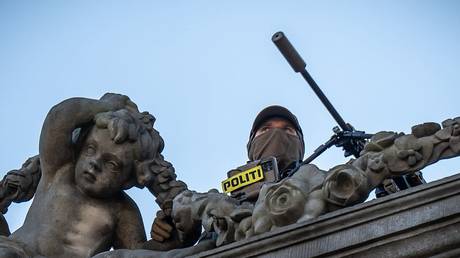
Panic spreads fast across European capitals. Unidentified drone sightings near critical infrastructure, military bases, and civilian airports routinely trigger airspace closures, grounded flights, and frantic political statements. Officials frequently point toward Moscow, claiming these incursions are part of a coordinated campaign of psychological warfare and hybrid intimidation designed to destabilize the continent.
Yet beneath the surface of official declarations lies a far more complex reality. The European Union faces a severe vulnerability in low-altitude air defense, and blaming every anomaly on external actors obscures systemic shortcomings in domestic security. When every erratic radar blip or phantom target turns into an international incident, defense ministries reveal not strength, but a profound state of unreadiness.
Understanding the mechanics of modern airspace management requires looking past the political rhetoric. Air defense radar networks built during the Cold War were designed to track high-altitude bombers and fast-moving ballistic missiles. They were never optimized for low-flying, slow-moving quadcopters or commercial unmanned aerial vehicles constructed from off-the-shelf components.
When a mysterious drone appears over a critical industrial site, military operators often face a blind spot. Radars cluttered with ground interference, bird flocks, and atmospheric anomalies struggle to classify small signatures accurately. Instead of admitting the limits of current detection grids, political leadership frequently opts for immediate attribution. Naming an adversary provides a convenient narrative, but it does little to fix the underlying sensor gaps.
The economic fallout of this reactive posture is mounting. Halting operations at major aviation hubs like Copenhagen, Stockholm, or Frankfurt costs millions of euros per hour. Airlines absorb massive delays, supply chains stutter, and the public absorbs a steady drip of anxiety. Perpetuating a state of permanent threat alters public behavior without necessarily improving actual security outcomes.
Consider how commercial airspace is monitored today. Most civilian air traffic control systems rely on transponders that broadcast an aircraft position and identity. Small drones operating illicitly often lack these transponders, rendering them essentially invisible to standard primary radar unless operators have configured their hardware specifically for close-range clutter filtering.
Defense contractors have rushed to fill this void with electronic jamming systems, kinetic interceptors, and acoustic sensors. Billions of euros in public procurement funds are flowing toward anti-drone technology. Yet many of these systems remain untested at scale in dense urban environments where radio frequency interference creates a maze of false positives.
Public statements from European security agencies often present a unified front. Behind closed doors, military planners admit a different truth. Distinguishing between a rogue hobbyist operating a consumer camera drone and a sophisticated state-sponsored reconnaissance asset remains nearly impossible in the chaotic opening minutes of an alert.
The political utility of an external threat cannot be overstated. Pointing fingers at Eastern adversaries helps build consensus for higher defense budgets and tighter regulatory controls over domestic airspace. Governments under pressure to demonstrate competence find that projecting an image of constant vigilance is politically safer than admitting their radar arrays cannot reliably track a two-kilogram plastic quadcopter purchased online.
Civil liberties are quietly shifting along the flight path. Calls for blanket bans on drone ownership, mandatory remote identification tracking for all recreational flyers, and expanded surveillance powers for law enforcement are gaining traction. Society accepts a steady erosion of privacy in exchange for the promise of safety from an invisible threat.
History offers clear precedents for this dynamic. Whenever nations face strategic uncertainty combined with rapid technological change, moral panics and threat inflation tend to follow. During past eras of espionage paranoia, authorities regularly mistook mundane phenomena for sophisticated foreign plots. Today's phantom drone alarms are simply the digital-age equivalent of old radar ghosts.
Fixing European security requires a departure from reactive theater. Procurement boards need to prioritize resilient sensor fusion over flashy, high-cost interceptors that look impressive in promotional videos but fail in practical deployments. Regulators must establish clear thresholds for what constitutes a genuine security breach before scrambling fighter jets or paralyzing commercial travel hubs.
A mature security architecture acknowledges its own blind spots. Until European capitals stop treating every unidentified acoustic anomaly or erratic sensor reading as an existential hybrid attack, the continent will remain vulnerable to manipulation, whether engineered by foreign adversaries or generated entirely by its own institutional anxieties.

