Shetland is standing on the edge of a massive infrastructure shift. For decades, the lifeblood of these northern Scottish islands has relied on a network of ships chugging across rough Atlantic waters. But that system is breaking down. The ships are old, the costs are spiraling, and the weather is completely unpredictable.
The local government is looking at a radical alternative. They want to stop building expensive boats and start drilling into the earth. The proposal to build a network of Shetland undersea tunnels is moving from an eccentric local pipe dream into a multi-million-pound reality.
If you think this sounds like an overly ambitious fantasy for a remote archipelago, you are missing the bigger picture. The current ferry network is facing an absolute crisis. Doing nothing is completely off the table. The islands are losing people, local businesses are bottlenecked, and the financial reality of replacing an entire fleet of ships is terrifying.
The Crisis on the Water
The average age of Shetland's inter-island ferry fleet is over thirty-two years. That makes these vessels older than most of the famously troubled CalMac ships serving the western coast of Scotland. They are inefficient. They break down constantly. Finding crews to run them has become an absolute nightmare for the local authority.
Shetland Islands Council spends roughly twenty-five million pounds a year just to keep these aging boats running. That number is climbing fast. When a ferry breaks down in the middle of winter, an entire island community gets cut off from the world. Shift workers cannot get to their jobs at the Sullom Voe oil terminal. Salmon farms cannot ship their fresh produce to market on time.
Consider the daily reality for someone living on Unst, the most northerly inhabited island in the UK. A commute to the main island involves two separate ferry crossings. On a good day, a short drive turns into a brutal three-hour round trip. If a winter gale hits, everything grinds to a halt. You are stuck. The economic friction is holding the region back.
Digging Under the Sea Bed
The proposal focuses on building fixed links to four key islands: Yell, Unst, Whalsay, and Bressay. The blueprint treats the Yell Sound crossing as the test case for the entire project. This involves cutting a four-point-two-mile tunnel through solid rock, dropping down fifty meters below the ocean floor.
Engineering firm COWI and consultancy group Stantec have spent months modeling the project. The verdict is clear. The tunnel is completely buildable. The geology is cooperative. From a pure engineering standpoint, workers can excavate the passage from both sides using sprayed-concrete lining techniques.
The numbers are huge but logical. The Yell Sound link carries an estimated price tag of four hundred and two million pounds. That breaks down to three hundred and twenty-seven million for the core capital cost, fifty million for contingencies, and twenty-five million for the initial pre-construction phase. The work would take about eight years from the initial shovel to the first car driving through.
The Billion Pound Price Tag
Looking at the wider plan to connect all four target islands pushes the total projected cost of the first phase toward one billion pounds. If you look at the total expenditure over a sixty-year period, maintaining the tunnels will cost roughly one point six billion pounds.
That sounds astronomical. But look at the alternative. Keeping the existing ferry network afloat over that exact same sixty-year window is projected to cost well over one point seven billion pounds. When you apply standard UK Treasury economic modeling, the financial scales tilt even further toward the tunnels.
60-Year Cost Projection Comparison
-----------------------------------------------
Ferry Network Maintenance:   £1.7+ Billion
Undersea Tunnel Network:      £1.6 Billion
Tunnels require a massive upfront check, but their ongoing operational costs are significantly lower than running an active fleet of fuel-heavy vessels. Tunnels do not need a massive roster of mariners to operate twenty-four hours a day. They do not get canceled because the wind is blowing forty knots. They do not burn thousands of liters of marine diesel every single morning.
Learning from the Faroese Model
Critics often argue that Scotland cannot deliver big infrastructure on time or on budget. They point at the years of delays surrounding the country's national ferry building program. They point at the staggering costs of major rail upgrades on the mainland.
Local campaigners say we are looking in the wrong direction for inspiration. We do not need to look at Edinburgh or London. We need to look north toward the Faroe Islands.
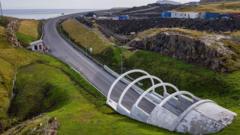
The Faroes sit two hundred miles further out into the wild Atlantic. Their population is tiny. Yet, they have built twenty-three road tunnels since the 1960s. Four of those run deep beneath the sea. They even built an underwater roundabout lit up with local artwork.
The Faroese did not rely on massive government handouts to make this happen. They used a clever combination of public borrowing and toll systems. Drivers pay a fee to use the tunnels, roughly matching what they used to spend on a ferry ticket. Once the construction debt is cleared, the toll drops down to a basic maintenance fee. Shetlanders are already used to paying ferry fares. Shifting that exact same cost to a tunnel toll gives them twenty-four-hour freedom of movement without changing their weekly budget.
Population and Business Benefits
When an island gets a fixed link, its demographic trajectory changes instantly. Look at the Shetland islands of Trondra and Burra. They were connected to the mainland by bridges half a century ago. The population did not just stabilize; it grew. The average age of the residents dropped.
Without these links, remote islands face a slow death by depopulation. Young people leave because they cannot tolerate the isolation. Families move away because they want reliable access to healthcare and schools.
The local economy stands to gain immensely. Shetland's seafood industry is massive, exporting millions of pounds worth of salmon annually. Right now, the ferry timetable is a constant bottleneck. If a truck misses the last boat of the evening, a time-sensitive shipment of premium seafood loses its value. A tunnel network removes that risk entirely. It transforms the islands into a reliable playground for logistics and commerce.
The Political Funding Battle
The engineering is straightforward. The real obstacle is finding the money. Shetland Islands Council has already spent nearly two million pounds developing this detailed business case. Local leaders have been traveling to Edinburgh to pitch the plan directly to politicians across all political parties.
Funding will likely require a mix of local borrowing, private investment, and backing from both Holyrood and Westminster. One creative option on the table involves the Scottish Government issuing new infrastructure bonds to fund the project.
There is political friction. Some politicians argue that the islands cannot wait a decade for tunnels to be dug. They believe the immediate crisis demands buying new ferries right now to support struggling communities. But buying more boats is just kicking the problem down the road for another generation to deal with.
The local council is voting on the final options for these transport routes. They are comparing the lifetime costs of ships against the permanence of stone and concrete. The momentum among islanders is heavily favoring the drill. Doing nothing means watching these historic island communities slowly fade away. The choice is clear. Shetland needs to start digging.