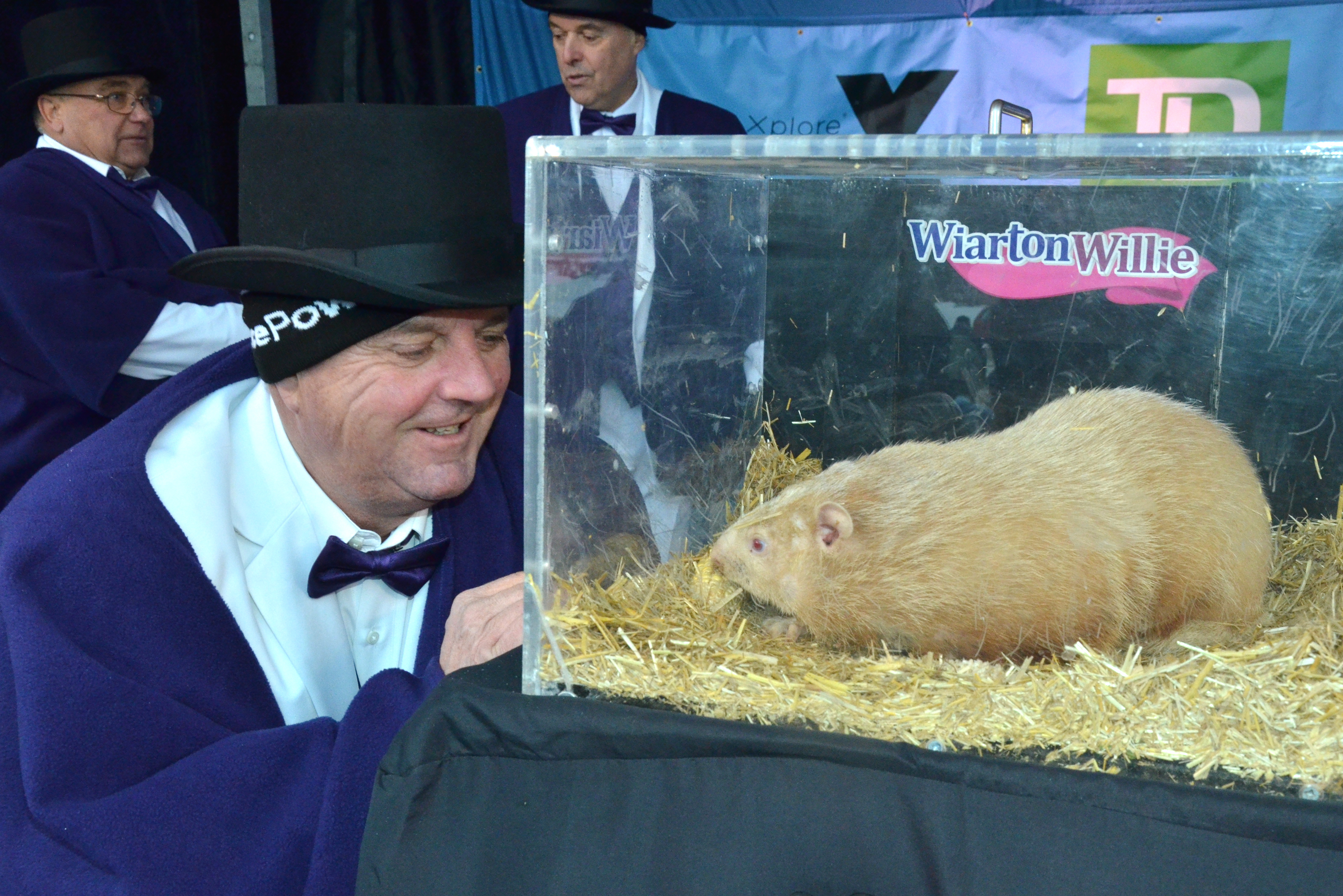
The wind off Colpoy’s Bay doesn’t just blow; it carves. In the deep mid-winter of the Bruce Peninsula, the air carries a specific, metallic scent of frozen lake water and cedar. It is a place where, for sixty-five years, the town of Wiarton, Ontario, has wagered its identity on the sleeping habits of a single, albino rodent.
When the news broke that Wiarton Willie had died, it wasn’t delivered with the clinical coldness of a standard obituary. It felt like a crack in the town's foundation. For the residents of South Bruce Peninsula, Willie was never just a weather-forecasting groundhog. He was a beacon of survival. He was the local celebrity who didn’t ask for much—just some straw, some carrots, and the heavy burden of carrying a community’s hope for an early spring on his small, white shoulders.
The official announcement from the town was brief, noting that the legendary albino groundhog had passed away of natural causes. He was thirteen. In groundhog years, that’s an ancient, venerable age, yet the numbers do little to soften the blow. To understand why a town would mourn a marmot, you have to stand in the snow at 7:00 AM on a February morning, feeling the frost bite at your cheekbones, waiting for a sign that the grey world might soon turn green.
The Weight of a Shadow
Groundhog Day is an absurdity we’ve collectively agreed to treat as gospel. It is a strange, secular liturgy. We take a creature that spends its life avoiding us and put it center stage under the glare of television cameras. We ask it to perform a miracle of meteorology. If he sees his shadow, we brace for six more weeks of the biting cold. If he doesn't, we start dreaming of the first thaw.
Willie was unique in this pantheon. While Pennsylvania has its Punxsutawney Phil—a brown, common variety of Marmota monax—Wiarton had the Great White Prophet. His albinism made him a ghost in the snow, a rare occurrence that felt, to the locals, like a touch of the supernatural. When he wasn’t there to meet the crowds, the silence was deafening.
Consider the stakes for a moment. In a town where tourism is the lifeblood, February is usually a dead zone. The summer crowds have long since evaporated. The boaters are gone. The hiking trails are buried under drifts that can swallow a grown man to his waist. Without Willie, Wiarton is just a quiet dot on a map, shivering in the dark. With him, it is the center of the national conversation. He wasn't just a pet; he was the town's primary economic engine and its most beloved neighbor.
Behind the Plexiglass
To his caretakers, Willie was a creature of habit. He lived in a climate-controlled enclosure, a luxury his wild cousins could only dream of while they huddled in frozen dirt. But there is a particular loneliness to being a symbol. While the world saw a furry weather vane, his handlers saw a living being that required meticulous care. They monitored his diet. They ensured his burrow was just right. They bore the secret of his health, knowing that every year he aged, the town’s anxiety grew.
There is an old story in Wiarton about the time a previous Willie died just days before the festival. The panic was real. The legend goes that they couldn't find a replacement in time, so they put a stuffed groundhog in the tiny coffin for the public wake. It’s the kind of dark, rural humor that keeps people warm in the North. It highlights the desperation to keep the tradition alive. We need our symbols to be immortal, even when we know they are fragile.
The death of this particular Willie marks the end of an era because he was the one who saw us through some of the strangest years in modern history. Through lockdowns and global shifts, he remained a constant. He was the one thing that didn't change. You could count on him waking up, blinking at the cameras, and giving us something to talk about that wasn't a spreadsheet or a crisis.
The Science of the Sacred
If we look at the data, the accuracy of a groundhog’s prediction hovers somewhere around 37% to 39%. A coin flip would be more reliable. A sophisticated computer model at a university would be infinitely more precise. But nobody gathers in a town square at dawn to watch a computer model.
We don't want precision. We want a story. We want to believe that there is a connection between the wild world and our civilized lives. By following Willie's lead, we are participating in an ancient human impulse to find meaning in the behavior of animals. It’s a bridge to our ancestors who watched the flight of birds or the movement of deer to decide when to move and when to stay.
When Willie died, that bridge felt a little more precarious. The town had to scramble to find a successor, but you cannot simply replace a legend. The search for a new "Willie" is a process fraught with tension. Do they find another albino? Can they find a brown groundhog and hope the public accepts the change? It is like casting a new lead in a long-running play where the audience knows every line by heart.
A Legacy in the Permafrost
The true cost of losing Willie isn't measured in lost tourism dollars, though those are significant. It is measured in the quiet conversations at the local coffee shop, where the "Willie talk" is a staple of the winter. It’s the loss of a shared language. In a world that is increasingly fractured, where we can't agree on basic facts, everyone in Wiarton could agree on Willie.
He represented the endurance of the small-town spirit. To live on the Bruce Peninsula is to be at the mercy of the elements. You learn to respect the wind. You learn to stock your pantry before the blizzards hit. Willie was the mascot of that resilience. If he could survive the winter in his little house, so could we.
There is a certain irony in mourning a creature whose entire job was to hide from the light. We dragged him into the sun so he could tell us when we could finally come out of our own shelters. Now, he has returned to the earth for good, leaving the town to face the remainder of the winter without its guide.
The next festival will happen. The crowds will return. A new groundhog—perhaps a bit smaller, perhaps a bit more nervous—will be held up for the cameras. The Mayor will lean in close to "listen" to the groundhog’s whistle, and the declaration will be made.
But for those who knew the white groundhog, the one who carried the torch for over a decade, the shadow will look a little different this year. It will be the shadow of something gone, a reminder that even the most cherished traditions are held together by the heartbeat of a tiny, fragile thing.
The snow continues to fall on the Bruce Peninsula. The ice on the bay is still thick enough to drive on. Winter hasn't relented just because its prophet is gone. But in the quiet streets of Wiarton, there is a sense that we are all just waiting—not just for the spring, but for a way to fill the hole left by a ghost who lived in a burrow and once told us that the sun was coming back.
The town will find its way. It always does. But tonight, the straw in the enclosure is cold, and the carrots remain untouched, and the long, white winter feels just a little bit longer.
Would you like me to research the history of the previous "Willies" to see how the town handled these transitions in the past?