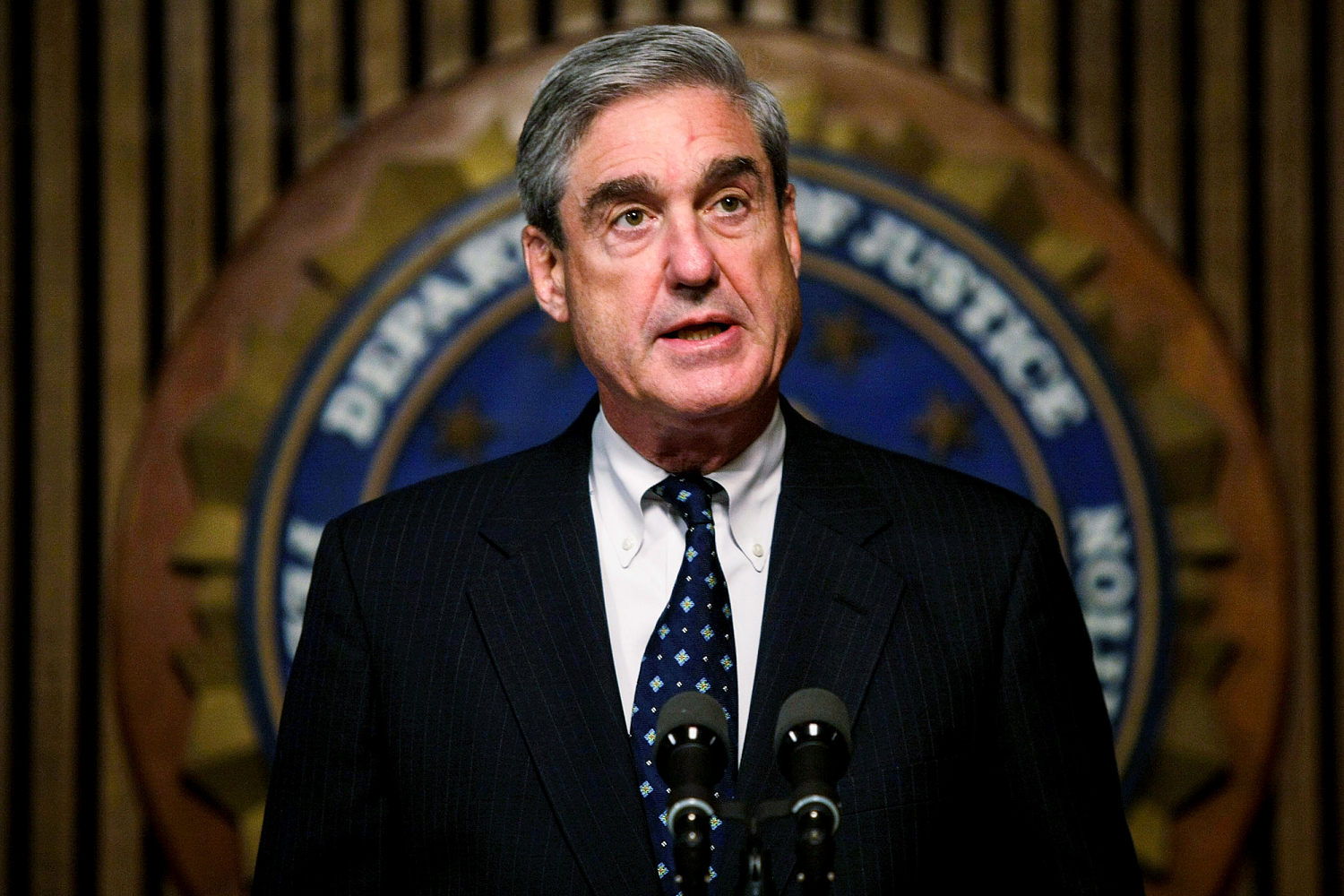
The man who once held the heartbeat of a nation in a 448-page bind of heavy paper has finally stepped into the permanent quiet. Robert Swan Mueller III, the former Director of the FBI and the Special Counsel who became a Rorschach test for American justice, has died at 81. He passed away not with a bang, nor a press conference, but with the same austere privacy that defined a half-century of public service.
To understand the weight of that silence, you have to look past the cable news chyrons and the partisan firestorms. You have to look at the jawline. It was a square, granite thing, usually clamped shut as if holding back a thousand secrets he had no intention of sharing. Mueller belonged to a dying breed of Washington creature: the institutionalist. He didn't tweet. He didn't leak. He didn't explain. In a city that survives on the oxygen of gossip, Mueller was a vacuum.
Consider the young Marine in the jungles of Vietnam. This wasn't the man in the tailored suit or the crisp white shirt that became his uniform in the Department of Justice. This was a man leading a rifle plenary through the mud of the Quang Tri Province. He earned a Bronze Star there. He earned a Purple Heart. When a bullet finds you in a jungle, the abstract theories of law and order become very literal. You survive because of rules. You survive because of the man to your left and the man to your right. That iron-clad devotion to the chain of command didn't just stay in Southeast Asia. It followed him into the hallways of the DOJ, where he spent decades as a prosecutor, chasing the Gambino crime family and the terrorists who blew up Pan Am Flight 103.
But the world remembers him most for a three-year window where he became a secular saint to some and a deep-state villain to others.
When he was appointed as Special Counsel in 2017 to investigate Russian interference in the 2016 election, the country was already fracturing. Mueller was the man both sides thought they wanted. Republicans remembered him as the steady hand who took over the FBI just one week before the Twin Towers fell. Democrats saw him as the last bastion of the "old guard" who would provide a definitive, explosive answer to a national crisis.
They were both wrong.
Mueller was never going to be a protagonist in a political thriller. He was a technician. He approached the most volatile investigation in modern history with the bedside manner of a forensic accountant. While the world outside his office screamed about treason and witch hunts, Mueller and his team of "pit bulls" worked in a windowless room, following a trail of digital breadcrumbs and bank records that spanned from Moscow to Trump Tower.
The stakes were invisible but absolute. It wasn't just about whether a president had broken the law. It was about whether the law itself was still the highest authority in the land. Mueller felt that pressure. You could see it in the way his shoulders seemed to settle lower into his coat as the months dragged on. He became a ghost. He was the most famous man in the world who never spoke.
Then came the report.
It wasn't the cinematic climax many hoped for. There were no handcuffs on the White House lawn. There was no "smoking gun" that fit neatly into a thirty-second soundbite. Instead, there was a dense, two-volume document written in the dry, cautious language of a man who feared overstepping his bounds more than he feared being misunderstood. He laid out the evidence of Russian interference with surgical precision. He detailed instances where the President had attempted to exert influence over the probe. But he stopped at the edge of the cliff.
"If we had confidence that the President clearly did not commit a crime, we would have said so," Mueller told a stunned press corps during one of his rare public statements.
It was a classic Mueller move. Precise. Technical. Tortured by its own nuance. To his critics, it was a cowardly punt. To his defenders, it was a masterclass in prosecutorial restraint. He believed in the Department of Justice guidelines that forbade indicting a sitting president. To Mueller, the rules weren't suggestions. They were the walls of the house. If you break the walls to catch the wolf, you no longer have a house to live in.
After the storm subsided, Mueller retreated. He didn't write a multi-million dollar memoir. He didn't join a cable news network as a paid contributor. He went back to the shadows, perhaps confused by a world where the quiet application of the law was seen as a provocation.
His death marks the end of more than just a long career. It marks the fading of an era where "the Bureau" and "the Department" were seen as entities that existed above the fray. Whether that era was a reality or a polite fiction is something historians will debate for decades. But for Mueller, it was the only reality that mattered.
The marble halls of the DOJ are a little quieter today. The man who wouldn't speak has finally yielded to the ultimate silence. He leaves behind a legacy of 34 indictments, seven guilty pleas, and a country still grappling with the questions he refused to answer with a simple "yes" or "no."
In the end, Robert Mueller was a man who believed that if you did your job correctly, you didn't need to be liked. You just needed to be right. He lived his life by a code that felt ancient even when he was in his prime—a code of gray suits, red ties, and the unwavering belief that the process is more important than the person.
He was the last of the sentinels. The light in his office has finally gone out, leaving the rest of us to decide if we still believe in the rules he spent his life defending.