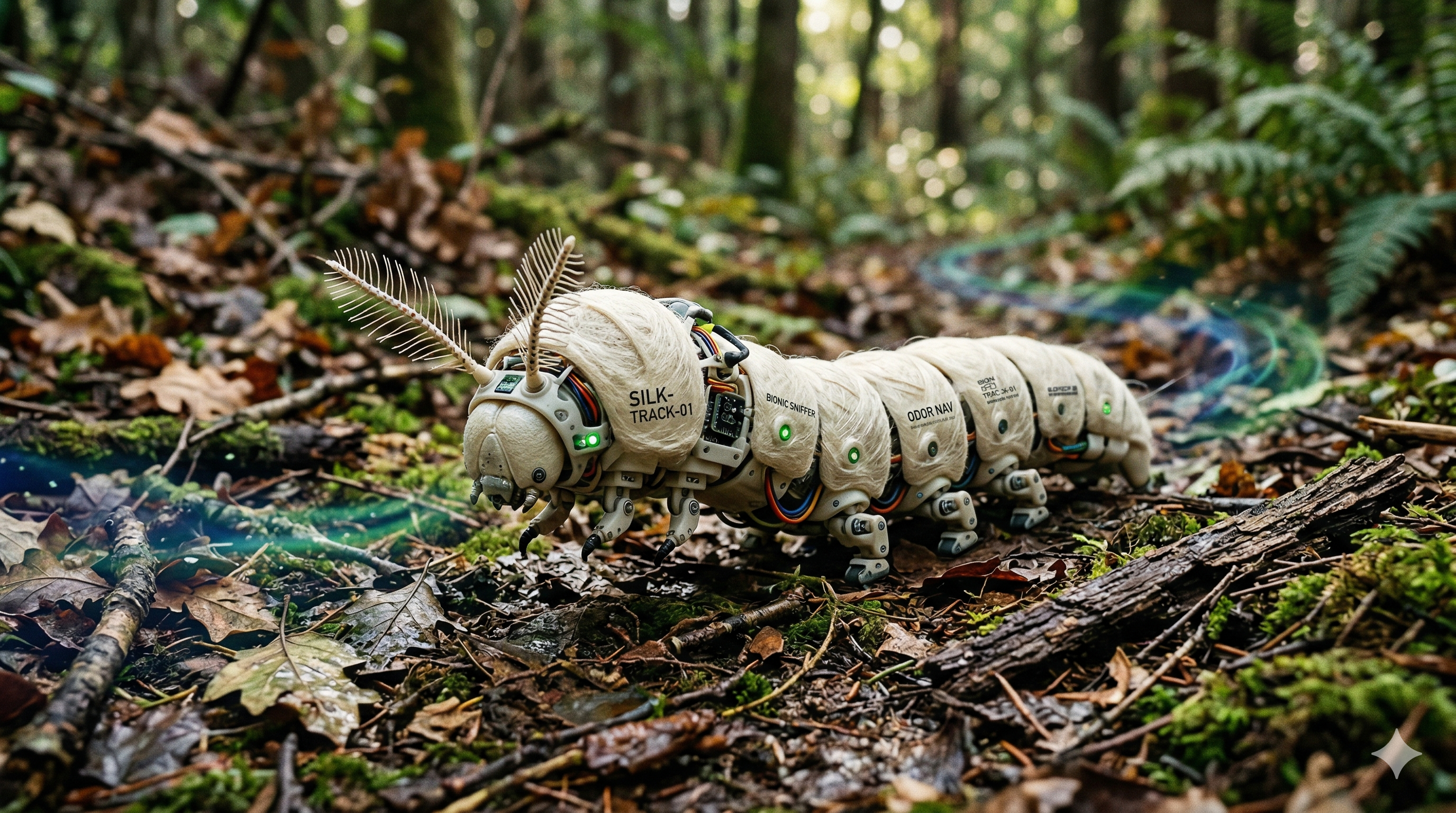
The tech world is currently swooning over a motorized moth.
Researchers have spent years obsessing over the Bombyx mori—the domestic silkworm moth—claiming its pheromone-tracking abilities are the blueprint for saving lives in earthquake zones. They’ve built tiny, wheeled platforms steered by male moths on treadmills. They’ve reverse-engineered the moth’s neural pathways to create "bio-hybrid" sensors. They promise a future where swarms of insect-inspired bots sniff out survivors trapped under concrete. Learn more on a similar topic: this related article.
It is a beautiful, expensive, and utterly flawed fantasy.
While the academic press celebrates the "elegant bio-mimicry" of odor-tracking robots, they are ignoring the physics of a disaster site. In a lab, a moth can follow a plume of pheromones in a controlled wind tunnel. In a collapsed parking garage, the air doesn’t behave like a gentle stream. It’s a chaotic, turbulent mess. Further reporting by Mashable delves into similar views on this issue.
We are pouring millions into "bio-inspiration" while ignoring the brutal reality of fluid dynamics. If we want to find people buried under rubble, we need to stop trying to build mechanical bugs and start respecting the math of chaos.
The Turbulence Trap
The fundamental flaw in the silkworm-robot obsession is a misunderstanding of how smell actually works in the wild.
Most researchers treat odor like a breadcrumb trail—a continuous line that a robot can simply follow to the source. This is what we call "gradient climbing." In a vacuum or a perfectly laminar flow, the concentration of a scent gets stronger as you get closer to the person.
But a disaster zone isn't a lab. It’s a graveyard of structural interference.
When wind hits a pile of jagged rebar and broken drywall, it creates eddies. These are swirling pockets of air that trap scents, swirl them around, and then spit them out in the wrong direction. A silkworm moth’s brain is hardwired to respond to specific pheromone pulses, not to calculate the stochastic variables of a three-dimensional debris field.
When you put a moth-bot in a turbulent environment, it doesn't "track" the scent. It gets stuck in a loop. It follows a "false positive" plume created by a gust of wind bouncing off a slab of granite. We are effectively sending a blind navigator into a hall of mirrors and expecting it to find the exit because it has a good sense of smell.
The Reynolds Number Reality
To understand why this fails, you have to look at the Reynolds number ($Re$). This dimensionless value helps predict flow patterns in different fluid situations.
$$Re = \frac{\rho v L}{\mu}$$
Where:
- $\rho$ is the density of the fluid.
- $v$ is the velocity.
- $L$ is the characteristic linear dimension (the size of our bot).
- $\mu$ is the dynamic viscosity.
At the scale of a tiny silkworm robot, the air feels "thicker" or more viscous. But the wind moving through a collapsed building is high-velocity and high-chaos, meaning a high Reynolds number. The robot is operating in one physical reality, while the odor molecules are being whipped around in another. The moth's biological sensors evolved for open fields and low-altitude flight, not for navigating the high-pressure micro-climates of a structural collapse.
The "Biological Superiority" Myth
I’ve seen venture capital firms throw eye-watering sums at "bio-hybrid" startups because the pitch sounds sophisticated. "Nature has had millions of years to perfect this," they say.
Nature didn't design the silkworm to find a human gasping for air under six feet of toxic dust. Nature designed the silkworm to find a mate in a forest.
The domestic silkworm moth is a particularly poor choice for a search-and-rescue template. It’s a flightless, highly specialized organism that has been domesticated for thousands of years. It is the "pug" of the insect world. Its sensory range is incredibly narrow.
Why Chemical Sensors Beat Biology
The current push for silkworm bots relies on the moth’s antennae to act as the sensor. The argument is that biological receptors are more sensitive than man-made Metal Oxide (MOX) sensors.
That was true in 2010. It’s not true now.
Modern Photoionization Detectors (PIDs) can detect volatile organic compounds (VOCs) at parts-per-billion levels. More importantly, they don't die. They don't get tired. They don't get "distracted" by other environmental smells.
A biological sensor—a moth’s antenna—begins to degrade the moment you "harvest" it or attempt to integrate it into a circuit. You are dealing with a ticking clock of cellular decay. Why would we build a life-saving tool around a component that rots?
The Swarm Fallacy
The "People Also Ask" sections of tech journals are obsessed with the idea of "swarming." The theory is that if you send 1,000 cheap silkworm bots into a building, it doesn't matter if 900 of them fail.
This is a logistical nightmare masquerading as a solution.
- The Bandwidth Bottleneck: Communication in a collapsed building is nearly impossible. Radio waves don't play nice with reinforced concrete and metal mesh. How do you coordinate a swarm when 80% of your units lose contact with the hub three minutes after deployment?
- The Debris Obstacle: Silkworm bots are typically small, wheeled, or tracked units. Have you ever looked at a disaster site? It’s not a flat floor. It’s a mountain of jagged, unstable material. A 2-inch robot isn't "navigating" that; it's getting stuck in the first crack it encounters.
- The Power Problem: Odor-tracking is slow. It requires constant stopping, sampling, and re-orienting. Small-scale robots lack the battery density to perform these high-computation tasks for more than twenty minutes.
We are building toys when we need tanks.
What Actually Works: The Unconventional Path
If we want to save lives, we need to stop trying to mimic the moth and start mimicking the Bloodhound, but through a digital lens.
Instead of tiny, fragile "bio-hybrids," we should be focusing on Massive-Scale Acoustic Mapping combined with Thermal Integrity Imaging.
1. Forget the "Smell," Find the "Sound"
A survivor trapped in rubble isn't just a "scent source." They are a vibration source. Instead of tracking chemical plumes that are easily disrupted by wind, we should be deploying seismic sensor arrays that can triangulate the heartbeat or the scratching of a survivor. This isn't "bio-inspired" fluff; it's hard-core signal processing.
2. High-Pressure Air Injection
Instead of waiting for a scent to drift out, we should be using robots to inject tracer gases or high-pressure air into voids. By monitoring how that air returns to the surface using laser spectroscopy, we can map the "void spaces" where humans are likely to be. We create the gradient rather than trying to find a broken one.
3. The "Mule" Approach
Stop building 2-inch robots. We need 2-foot robots with enough torque to shift debris and enough battery life to run a high-fidelity LiDAR scanner for ten hours. A robot that can actually move a brick out of the way is worth a thousand moth-bots that get stuck on a pebble.
The Industry’s Dirty Secret
Why does the silkworm-bot narrative persist? Because it wins grants.
University departments love "interdisciplinary" projects that combine biology, robotics, and ethics. It makes for a great press release. "Scientists Use Moths to Save Lives" is a better headline than "Industrial Engineers Refine Seismic Filtering Algorithms."
I’ve sat in rooms where millions were allocated to these "novel" approaches while the "boring" tech—the stuff that actually works—was left to rot. We are prioritizing the aesthetic of innovation over the utility of the result.
If your loved one is trapped under a building, do you want a swarm of confused moths on wheels trying to find them? Or do you want a heavy-duty, LiDAR-equipped rover that can see through the dust and hear a whisper through three feet of concrete?
The obsession with silkworm-inspired robotics is a triumph of form over function. It is a distraction from the gritty, unglamorous work of solving the physics of disaster response. It’s time to stop playing with insects and start building tools that can actually handle the chaos of a broken world.
The moth is a marvel of evolution, but it's a terrible first responder.
Stop funding the swarm. Start funding the signal.