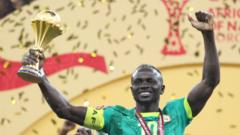
The metal was cold, but the air in Dakar was screaming.
Imagine a man named Moussa. He isn't a politician or a FIFA official. He is a father who saved three months of wages from a small fishing stall to buy his son a jersey with a star over the crest. To Moussa, that star isn't a graphic design choice. It is a birthright. It is the physical manifestation of the night in 2022 when the Teranga Lions finally stopped being the "almost" team of Africa and became the kings. You might also find this related story useful: What the Sydney Swans assault investigation means for the AFL.
But today, the history books have a line through that name.
The news filtered through the markets and the luxury hotels alike: Senegal had been stripped of their Africa Cup of Nations title. A technicality, an administrative shadow, a ghost in the machine of sports governance had reached back through time to snatch the trophy away. Usually, when a title is vacated, the parades stop. The flags are lowered. The fans retreat into a bitter, hushed silence to nurse the wound of "what might have been." As extensively documented in latest coverage by ESPN, the implications are significant.
Senegal did the opposite. They decided to march anyway.
The Weight of a Hollow Shell
There is a specific kind of madness required to celebrate a victory that the world says no longer belongs to you. To the rest of the globe, the trophy being driven through the streets of Dakar is a hollow shell—a piece of silvered hardware that represents a voided contract. To the people lining the Boulevard de la République, it is the only thing that is real.
Rules are written in boardrooms in Zurich or Cairo. They are etched in ink on high-grade bond paper. But glory? Glory is written in the collective memory of a million people who saw Sadio Mané stand over a ball with the weight of a continent on his shoulders. You can delete a spreadsheet. You can’t delete the way the ground shook when that final penalty hit the back of the net.
This parade isn't an act of denial. It is an act of rebellion.
Consider the logistics of a stolen joy. When a team is stripped of a title, the "proper" protocol is a quiet return of the silverware. A courier is dispatched. A statement is issued. The runners-up are elevated in a somber, secondary ceremony that feels like a wedding held in a funeral home. Senegal looked at that script and burned it. By taking to the streets with a "ghost" trophy, they are posing a dangerous question to the world of organized sport: Who actually owns a win?
Is it the institution that sanctions the match, or the people who lived through the ninety minutes?
The Invisible Stakes of the Technicality
To understand why a nation would parade a voided prize, you have to look at what that prize replaced. For decades, Senegalese football was defined by the heartbreak of 2002—a golden generation that enchanted the world but came home empty-handed. That loss wasn't just a sports statistic; it became a cultural metaphor for the country's perceived ceiling.
Then came the star.
When the title was stripped, it wasn't just a trophy that was taken. It was the proof of a new era. In the eyes of the administrative body—let's call them the "Architects"—a rule was broken. Perhaps a player’s eligibility was miscalculated by a margin of days. Perhaps a signature was missing from a document that no fan will ever read. To the Architects, the rule is the game.
But to the man in the jersey, the game is the game.
The Architects operate in a vacuum of logic. They believe that if you remove the record of the event, you remove the event itself. They are wrong. They have forgotten that sports are the last place in modern society where we search for an objective truth that cannot be argued away by lawyers. Or so we thought.
By continuing with the parade, the Senegalese football federation is effectively telling the Architects that their authority ends where the asphalt begins. They are asserting that the emotional labor of a nation is a higher currency than the bylaws of a committee.
A Hypothetical Dialogue in the Stands
If you were to stand next to Moussa during this parade and point out that, technically, the trophy is no longer "theirs," he would likely look at you with a mix of pity and confusion.
"Does the sun stop being hot because a scientist says it’s an illusion?" he might ask.
"But the records," you would insist. "The records will show someone else as the champion."
He would point to the players on the bus, sweat-streaked and grinning, holding the silver aloft. "The records are for people who weren't here. This? This is for us."
This is the central tension of the modern era. We are increasingly governed by digital ledgers and "official" versions of reality that often contradict our lived experiences. We see it in politics, we see it in finance, and now, we see it in the most sacred of secular spaces: the stadium.
Senegal's choice to celebrate is a refusal to be gaslit by a bureaucracy. It is a demand for the "Experience" to take precedence over the "Evidence."
The Cost of Defiance
There is, of course, a risk.
To the international community, this parade looks like a farce. It looks like a country that cannot accept the rules of the game it chose to play. There is a danger that by clinging to a stripped title, Senegal isolates itself from the very structures that give the sport its global reach. You cannot be part of the club if you refuse to acknowledge the club’s right to judge you.
But what is the cost of compliance?
If Senegal had surrendered quietly, they would have sent a message to every child in Dakar: The things you achieve can be taken away by people you will never meet, for reasons you will never understand. That is a much more expensive lesson to teach a generation than the cost of a few sanctions or a fine from a governing body. By parading the ghost trophy, the leaders are choosing to protect the psyche of their people over their standing in the boardroom.
They are choosing the human over the ledger.
The Anatomy of the Parade
The streets are a riot of green, yellow, and red. The bass from the speakers is so loud it rattles the windows of the colonial-era buildings in the city center. On top of the open-top bus, the players aren't acting like men who have been caught cheating or men who have lost. They are acting like men who have been vindicated.
There is no shame here.
Shame requires an internal acceptance of guilt. Senegal feels no guilt because, on the pitch, they did exactly what they were asked to do. they scored the goals. They stopped the attacks. They ran until their lungs burned. The "infraction" that led to the stripping of the title is, to them, an administrative clerical error that has nothing to do with the grass and the boots.
This is the ultimate divide. To the official, the game is a series of complied regulations. To the player, the game is a series of physical trials.
When the bus passes, the crowd doesn't just cheer. They reach out to touch the sides of the vehicle. They want to be close to the metal. They want to verify that the silver is still solid, that it hasn't evaporated into the mist of a legal ruling.
It is still there.
The Echo in the Dust
As the sun begins to set over the Atlantic, the parade slows. The adrenaline starts to ebb, replaced by a quiet, stubborn pride. The trophy will eventually be put in a box. It will be moved to a room where the public can no longer see it. The official maps of African football history will be redrawn, and Senegal will be a footnote in the year they should have owned.
But something happened in Dakar today that cannot be undone.
A nation looked at an objective, cold, and "official" truth and decided it wasn't true enough. They decided that some things are too important to be left to the people who write the rules.
The silver ghost has finished its rounds. The streets are littered with confetti and the remnants of a party that "technically" shouldn't have happened. The Architects will have their way in the books. They will have their way in the archives.
But tomorrow, when Moussa’s son puts on that jersey, he won't look at the star and think of a legal brief. He will think of the day the trophy came home, even after they told him it was gone.
Power is the ability to write the rules.
Strength is the audacity to ignore them when they don't make sense.
Senegal didn't just parade a trophy today. They paraded the idea that some victories are etched so deeply into the soul of a place that no pen on earth is sharp enough to scratch them out.
The star remains.
Would you like me to analyze how this narrative approach compares to standard sports journalism?