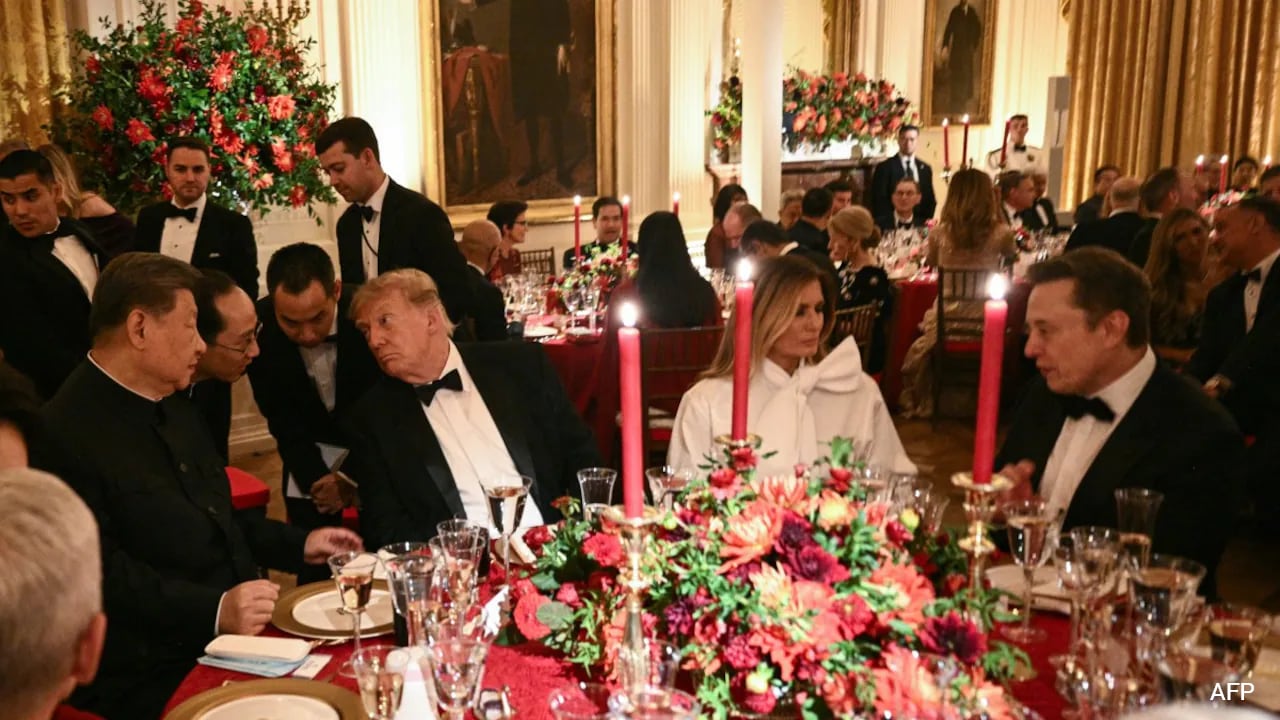
The porcelain clinked against the crystal. Outside the high, tall windows of the State Dining Room, the Washington dusk had settled into a heavy, violet bruise. Inside, under the amber glare of gilded chandeliers, the menu was French, the suits were bespoke, and the future was being negotiated between bites of pear tart.
At the center of it all sat two men who rarely shared the same hemisphere of thought, let alone the same table.
Across the room, separated by a sea of starched linen and quiet, lethal ambition, sat the architects of the modern machine. Tim Cook adjusted his cuffs, his expression a masterclass in corporate neutrality. Sam Altman leaned forward, eyes wide behind his frames, absorbing every shift in the tectonic plates of global power. Down the table, Elon Musk picked at his plate, a man physically present in a tuxedo but mentally orbiting somewhere near Mars or staring down the barrel of a quarter-to-three tweet.
They were not there to break bread. They were there to measure each other.
To understand the strange alchemy of that evening, you have to look past the protocol and the pool reports. You have to look at what happens when the statecraft of old empires collides with the hyper-accelerated feudalism of Silicon Valley. Xi Jinping had flown thousands of miles to a capital that viewed his nation alternatingly as a factory floor and an existential threat. And yet, flanked by diplomats and guards, the foreign delegation found themselves breaking bread not just with politicians, but with the high priests of code and compute.
Power has shifted. It no longer lives exclusively in red-brick federal buildings or marble-columned central banks. It lives in server farms cooled by Icelandic air. It lives in the proprietary weights of large language models. It lives in supply chains so brittle and complex that a single dust storm in the South China Sea can halt the assembly lines of three continents.
Consider the strange theater of the invite list.
Tim Cook represents the magnificent, terrifying triumph of globalism. Apple is an empire built on the delicate choreography of American design and Chinese manufacturing—a fragile, beautiful bridge spanning an ideological chasm that grows wider by the day. Every iPhone in a suburban pocket is a treaty signed in silicon. To watch Cook in that room was to watch a tightrope walker who has been performing without a net for a decade, acutely aware that a single geopolitical tremor could snap the cable.
Then there was Altman. If Cook is the custodian of the existing machine, Altman is the mechanic frantically trying to bolt a rocket engine onto a bicycle while riding it down a mountain. Artificial intelligence is not merely a new product category; it is an epochal pivot. The race for artificial general intelligence is the Manhattan Project played out in venture-backed boardrooms, and the state knows it. Washington and Beijing are both realizing, with a creeping, cold horror, that the most powerful tools of the twenty-first century might not be owned by governments at all. They might be rented from twenty-somethings in hoodies.
And Musk. Always Musk. The wildcard in every deck. He is the industrialist who brought manufacturing back to American soil while simultaneously depending entirely on Chinese Gigafactories to keep his electric vehicle empire humming. He is the man who can launch a constellation of satellites into orbit with one hand while buying the global town square with the other. To see him at a state dinner is to see a twentieth-century titan trying to survive in a twenty-first-century arena that he helped invent.
The tension in the room wasn't hostility. It was recognition.
For decades, Silicon Valley operated under the cozy delusion of sovereign exception. Tech founders fancied themselves digital nomads unbound by borders, laws, or the messy friction of nation-states. Code was law. The internet was a separate continent.
That illusion died sometime between the appetizers and the main course.
Governments are waking up. They realize that software eats the world, and whoever controls the software controls the sovereignty. Export controls on advanced semiconductors, antitrust investigations, data localization laws—these are not just bureaucratic nuisances. They are the defensive trenches of the traditional state, digging in against the relentless advance of the technologist.
And the tech leaders are waking up, too. They discovered that you can code an operating system to bypass a border, but you cannot code your way out of a naval blockade. You cannot scale a server farm without megawatts of power, and you cannot secure megawatts of power without the blessing of regulators, governors, and presidents.
The state dinner was a recognition of mutual hostage-taking.
The politicians need the tech titans to maintain economic dominance, to generate the GDP growth that funds the pension funds, to win the geopolitical race for supremacy. Without them, the empire stagnates into a museum of past glories.
The tech titans need the politicians to write the rules, to subsidize the fabs, to provide the legal framework for a world reshaped by automation. Without them, the wild west becomes a lawless battlefield where no investment is safe and no patent holds weight.
So they smiled for the cameras. They raised their glasses to cooperation and stability. They spoke the diplomatic language of mutual respect while quietly calculating the cost of a decoupling supply chain.
When the dinner ended and the motorcades dissolved into the foggy Washington night, the chandeliers were dimmed. The plates were cleared. But the gravity of that room lingered.
We are living through a quiet, radical renegotiation of who runs the world. It doesn't happen with a revolution in the streets or a declaration of war on the evening news. It happens in banquet halls, over expensive wine, between men who command more capital than most nations and men who command armies.
The line between the state and the startup has blurred into nothingness. And the rest of us are just living in the room where they are figuring out what comes next.