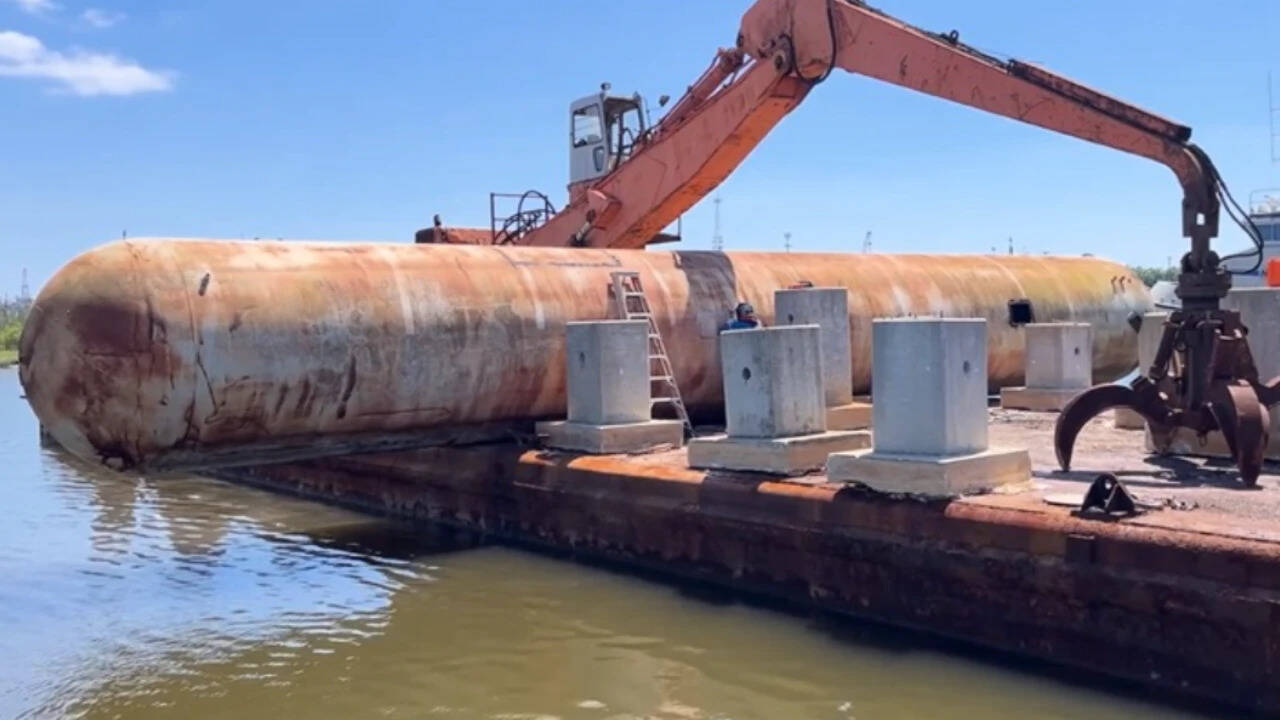
Drop a 31-ton steel cylinder into the Gulf of Mexico. Watch the press releases roll out. Everyone claps.
That is the playbook. A state agency or marine nonprofit takes a retired industrial asset—in this case, a massive propane tank once used to train firefighters—strips out the hazardous residues, sinks it off the coast, and calls it a triumph for marine life. The story writes itself. Recycled steel. Saved from the scrapyard. Instant habitat for red snapper and amberjack.
It makes for a great photo op. It is also a lazy consensus that mistakes motion for progress.
I have spent years watching coastal restoration projects, charter operators, and municipal planners celebrate big, heavy deployments while ignoring what actually happens underwater ten years later. People love a dramatic splash. A crane lifting 62,000 pounds of steel feels heroic. Nobody writes headlines about slow, unglamorous fisheries enforcement, watershed sediment control, or the quiet failure of a single metal tube to replace a functioning reef ecosystem.
Sinking a retired firefighter training tank in Mississippi waters is not bad because someone did something evil. It is a distraction because it lets coastal stakeholders pat themselves on the back over a tiny, localized fix while the real bottlenecks in Gulf reef management stay untouched.
What Everyone Gets Wrong About "Artificial Reefs"
First, let's get the terminology straight before the romanticism takes over.
When marine engineers and fisheries biologists talk about an artificial reef, they are talking about a substrate—a hard surface placed on a soft or featureless seafloor to attract organisms that attach to hard surfaces, shelter mobile fish, or alter local water flow. When laypeople hear "artificial reef," they picture a vibrant, self-sustaining coral head teeming with life like a natural reef.
Those are not the same thing. A natural reef—or even a mature, complex hard-bottom habitat in the northern Gulf—is a web of biological engineering, calcium carbonate accretion, varied micro-niches, and food-web connections across space and time. A steel tank is a chunk of manufactured iron sitting in saltwater.
Fish congregate around steel structures. That part is real. Anglers know it. Commercial captains know it. A giant cylinder rising off a flat sand or mud bottom creates shadow, current eddies, and refuge from predators. Juvenile fish use the crevices. Bigger predators patrol the perimeter.
Here is the trap: attraction is not production.
If you place a steel structure in an area where recruitment is already limited by overfishing, hypoxic "dead zones," or degraded estuarine nurseries, you can concentrate fish in one spot without increasing the total healthy population across the Gulf. Worse, if you put a high-profile structure in easy reach without management discipline, you can turn a "reef" into a fish-aggregation trap where boats line up and pull out biomass faster than the surrounding ecosystem can replace it.
I have seen coastal initiatives blow serious money and political capital on high-visibility deployments that looked fantastic on day one and functioned mostly as localized gathering spots rather than broad ecological recovery engines. Steel does not magically manufacture juvenile fish out of thin air. Biology still sets the ceiling.
Why a Retired Propane Tank Is Never Just Free Scrap
There is a comforting myth in repurposed-asset stories that turning old industrial gear into an artificial reef is practically free, pure circularity.
In reality, marine deployment is a specialized engineering and regulatory operation. A tank used for firefighter training has lived a hard life. Heat cycles, fuel systems, coatings, attachments, internal baffles, residual hydrocarbons or firefighting foam chemicals, structural fatigue—none of that can simply be rolled off a barge and forgotten. Everything potentially harmful has to be cleaned, inspected, and cleared according to strict environmental and navigational rules.
Then comes the real cost driver in marine work: marine logistics.
Moving 31 tons of steel is one thing on dry land. Moving it onto a barge, securing it, towing it offshore, monitoring weather windows in the Gulf of Mexico, coordinating deployment permits, and placing it accurately on the seabed where it will not shift into shipping lanes or bury itself completely in soft sediment is where budgets get real.
Add ongoing accountability to that list. An artificial reef program is not a one-and-done drop. You have to track coordinates, verify stability after major storms, check depth clearances, and evaluate whether the structure is actually doing what you claimed it would do.
None of that makes a steel tank a bad idea on paper. Repurposing heavy steel can make sense when the engineering checks out, the cleaning is verified, and the deployment fits into a broader permitted reef plan. It just means the headline "repurposed tank" hides a lot of heavy lifting, compliance, and marine transport costs that never show up in a celebratory soundbite.
The Questions People Are Actually Asking—And Why They Miss the Point
When a story like Mississippi sinking a 31-ton propane tank hits the feed, the search queries are predictable. People ask if old tanks are safe in the ocean, how long steel lasts underwater, and whether artificial reefs actually help fish populations.
Those questions treat a complex system like a binary trivia quiz.
"Are repurposed industrial tanks safe for marine life?"
They are safe only if they are properly stripped of contaminants and placed where structural wear and corrosion will not create hazards. Uncleaned tanks are liabilities; properly decontaminated steel is largely inert compared to many pollutants, though corrosion rates, coatings, and placement matter. Asking "Are they safe?" in the abstract misses the real operational question: Who verified the cleaning, and who is watching the site over time?
"How long does a steel tank last as an artificial reef?"
Long enough to be useful, not forever. In warm, oxygenated seawater with wave and current action, bare or worn steel corrodes. Thin sections go first; thicker plate steel holds up longer. Depending on wall thickness, water chemistry, and storm energy, a steel structure may provide strong structural relief for years or decades before collapsing into lower-profile scrap. That is not a flaw—even collapsed steel still adds complexity—but treating a single tank as a permanent monument ignores basic marine corrosion physics.
"Do artificial reefs really increase fish numbers?"
Sometimes they boost local abundance and support specific life stages or fisheries; sometimes they mostly redistribute fish that were already there. Fisheries scientists—researchers like Stephen Bortone, William Seaman Jr., and Bob Shipp, whose work has shaped modern artificial reef science for decades—have spent years dissecting the attraction-versus-production dynamic. The consensus among serious reef scientists is far more cautious than the press releases: structure helps when it addresses a real habitat bottleneck and sits inside smart management. Structure alone is not a silver bullet.
Where My Contrarian Take Can Bite You
I am pushing hard against the cheerleading around single-object reef drops, so let's put the downside of my own stance on the table.
If you demand massive ecological proof, multi-decade monitoring budgets, and sweeping policy overhaul before ever deploying a piece of steel, you can easily get paralyzed by perfectionism. Coastal restoration suffers plenty from analysis paralysis and endless meetings where nothing hits the water.
A well-sited, cleanly prepped 31-ton tank inside an established reef zone can give divers a cool site, give anglers a known waypoint, and give local communities a tangible connection to coastal stewardship. Public engagement matters. Getting people to care about the Gulf is hard, and visible projects sometimes pull folks into the conversation who would otherwise tune out coastal policy.
Just do not confuse public engagement or localized fish attraction with solving Gulf fisheries health. That is where good intentions turn into self-deception.
A Thought Experiment: Two Ways to Spend $250,000 on the Coast
Imagine a scenario where a coastal coalition has $250,000 earmarked for marine habitat and fisheries improvement.
In Scenario A, they spend almost all of it cleaning, transporting, permitting, and dropping one dramatic, oversized steel vessel or tank onto a sandy bottom a few miles offshore. Local TV covers the splash. A plaque goes up on shore. Five years later, fish hang around it when weather allows, while upstream runoff, habitat loss, and fishing pressure in the broader region remain unchanged.
In Scenario B, they put a smaller slice toward well-vetted reef material placed strategically within an existing reef complex, and put the rest into unglamorous fundamentals: protecting oyster reefs and marsh edges that nursery juvenile fish, funding data collection and enforcement, or pairing habitat work with science that tracks actual survival and stock health.
Scenario A wins the news cycle. Scenario B actually moves the needle for the ecosystem.
What to Do Instead of Cheering Every Splash
If you work in coastal policy, marine conservation, charter fishing, or philanthropic funding—or if you just care whether ocean headlines mean anything—stop judging projects by how dramatic the deployment looks.
- Demand ecosystem context, not isolated stunts. Ask how a new structure fits into an existing reef zone, what habitat type is actually scarce in that spot, and how it connects to estuarine nurseries.
- Separate PR wins from biological outcomes. When someone touts a new reef deployment, ask what is being measured after year one, year three, and year ten. Fish counts on a single dive do not equal a healthier fishery.
- Fund the unsexy bottlenecks. Marsh restoration, oyster reef rebuilding, clean water inflows, and disciplined fisheries management rarely get splashy headlines, yet they do far more heavy lifting for coastal productivity than one giant piece of scrap steel.
- Insist on full lifecycle accounting. Factor in cleaning, transport, permitting, storm movement, and long-term monitoring before calling a repurposed asset a bargain.
Sinking a 31-ton former firefighter training tank in Mississippi is a neat piece of hardware trivia. Calling it a major victory for the ocean is letting a splash distract you from the tide.


