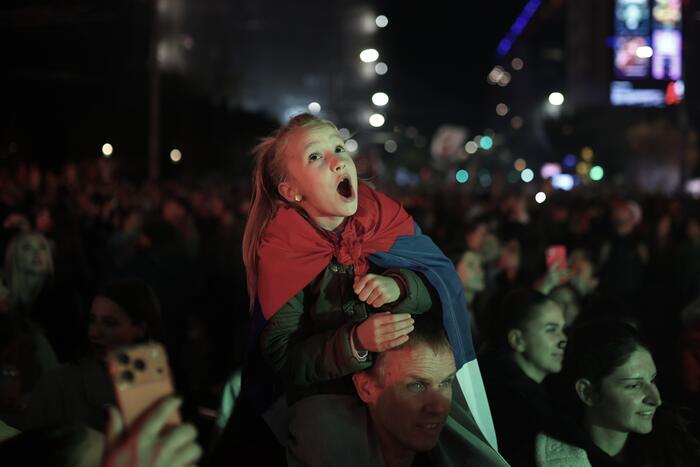
Cold rain in November tastes like wet concrete and coal smoke. If you stood on Slavija Square in Belgrade during the winter of 2024 and 2025, you know that taste by heart. You remember the red paint on hands held up against gray skies, the rhythmic chant of ruke su vam krvave—your hands are bloodied—echoing off Austro-Hungarian facades, and the sudden, electric silence at 11:52 AM when an entire city froze for fifteen minutes to honor fifteen people crushed beneath a collapsed railway canopy in Novi Sad.
Victory smells different.
Victory smells like stale coffee in a university plenum at three in the morning. It smells like wet wool, printer toner, and the quiet terror of realizing that the wall you spent two years pushing against has finally given way—and now you are standing inside the building, holding the keys, with the roof still leaking.
According to political analysts and regional reporting tracking Serbia’s dramatic political upheaval following the student-led protest wave of 2024–2026, the student movement that forced a generational reckoning in Belgrade now faces the hardest transition in modern democratic history: moving from the moral clarity of the street to the messy, unforgiving machinery of governance.
The Architecture of a Protest
To understand why taking power is so dangerous for a movement born in lecture halls, you have to understand how they won in the first place.
For over a decade, political opposition in Serbia followed a predictable, exhausting script. Party leaders argued on television, formed fragile coalitions, split over ego, and watched voter turnout wither under the weight of state-aligned media dominance and institutional pressure. Citizens grew numb. Cynicism became a national survival strategy, a thick coat worn against the chill of broken promises.
Then came November 1, 2024. The concrete canopy at the newly renovated Novi Sad railway station collapsed, killing fifteen people—later rising to sixteen as another victim succumbed to injuries—and turning grief into an unstoppable civic current.
Students at the Faculty of Dramatic Arts in Belgrade were among the first to blockade their buildings after being attacked while paying silent tribute to the dead. Within weeks, more than sixty faculties across Belgrade, Novi Sad, Niš, and Kragujevac were occupied.
They did something the professional politicians had forgotten how to do. They refused to appoint a single charismatic savior.
Instead, they governed themselves through plenums—direct-democracy assemblies where every student had one vote, rotating moderators kept egos in check, and decisions required consensus or clear majorities. They marched hundreds of kilometers on foot through winter frost to villages where state television rarely told their side of the story, sleeping on gymnasium floors in rural towns while grandmothers wept and handed them jars of homemade ajvar and wool socks.
Analysts at organizations such as the European Council on Foreign Relations and Balkan Insight have noted that this leaderless structure was their greatest shield. You cannot smear a single figurehead on the evening news when there is no figurehead to smear. You cannot buy off a movement when its decisions are made by thousands of twenty-one-year-olds sitting on auditorium steps.
Wait.
Think about what happens when that exact superpower collides with the reality of running a state.
The Morning After the Revolution
Consider a hypothetical scenario—a composite drawn from the real dilemmas currently facing student delegates and civic coordinators in Belgrade. Imagine a twenty-three-year-old mechanical engineering student named Luka, who spent eighteen months organizing logistics for university blockades, sleeping four hours a night on foam mattresses, and coordinating food deliveries across four campuses.
Luka knows how to verify a rumor in three minutes. He knows how to keep three thousand demonstrators calm when provocateurs try to throw flares at riot police. He knows how to run a plenum until dawn.
Now imagine Luka—or the civic coalition his movement has propelled into power—walking into the Ministry of Finance or the Ministry of Construction on a Monday morning.
The fluorescent lights hum. The filing cabinets are locked. Half the senior civil servants owe their jobs to the previous administration and view the newcomers with quiet hostility, while the other half are waiting to see who blinks first. Outside, pensioners need their checks on the tenth of the month. International lenders are asking about Serbia’s credit rating and fiscal deficit. The European Union is demanding clarity on rule-of-law benchmarks, while energy contracts with Russia and infrastructure loans with China sit on the desk like unexploded ordnance.
You cannot run a national power grid by plenum.
That is the central paradox documented by political scientists studying post-protest transitions from Prague in 1989 to Sofia and Kyiv in the decades since. A protest movement thrives on horizontal purity; a modern state runs on vertical delegation. In a plenum, delaying a vote by six hours to hear every voice is a triumph of democracy. In a ministry during a currency dip or an energy shortage, delaying a decision by six hours costs millions of euros.
The Four Traps Waiting Inside the Ministries
Observers of Serbian politics and democratic transitions point to four distinct fault lines threatening to fracture the movement as it steps from opposition into authority.
First, the purity trap. Street movements survive on moral absolutes. Either the contract is transparent or it is corrupt; either the prosecutor is independent or compromised. Governance, by contrast, is the art of choosing between two imperfect options before noon. The moment a student-backed administration signs a necessary compromise—whether on a budget freeze, a regional diplomatic negotiation, or retaining mid-level technocrats to keep hospitals running—purists in the movement will cry betrayal. Watch how quickly comrades become "sellouts" once they sit behind a mahogany desk.
Second, the institutional hollowing. Years of centralized control do not vanish when an election is won or a transitional government takes office. As watchdog groups like Transparency Serbia and CRTA have repeatedly documented over recent election cycles, deep patronage networks often span public enterprises, municipal administrations, the judiciary, and state-aligned media outlets. Replacing corrupt directors without collapsing basic municipal services—water, transit, healthcare—requires a deep bench of experienced administrators that a twenty-something movement simply does not have on its own.
Third, the geopolitical tightrope. Serbia does not exist in a vacuum; it sits at one of Europe’s most contested intersections. Western diplomats in Brussels and Washington watch closely to see whether a new leadership will align more firmly with European Union standards, press freedom, and regional stability. Meanwhile, Moscow retains deep historical and energy ties, and Beijing holds billions of dollars in infrastructure investments across the country—including the very railway corridor tied to the Novi Sad tragedy. Every foreign minister who lands at Nikola Tesla Airport will demand to know where Belgrade stands, and every answer carries an immediate economic price tag.
Fourth, the Kosovo question and nationalist undercurrents. The student movement succeeded in uniting liberals, moderates, and traditionalists around a simple, undeniable demand: institutional accountability and the rule of law. They deliberately kept divisive ideological labels off their banners. Yet once in power, a government cannot avoid taking concrete positions on Belgrade-Pristina negotiations, regional relations in the Western Balkans, and national identity. The moment those decisions are made, the broad tent that sheltered everyone in the rain begins to tear along ideological seams.
What History Whispered to Those Who Listened
We have seen this movie before in the Balkans, and the ending is never guaranteed.
In October 2000, hundreds of thousands of Serbs converged on Belgrade to topple Slobodan Milošević, driven in large part by Otpor!, a bold, decentralized student movement whose clenched-fist symbol became famous worldwide. The euphoria in the streets felt permanent. People danced on the steps of the Federal Assembly believing the hardest work was finished.
It wasn't.
Within three years, the broad coalition that followed fractured into bitter rivalry. Institutional reforms stalled in the courts and security services. By 2003, reformist Prime Minister Zoran Đinđić was assassinated outside a government building, and within a decade, many of the old political reflexes crept back into power under new names.
Today’s students know that history. They grew up in its shadow. That is precisely why they were so allergic to creating new political idols, why they insisted on institutional accountability rather than personal loyalty, and why they treated state television cameras with skeptical humor rather than reverence.
Yet knowing the trap exists does not automatically build the bridge over it.
The Quiet Courage of Boring Work
There is an analogy every engineer in Belgrade understands: tearing down an unsafe structure requires explosives, courage, and clear safety perimeters. Building a bridge that can carry freight trains in winter requires soil samples, rebar calculations, welding inspections, and months of unglamorous, repetitive labor that nobody applauds.
For two years, Serbia’s students performed the demolition of apathy. They woke up a generation that had been told politics was dirty and resistance was futile. They proved that civic dignity is still contagious, even in an era of algorithmic distraction and entrenched media control.
Now comes the rebar.
To survive taking power, the movement has to perform an almost impossible alchemy: translating its ethical DNA into durable institutions without losing its soul in the process. That means pairing youthful vigilance with experienced, uncorrupted legal and economic professionals—judges, auditors, engineers, economists—who know how the machinery works without owning shares in its dysfunction. It means building transparent public procurement portals where every dinar of a railway renovation can be tracked by a teenager on a smartphone. It means protecting an independent judiciary even when that judiciary rules against the new government’s own wishes.
Most of all, it means resisting the seduction of the very power they fought to dismantle. Power in the Balkans has always had a way of softening the edges of rebels, whispering that just this once the rules can be bent for a good cause, just this once a loyal friend is better than an independent critic.
Stand again in memory on Slavija Square at 11:52 AM.
Think of the silence that held tens of thousands of people motionless in the cold. Nobody needed a microphone to tell them why they were there. The truth was simple, heavy, and unmistakable.
Outside the ministries in Belgrade today, the sirens have stopped. The banners are folded in dorm closets, stained with rain and red paint. Inside, the fluorescent lights are humming, the stacks of unread contracts are waiting on the desks, and a generation that refused to be silenced is about to discover whether freedom is something you win in the street—or something you have to prove, line by line, on a Tuesday afternoon when nobody is watching.