The floorboards were never level. If you set a marble down near the north wall of the parlor, it rolled with a soft, persistent clicking toward the cast-iron stove, tracing a path worn smooth by five generations of stocking feet.
Houses are supposed to stay put. We treat them like geological features, anchored by concrete foundations and stubborn property lines, as permanent as the hills behind them. When you inherit a house, you inherit an address. You inherit a permanent dot on a fading map.
Except when you refuse to leave the past behind.
The Weight of Wood and Nails
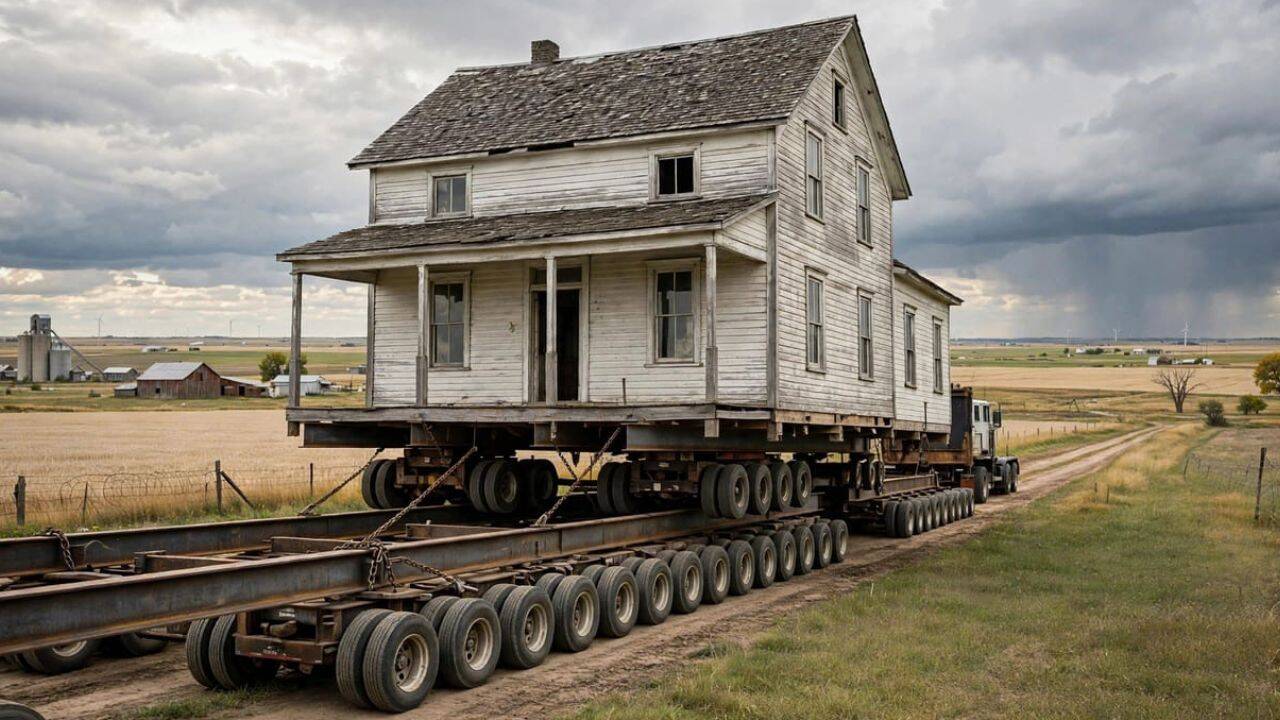
Granite is heavy. Oak is heavier. Put them together into a two-story structure built in the late nineteenth century, load it onto a custom hydraulic multi-axle trailer, and you are looking at roughly six hundred tons of local history staring down a narrow, winding country highway at four miles per hour.
Most people buy a new sofa when they move. Some buy a new zip code. But Sarah Williams looked at the crumbling timber frame where her great-great-grandparents had whispered secrets, baked bread, and weathered three century-turns, and decided that three hundred and eighty thousand dollars was a fair price to pay for gravity's defeat.
The logistics alone read like a military campaign. Power lines had to be lifted by utility crews trailing behind the slow-moving convoy. Low-hanging oak branches, untouched for a century, fell beneath a chainsaw to clear a corridor of safe passage. Traffic backed up for miles behind a house creeping across the asphalt, drivers squinting through their windshields at an impossibly domestic sight: a living room with its curtains still hanging, rolling past a gas station at a walking pace.
Why do we do this? Why fight entropy with hydraulic jacks and heavy machinery?
A Century in Transit
Consider what lives inside the walls of an old home. It is not just plaster and lathe. It is the invisible accumulation of ordinary moments. The notch on the pantry doorframe measuring a child's height year by year until the numbers stopped. The faint scent of woodsmoke and dried lavender embedded deep in the pine framing. The ghosts of arguments hushed by the hearth and laughter that rattled the single-pane windows.
When Sarah’s great-great-grandfather drove the first iron nails into the sill plates, he was not thinking about historical preservation. He was thinking about shelter. He was thinking about winter. He planted a stake in the soil and dared the elements to knock it down.
Generations passed. The family scattered. The local economy shifted like sand beneath a tide, pulling children toward distant cities and office cubicles. The old homestead was left behind, sitting empty under a sagging roof, surrendering slowly to the vines and the rain. It was, by all rational financial metrics, a total loss. A money pit of dry rot and structural compromise. A relic destined for a match or a bulldozer.
Rationality is a cold counselor.
The Journey Home
Moving six hundred tons of timber across state lines is an exercise in agonizing patience. The process took months of engineering assessments, permit applications, and structural shoring. Steel beams had to be threaded through the foundation like surgical pins to keep the framing from twisting under its own weight. Every windowpane was braced. Every brick of the massive central chimney was documented, dismantled, and rebuilt piece by painstaking piece at the new destination—the historic family farm where Sarah’s husband had grown up riding horses through the creek bottoms.
On the day of the move, the atmosphere was charged with a strange, nervous electricity. Neighbors lined the gravel shoulders, holding paper coffee cups against the morning chill. They weren't watching a construction project. They were watching an act of defiance.
When the house finally settled onto its new stone foundation beside the old red barn, something shifted in the landscape. It looked as though it had always been there, slotted neatly into the topography like a missing puzzle piece. The front porch faced the same angle of the morning sun it had faced a hundred miles away.
The Architecture of Belonging
We live in an era of disposable architecture. Entire subdivisions rise from empty cornfields in a matter of weeks, constructed from engineered lumber and synthetic siding designed to look modern for precisely ten years before requiring a remodel. We move with casual frequency, packing our lives into cardboard boxes every few lease cycles, treating our living spaces as temporary holding pens.
Because of this rootlessness, we crave permanence. We look at historic preservation not as an academic exercise, but as an emotional anchor. When we save an old house, we are trying to save ourselves from the relentless velocity of modern life. We are trying to prove that things of value do not have to be discarded simply because they are old, inconvenient, or expensive to maintain.
Sarah didn't spend three hundred and eighty thousand dollars to acquire extra square footage. She spent it to buy a bridge across time. She bought the right to stand in her kitchen on a Tuesday morning, listening to the same floorboards groan beneath her feet that her great-great-grandmother heard while waiting for the coffee to boil.
The marble still rolls toward the north wall. The stove still ticks as it cools down in the evening. And out on the country farm, where the old timber meets the new foundation, the house stands quiet and steady, refusing to let go.