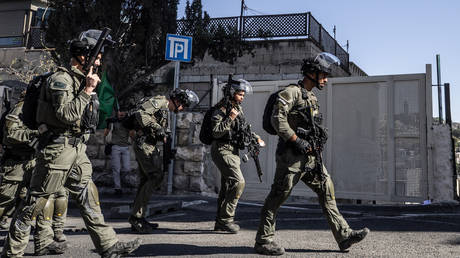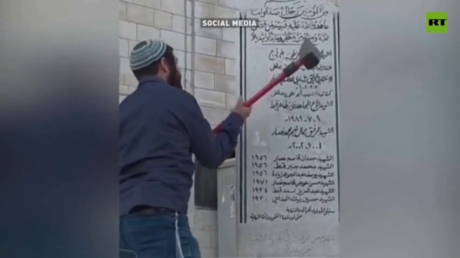
When an elected legislator trades his parliamentary seat for a construction tool, the theater of politics has curdled into active subversion. Zvi Sukkot, a member of the Knesset representing Finance Minister Bezalel Smotrich's Religious Zionism faction, marched into the West Bank village of Madama accompanied by military escorts. He carried a sledgehammer. His target was a local monument honoring Palestinians killed over decades of conflict. His method was theatrical vandalism recorded for social media optics.
The immediate fallout generated standard political theater. The Israel Defense Forces condemned the stunt, claiming Sukkot and his aides operated deceptively to manipulate an authorized security tour. Opposition figures blamed Prime Minister Benjamin Netanyahu for enabling lawless behavior among far-right coalition members. Yet these institutional reprimands miss the structural decay underneath the spectacle. This was not a rogue outburst by an undisciplined backbencher. It was a calculated assault on the monopoly of state violence, executed by a representative who believes ideological purity supersedes the chain of command.
To understand why this incident matters beyond the cycle of daily headlines, one must look at the mechanics of governance in the occupied territories. The West Bank operates under military law where the IDF serves as the sole sovereign authority. When an influential lawmaker bypasses military channels to execute extrajudicial demolitions, he signals to both constituents and soldiers that institutional hierarchy is optional.
The Anatomy of Manufactured Direct Action
Sukkot defended his actions through a lens of administrative failure. He argued that because the military had not moved swiftly enough to dismantle monuments he deemed glorifications of terror, he was forced to take matters into his own hands. This logic is familiar. It mimics the operational philosophy of extremist settler groups who view government bureaucracy as an obstacle rather than a safeguard.
By positioning himself as a vigilante lawmaker, Sukkot collapses the distinction between civilian legislator and executive enforcer. A member of parliament possesses structural avenues for change. He can draft legislation, summon committee hearings, demand ministerial accountability, or lobby the defense establishment. Swinging a hammer on camera abandons those tools. It prioritizes digital engagement metrics over legal order.
The military response exposed deep operational vulnerabilities. Soldiers assigned to protect the tour found themselves caught between the physical presence of a protected Member of Knesset and the unlawful nature of his actions. Video evidence confirmed that troops stood by while the monument was struck. Junior commanders faced an impossible dilemma. Intervening physically against an immune parliamentarian risks a constitutional crisis, while standing aside makes the army an accessory to criminal mischief.
The Strategic Cost of Performative Lawlessness
National security relies on predictability. When political leaders inject volatile stunts into an already explosive arena, the friction spreads directly to the field units trying to maintain order.
Consider the operational burden. The Central Command has repeatedly warned that nationalist friction in the West Bank threatens to ignite a wider conflagration. Troops are stretched thin across multiple active fronts. Diverting security details to chaperone parliamentary provocateurs actively degrades defensive readiness.
Furthermore, the optics provide immediate ammunition to international critics. For decades, legal defenses of Israeli policy in the West Bank have rested on the argument that the territory is administered under rigorous legal frameworks overseen by military courts and administrative checks. When an architect of the system treats the law as a suggestion, that defense collapses.
The phenomenon is part of a broader shift. Ideological actors within the political establishment increasingly view state institutions not as instruments to be managed, but as obstacles to be co-opted or ignored.
[Political Grievance] --> [Bypass State Bureaucracy] --> [Performative Direct Action] --> [Erosion of Institutional Authority]
This loop creates a dangerous precedent. If a lawmaker can pick up a sledgehammer to enforce his view of justice, local communities on all sides absorb the lesson that structural power belongs to whoever wields the heaviest blunt instrument.
The Crisis of State Monopolies
A functioning state defines itself by its exclusive right to use force and administer punishment. When that monopoly fractures, governance gives way to factional anarchy.
The irony of the Madama incident lies in its betrayal of nationalist philosophy. True sovereignty does not mean the freedom to break the law when it suits an agenda. It means possessing the power to enforce order while remaining strictly bound by legal constraints.
When leadership abandons those constraints for the sake of a viral video clip, the state weakens itself far more effectively than any external adversary could manage. The dust in Madama settled quickly, but the structural fracture left by that sledgehammer runs deep through the foundations of public trust.