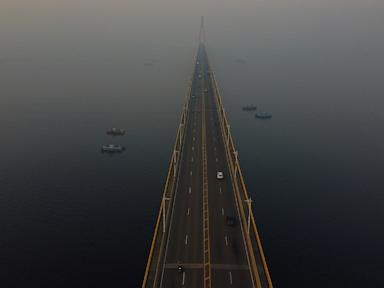
The morning does not arrive with gold. It arrives with gray.
In Manaus, a city of over two million souls anchored at the beating heart of the Brazilian rainforest, the dawn has learned to wear a shroud. You step outside, and the air does not greet your lungs; it coats them. It tastes of old ash, of scorched timber, of a million unseen leaves turning to carbon miles away. The sun is a pale, bruised coin suspended in a ceiling of soot.
To live here during the burning season is to inhabit a slow-motion emergency that no siren announces.
Consider a hypothetical mother named Elena, waking up before the city fully stirs. She listens to the small, ragged cough of her four-year-old daughter from the next room. It is a sound that has become as familiar to her as the hum of the refrigerator. She goes to the window, pushes it open just a fraction—seeking relief from the equatorial heat—and immediately closes it. The haze has already found its way inside, smelling like a campfire built in a closed closet.
The air quality index in Amazonas state does not merely drop; it plummets into territory that meteorological instruments struggle to categorize safely. Fine particulate matter—the microscopic debris known as PM2.5—rides the wind straight past the body's natural defenses, slipping deep into the bloodstream.
We talk about the Amazon as an abstract lung of the earth. We write policy papers in air-conditioned rooms thousands of miles away, debating deforestation rates and carbon credits. But the lung is coughing. And the people living inside the chest cavity are paying the price in breaths.
The Anatomy of a Man-Made Fog
Fires in the Amazon are rarely accidents of nature. Lightning strikes can ignite the canopy, yes, but the dense, humid embrace of the primary rainforest usually resists a blaze unless a human hand has prepared the tinder.
What happens in Amazonas state—particularly during dry spells exacerbated by shifting climatic patterns—is a chain reaction. Trees are felled to clear pasture or illegal land claims. The slash is left to dry under a merciless sun. Then comes the match.
The smoke travels. That is the cruel geometry of the wind.
The blazes might burn hundreds of miles upriver, deep in remote municipal boundaries where the jungle begins to thin toward the edges of human expansion. But the atmospheric rivers, those vast aerial currents sweeping across the basin, funnel the smoke downward. They trap it in the sprawling river valley where the Negro and the Solimões rivers meet. Manaus sits right in the basin of that atmospheric bowl. The smoke settles over the floating ports, the bustling markets, and the tin-roofed homes, refusing to lift.
Visibility drops so low that river pilots navigating the Amazon tributaries must rely entirely on radar, creeping forward at a snail's pace to avoid collisions with hidden sandbars or stray driftwood. Commercial flights into Eduardo Gomes International Airport are delayed or diverted as pilots find themselves blinded by a yellow-brown curtain.
Schools close. Outdoor workers—those who harvest rubber, tend docks, or build roads—wrap damp cloths around their noses and mouths, working through a haze that makes every exertion feel like running underwater.
The Cost We Do Not Measure on Balance Sheets
There is a temptation to reduce environmental crises to numbers. Acres lost. Parts per billion of carbon monoxide. Hospital admission spikes.
Numbers are sterile. They let us look away.
Step into a neighborhood clinic in Manaus during the peak of the burning season. The waiting room is a chorus of wheezes. Elderly residents sit on plastic chairs, leaning forward with elbows on knees, trying to coax oxygen into stubborn lungs. Toddlers wear miniature nebulizer masks strapped to their small faces, looking like tiny pilots strapped into cockpits that go nowhere.
The local healthcare system buckles under an invisible weight. Emergency rooms swell with patients suffering from acute bronchitis, asthma attacks, and cardiovascular flare-ups triggered by the relentless inhalation of particulate matter. Doctors work double shifts, running out of inhalers and oxygen tanks, fighting an enemy that enters the body with every single involuntary reflex of survival.
This is the hidden cost of the smoke. It is not just about a hazy view from a postcard. It is about lost workdays, terrified parents, and a baseline degradation of public health that lingers long after the embers are finally drowned by the rains.
The Choice Before Us
We have engineered a system where the destruction of our most vital ecological buffer zone is treated as a logistical challenge rather than a moral crisis. The fires are fed by economics, by land speculation, by the relentless demand for expansion at the expense of endurance.
Yet, looking at the gray skies over Manaus, a different truth becomes uncomfortably clear.
We cannot out-breathe our own mistakes.
The smoke is not a localized inconvenience confined to the northern states of Brazil. It is a warning flare sent up from the ground, reminding us that the health of the earth and the health of the human body are bound by the exact same fragile thread. When the forest burns, we burn with it—one choked breath at a time.
A boat drifts down the murky waters of the Negro River, its hull cutting through a surface reflecting nothing but ash. On the shore, the silhouette of the jungle fades into the gray, waiting for the rain that takes too long to come.