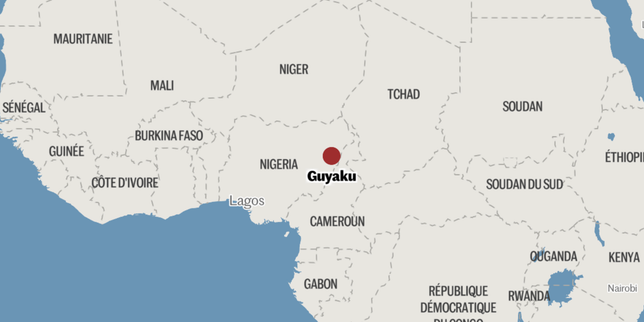
The sun over Borno State does not just shine. It punishes. It bakes the earth into a cracked, pale crust that looks like it hasn’t tasted water since the beginning of time. But in the village of Tilum, and the dusty stretches near Magumeri, the earth is dark today. It is wet. Not with the rain the farmers have been praying for, but with the heavy, metallic warmth of their own neighbors.
Thirty people.
That is the number the news tickers will flash. Thirty lives, reduced to a statistic that will be scrolled past by a world preoccupied with stock markets and celebrity scandals. To the people of northeast Nigeria, however, thirty is not a number. It is the man who knew how to fix a bicycle with nothing but a rusted wrench and sheer willpower. It is the woman who could haggle a market vendor into a laughing surrender. It is the silence that follows when a house that used to be full of shouting children suddenly has no one left to make a sound.
ISWAP (the Islamic State West Africa Province) claimed the credit. They talk of "operations" and "victories." They use the language of soldiers to mask the reality of what happened: men with guns rode into a space where people were just trying to exist, and they ended that existence.
The Anatomy of a Shadow
To understand why this keeps happening, you have to look past the headlines of "insurgency" and "terrorism." Those are sterile words. They suggest a war with clear front lines and uniforms. The reality is a ghost.
Imagine a farmer. Let’s call him Ibrahim. He has spent his entire life learning the moods of the wind. He knows when the locusts are coming. He knows which seeds will survive a drought. But Ibrahim cannot learn the mood of a shadow. He wakes up every morning knowing that his field—his only source of life—is also his most likely place of death.
He is caught in a vice. On one side, the Nigerian military tells him to stay in protected "garrison towns," where food is scarce and dignity is thinner. On the other side, the insurgents wait in the bush, demanding taxes, loyalty, or blood. If Ibrahim stays in the camp, his family starves. If he goes to his farm, he might never come back.
He went to his farm.
This is the choice faced by thousands. It isn't a choice at all. It is a slow-motion catastrophe where the options are a quick death by a bullet or a slow death by hunger. The "thirty people killed" were likely just trying to find a way to eat.
Why the World Looks Away
There is a specific kind of fatigue that sets in when a tragedy repeats itself for fifteen years. We call it "news," but it feels more like a weather report. Another attack in Borno. Another village burned. Another mass funeral.
The human brain is poorly wired to process a decade and a half of relentless suffering. We look for a climax, a resolution, an ending. When it doesn't come, we stop paying attention. We assume this is just how that part of the world is.
That is a lie.
This violence isn't a natural disaster. It isn't the weather. It is a manufactured crisis fueled by a toxic mix of radicalization, systemic neglect, and a vast, empty space where the state should be. For years, the Lake Chad basin has been a playground for groups like Boko Haram and ISWAP. They thrive in the gaps. They grow in the places where the government has failed to provide schools, roads, or hope.
When a young man in a rural village looks at his future and sees nothing but dust, a group offering him a gun and a purpose—no matter how twisted—becomes a terrifyingly effective recruiter.
The Cost of the Invisible Stake
What are the stakes here?
If you ask a geopolitical analyst, they will talk about the stability of West Africa. They will mention the migration patterns that push millions toward Europe. They will discuss the security of oil interests or the spread of global caliphates.
But there is a deeper cost. It is the death of trust.
In these villages, the social fabric is being shredded. When an attack happens, the survivors look at each other with suspicion. Who told the insurgents when to strike? Who pointed out the village head? Who was the "informant"?
This is the most insidious weapon of the insurgent: they don't just kill people; they kill the idea of community. They turn neighbors into strangers and strangers into enemies. Once that trust is gone, you can’t just rebuild a village with bricks and mortar. You are trying to build on a foundation of fear.
The Nigerian government often speaks of "degrading" the enemy. They announce the killing of high-ranking commanders. They showcase recovered trucks and ammunition. And yet, the cycle continues. Because you cannot shoot an ideology with a rifle, and you cannot secure a region by only holding the city centers.
The Sound of Thirty Silences
Think about the physical space thirty people occupy.
In a village, that is a significant portion of the adult population. It is a generation of knowledge. It is thirty seats at the communal meal. It is thirty voices that will no longer sing, argue, or pray.
The reports say the attack was "claimed" by the group. Think about that word. Claimed. As if these human beings were property. As if their lives were currency spent to buy a moment of notoriety on an extremist Telegram channel.
The victims were not "casualties." They were fathers who were worried about the price of grain. They were sons who were hoping to marry after the harvest. They were people who had names that their mothers whispered when they were babies.
Now, those names are written on simple markers in the dry earth.
The tragedy of Borno is not just that people are dying. It is that they are dying for nothing in a war that has no end in sight. The world moves on because the geography is distant and the politics are complicated. But the grief is the same as it is anywhere else. The tears of a mother in Maiduguri are as salt-heavy and bitter as those of a mother in Paris, New York, or London.
The sun will rise again tomorrow over Magumeri. It will bake the earth. It will turn the wet spots of blood into dark, hard scabs. The farmers who survived will look at the horizon, calculate the risk of their hunger against the risk of the shadow, and they will walk back out into the fields.
They have no other choice.
We, however, do. We can choose to see them. Not as a number, not as a headline, and not as a lost cause. We can choose to remember that thirty people did not just die; thirty worlds ended.
The silence they left behind is a scream, if only we were quiet enough to hear it.