The domestic manufacturing base for solid rocket motors faces severe supply chain contraction, defined by a structural deficit between tactical demand and active production lines. Addressing this deficit requires examining how industrial operators scale energetic assembly while managing intense chemical hazards, capital expenditure intensity, and strict regulatory compliance. Strategic expansions, such as Voyager Technologies' development of the American Defense Complex in Pueblo, Colorado, illustrate the operational pivots required to reindustrialize tactical propulsion. Evaluating these industrial scaling efforts demands a structured breakdown of production bottlenecks, chemical processing constraints, and the economics of vertical integration.
The Cost Function of Energetic Manufacturing
Producing tactical solid rocket motors involves balancing safety thresholds against volumetric throughput. Unlike standard mechanical components, solid rocket motors combine fuel and oxidizer inside a pressure vessel. This creates a high-energy density system where any failure in quality control results in catastrophic asset loss.
The primary cost drivers in solid rocket motor fabrication can be categorized into three operational variables:
- Raw Material Qualification: Propellant performance relies on tight chemical tolerances. Ingredients such as ammonium perchlorate oxidizers, liquid rubber binders, and specialized metallic additives require extensive batch testing before entering the mixing phase. Complex propellants frequently demand dozens of discrete quality verification tests on raw components alone, creating an upfront time and capital bottleneck.
- Batch Processing Safety Constraints: Traditional mixing procedures require vacuum-sealed vessels to strip out micro-air bubbles that cause structural fissures during combustion. Because these mixtures are volatile, standard operations traditionally mandate human proximity limits, severely capping throughput.
- Curing and Thermal Management: Once blended with curative agents, the propellant slurry must undergo controlled thermal cycles inside cure ovens to cross-link the polymer binder. The duration of this phase is dictated by chemical kinetics, preventing manufacturers from arbitrarily accelerating cure times without risking thermal runaway or internal stress fractures.
Vertical Integration as a Margin and Speed Defensive Play
Supply chain fragility in defense manufacturing stems from reliance on fragmented tier-two and tier-three component suppliers. When lead times for specialized chemicals or pressure vessels stretch out, final assembly halts. To bypass this vulnerability, industrial strategy increasingly favors vertical consolidation.
Acquisitions of specialized compounders—such as Voyager's integration of Estes Energetics—demonstrate how prime contractors secure proprietary control over raw inputs. Owning the upstream chemical synthesis eliminates margin stacking and provides direct oversight over ballistic release characteristics.
This structural integration impacts production velocity across two vectors:
- Compression of Lead Times: When a facility processes base ingredients in-house, it removes external vendor shipping loops and administrative customs delays.
- Iterative Prototyping Speed: Facilities equipped with standardized libraries of verified propellant formulations can bypass basic research phases for routine orders, shifting prototype delivery timelines from standard industry pacing down to weeks rather than quarters.
Automation and Infrastructure Reuse Economics
Scaling manufacturing capacity typically triggers prohibitive capital expenditures, particularly when acquiring specialized real estate capable of handling energetic materials. Operators must construct earth-covered magazines for storage, maintain safety buffer zones, and implement blast-mitigation architecture.
Utilizing brownfield assets with pre-existing defense infrastructure—such as repurposing former depot land containing hundreds of earth-covered storage magazines—mitigates initial capital outlay. This site selection strategy preserves capital for the installation of advanced manufacturing equipment rather than basic civil engineering.
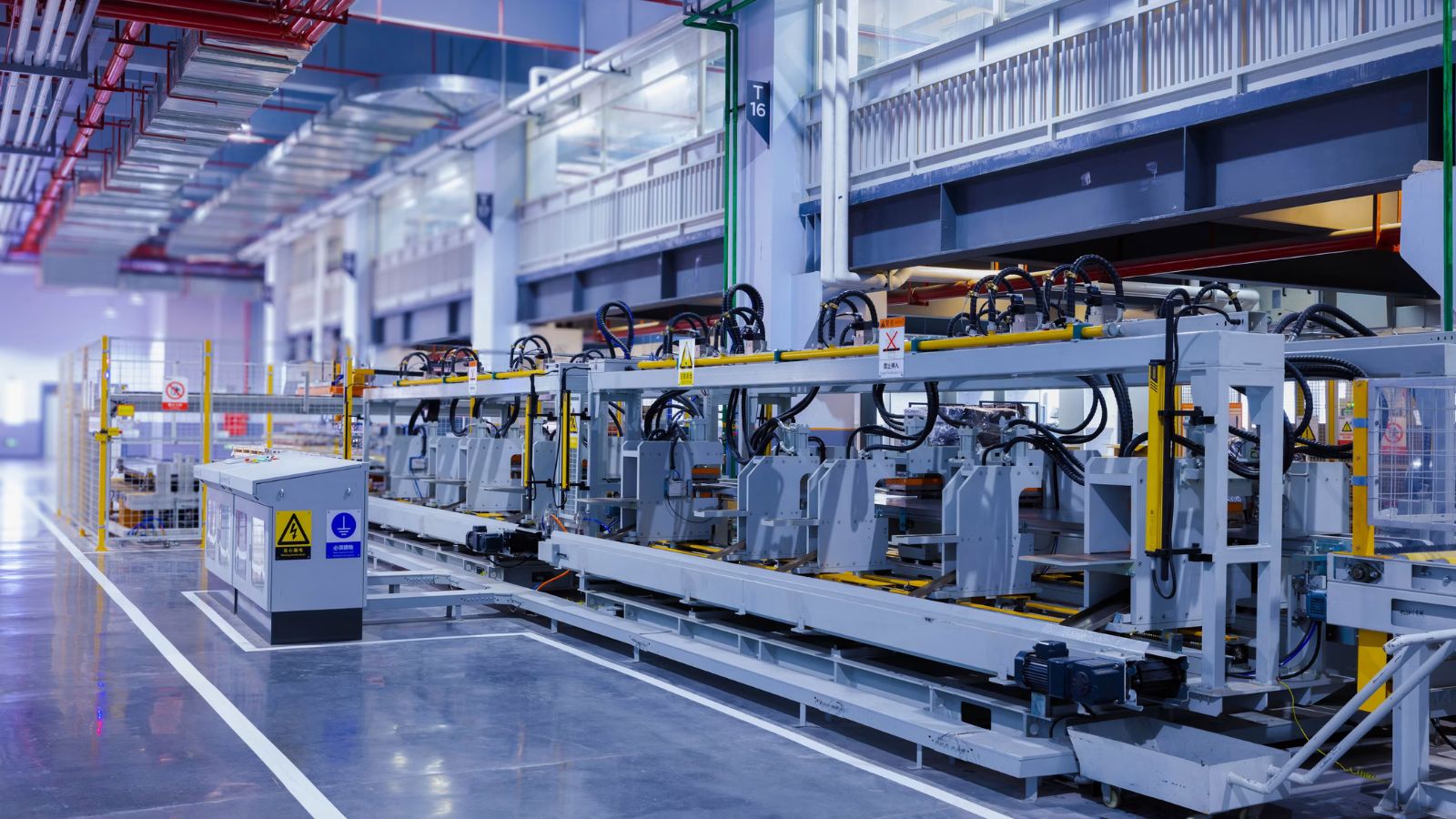
Concurrently, introducing automation into high-risk zones transforms the labor-to-output ratio. By deploying robotics to handle propellant mixing, casting preparation, and non-destructive inspection, operators remove personnel from direct proximity to explosive hazards. This shift not only satisfies modern safety mandates but enables continuous, multi-shift operations that manual safety protocols previously restricted.
The Mechanics of Controllable Propulsion Integration
Standard solid rocket motors suffer from a fundamental limitation: once ignited, the combustion cannot be easily throttled, extinguished, or reignited. This binary operational profile limits tactical flexibility on the battlefield, where changing mission parameters require dynamic energy management.
Advanced manufacturing initiatives increasingly focus on controllable solid propulsion. By embedding mechanical or chemical modulation valves into the nozzle and grain design, systems can regulate burn rates, throttle thrust profiles, and execute multiple ignition sequences.
Achieving this requires tightly coordinated digital engineering. Facilities must integrate real-time telemetry, automated non-destructive testing, and digital twin simulations to predict how a specific energetic grain will perform under variable thermal and aerodynamic stresses. Consequently, manufacturing complexes designed for high-volume output must double as software-driven analytical environments.
Strategic Industrial Execution
To capture market share in a constrained defense sector, operators must transition from custom, artisanal builds to semi-custom modular manufacturing. Relying on a foundational library of pre-qualified propellants allows engineering teams to meet specific customer impulse requirements without triggering costly requalification cycles. Simultaneously, capital allocation should prioritize the robotics layer of the assembly line to eliminate human-in-the-loop bottlenecks. Scale is achieved not merely by expanding square footage, but by optimizing the velocity of internal chemical verification and leveraging automated safety architecture to sustain continuous-flow production.