The Silence Before the Static
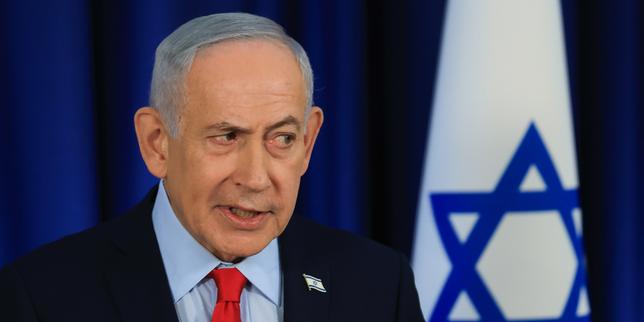
In the living rooms of Tehran and the bunkers of Tel Aviv, the air carries a specific kind of weight. It isn’t the heat of the desert or the humidity of the coast. It is the vibration of a phone screen lighting up in the dark. On that screen, a video circulates: Benjamin Netanyahu, standing before a backdrop that screams of officialdom, delivering a message that sounds less like diplomacy and more like an obituary.
He speaks of a nation being "decimated."
The word itself is heavy, ancient, and terrifying. To decimate is to remove a tenth, but in the modern lexicon of Middle Eastern brinkmanship, it suggests something far more absolute. It suggests an erasure. While the headlines in the West analyze the geopolitical shift or the fluctuating price of crude oil, the people under the flight paths of supersonic missiles are measuring something else entirely. They are measuring the distance between a threat and a reality.
Consider a man named Reza. He is hypothetical, but his anxiety is documented in every frantic Telegram message sent across the Iranian plateau this week. Reza owns a small repair shop in Isfahan. He doesn't spend his days studying the range of an F-35 or the intercept capacity of an Arrow-3 system. He spends them wondering if the spare parts he ordered will ever arrive, or if the sky above his shop will remain blue or turn into a kaleidoscope of magnesium and fire.
When a leader promises that your country is on the verge of being decimated, the abstract "state" vanishes. What remains is the very real fear for the roof over your head and the bread on your table.
The Architecture of the Brink
The rhetoric we are seeing today isn’t new, yet it feels different. It feels final. For decades, the shadow war between Israel and Iran was fought in the margins—in the lines of code that crippled a centrifuge, in the silent assassination of a scientist on a lonely road, or in the proxy battles of the Levant. But the veil has been torn. We are no longer watching a chess match; we are watching a demolition derby where the drivers have stopped tapping the brakes.
Netanyahu’s recent assertions aren't just for his domestic audience. They are a signal to the world that the "red lines" of the past have been scrubbed away. By suggesting that Iran is "on the verge" of destruction, he is attempting to shift the psychological landscape of the entire region.
But how did we get here?
The escalation didn't happen in a vacuum. It is the result of a geometric progression of violence. Each strike demands a "proportionate" response, but in the mathematics of war, 1+1 rarely equals 2. It equals a larger, more volatile 3. When Iran launched its barrage of ballistic missiles, it wasn't just a military maneuver. It was a statement of reach. When Israel promises decimation, it is a statement of capability.
The tragedy of this specific moment is the total absence of an exit ramp. In previous decades, there was always a back channel—a Swiss diplomat, an American intermediary, a quiet nod in a hallway in Vienna. Today, those channels are choked with dust. The language being used is binary: total victory or total decimation.
The Invisible Stakes of a Modern Siege
We often talk about war in terms of hardware. We count the drones. We debate the efficacy of the Iron Dome. We look at satellite imagery of scorched earth. We forget the software of a society—the trust, the economy, and the collective mental health of millions.
The "decimation" Netanyahu speaks of is already happening in the Iranian economy. Hyperinflation isn't a bomb, but it destroys a home just as effectively. When the rial plunges, a family’s savings evaporate. That is a form of slow-motion wreckage. On the other side, in Israel, the constant state of "Red Alert" creates a weary, hardened populace. Children in northern Galilee don't play in the streets; they play near the entrance of the bomb shelter.
This is the hidden cost of the rhetoric. It creates a reality where the future is an impossibility. You don't plan a wedding, start a business, or plant an olive grove when the man with the podium says your nation is about to be dismantled. You simply survive.
The facts of the military balance are stark. Israel possesses an air force that is decades ahead of anything the Islamic Republic can put in the sky. It has the backing of the world’s lone superpower. Iran, conversely, has built a "ring of fire" via its proxies, ensuring that any strike on its soil results in a rain of fire on Tel Aviv.
It is a suicide pact disguised as a strategy.
The Ghost of 1979 and the Weight of 2026
To understand the intensity of Netanyahu’s words, one has to look at the history of the wound. This isn't just about nuclear enrichment levels or maritime shipping lanes. It is about a fundamental, existential clash of visions. For the Israeli leadership, the Iranian regime is a ticking clock that must be stopped before it hits midnight. For the Iranian leadership, the existence of Israel is a historical anomaly that must be corrected.
Between these two immovable objects sit the people.
History tells us that when leaders start using words like "decimate," they are preparing their populations for the unthinkable. They are desensitizing the world to the carnage that follows. We saw it in the rhetoric preceding the collapse of empires and the onset of the Great Wars. The humanity of the "other" is stripped away until all that is left is a target on a thermal map.
But a target isn't just a building. It’s a kitchen where someone is making tea. It’s a classroom where a girl is learning the laws of thermodynamics. It’s a hospital where a doctor is trying to save a life despite a shortage of medicine caused by sanctions.
The technical reality is that a full-scale conflict would not be a clean, surgical affair. The "decimation" Netanyahu warns of would likely involve the total collapse of the regional energy grid. It would mean the closure of the Strait of Hormuz. It would mean a global economic shock that makes the 2008 crisis look like a minor accounting error.
But the real "decimation" would be the loss of a generation’s hope.
The Point of No Return
The sound of the rhetoric is getting louder because the options are getting fewer. When diplomacy fails, the only tool left is the threat of overwhelming force. Netanyahu is betting that by projecting an image of absolute ruthlessness, he can deter the next move from Tehran. Tehran is betting that by showing they are willing to burn it all down, they can force the world to restrain Israel.
It is a game of chicken played with nuclear-capable players.
We are currently in the "static" phase. The words have been spoken. The threats have been leveled. The satellites are repositioning. In Isfahan, Reza watches the news and then looks at his children. In Haifa, a mother does the same. They are the ones who will pay the price for the "decimation" if it ever moves from a speechwriter’s pen to a general’s command.
The world watches the headlines, waiting for the next update, the next strike, the next confirmation of disaster. We parse the sentences for a hint of de-escalation that never comes. Instead, we see the hardening of hearts. We see the narrowing of the eyes. We see a region where the sun sets over a horizon that feels increasingly fragile, as if the very light itself might shatter under the strain of what is being promised.
The static is getting louder. The screen is still glowing in the dark. The word "decimate" hangs in the air, a ghost waiting for a body. And in the silence that follows the broadcast, the only thing you can hear is the heartbeat of millions, wondering if tomorrow is a promise or a threat.