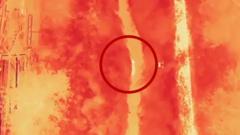
South Korea went into a collective meltdown because a single wolf-dog hybrid wandered away from its enclosure. The headlines read like a script from a low-budget disaster movie. Emergency alerts buzzed. Parents gripped their children's hands tighter. Police mobilized as if an invading army had crossed the DMZ.
All for a creature that was, by every biological metric, more confused than dangerous. For an alternative view, see: this related article.
The media circus surrounding the "escape" in Daejeon or the periodic sightings near the border ignores a fundamental biological reality. We aren't protecting society from a wild beast; we are witnessing a pathetic projection of urban anxiety onto a species we finished killing off decades ago. The Korean wolf (Canis lupus chancoensis) was wiped out by colonial-era "pest control" and habitat loss. What we see now aren't apex predators. They are ghosts, or worse, half-breed pets that remind us how much we’ve sanitized the peninsula.
The Myth of the Bloodthirsty Infiltrator
The "lazy consensus" dictates that a wolf in a human-populated area is a ticking time bomb. This logic assumes wolves view humans as prey. They don't. Data from the Norwegian Institute for Nature Research (NINA) suggests that across the globe, unprovoked wolf attacks on humans are so statistically insignificant they barely register compared to the damage done by domestic dogs. Related insight on this trend has been provided by BBC News.
In South Korea, the real danger isn't the wolf; it's the reaction.
When a "wolf" is spotted, the response is a heavy-handed paramilitary operation. This creates a feedback loop of fear. By treating an animal escape like a national security breach, the government validates a misplaced phobia. We have traded ecological literacy for a curated safety bubble.
Why the Wolf-Dog Hybrid is a Greater Insult
Most "wolves" captured in these high-profile South Korean chases aren't even pure wolves. They are hybrids. This is the ultimate irony of the modern "wolf panic." We are terrified of a creature that exists solely because of human interference.
A hybrid lacks the deep-seated, evolutionary fear of humans that keeps wild wolves away from cities. Hybrids are erratic. They are the product of "backyard" enthusiasts who want the aesthetic of the wild without the reality of the predator.
- The Wild Wolf: Avoids humans at all costs. Calculates risk. Operates within a strict pack hierarchy.
- The Hybrid: Confused. Lacks clear social cues. Likely to approach humans for food, leading to the very "aggressive" encounters the public fears.
By focusing on the "escape," the media avoids the harder conversation: the unregulated trade of exotic animals in a country with zero room for them to live naturally.
The Ghost of the Korean Peninsula
Let’s look at the "verifiable principles" of rewilding. Critics of wolf presence in Korea argue that the country is too densely populated. They aren't entirely wrong, but their reasoning is flawed. They claim there is no "space." In reality, there is plenty of forest; what’s missing is the tolerance.
The Korean wolf was a distinct subspecies. Its disappearance left a massive hole in the ecosystem, now filled by an overpopulation of wild boars and deer. These animals cause millions in crop damage and lead to dozens of fatal traffic accidents every year.
Imagine a scenario where: Instead of hunting down every stray canine with a dart gun and a news crew, South Korea invested in actual reintroduction programs in the mountainous interior.
The result? A natural check on the boar population. A reduction in agricultural loss. A restoration of the natural order. But we won't do that. It’s easier to scream "wolf" on the nightly news than to admit our "manicured" version of nature is actually a broken, expensive mess.
Stop Asking if the Wolf is Dangerous
The question "Is the wolf found?" is the wrong question. The question should be: "Why are we so fragile?"
We live in one of the most technologically advanced, hyper-monitored societies on Earth. The idea of a single animal existing outside our direct control breaks the collective psyche. This isn't about public safety. It’s about the ego of the urbanite. We have spent the last century paved over every square inch of "wild" and we cannot stand the reminder that something might still have teeth.
I have seen municipalities spend hundreds of thousands of dollars on "wildlife management" that amounts to nothing more than glorified pest control. We hire hunters to cull boars because we refuse to let the natural predator do the job for free. It is a massive, ongoing fiscal and ecological failure.
The Actionable Truth for the Urbanite
If you find yourself in the "red zone" of a wolf sighting, stop looking for a weapon.
- Acknowledge the distance. Wolves (and even hybrids) generally want nothing to do with your commute.
- Secure the trash. Predators are drawn to cities by calories, not a desire for combat.
- Demand better legislation. Stop the "exotic pet" pipeline that creates these hybrids in the first place.
The South Korean wolf isn't a threat to your life. It is a mirror. It reflects a society that has become so disconnected from the natural world that it views a displaced dog-relative as a monster. The real "moment the wolf is found" is the moment we realize the monster isn't in the woods; it's the one holding the camera, cheering for the capture of a ghost.
Stop rooting for the cage.


