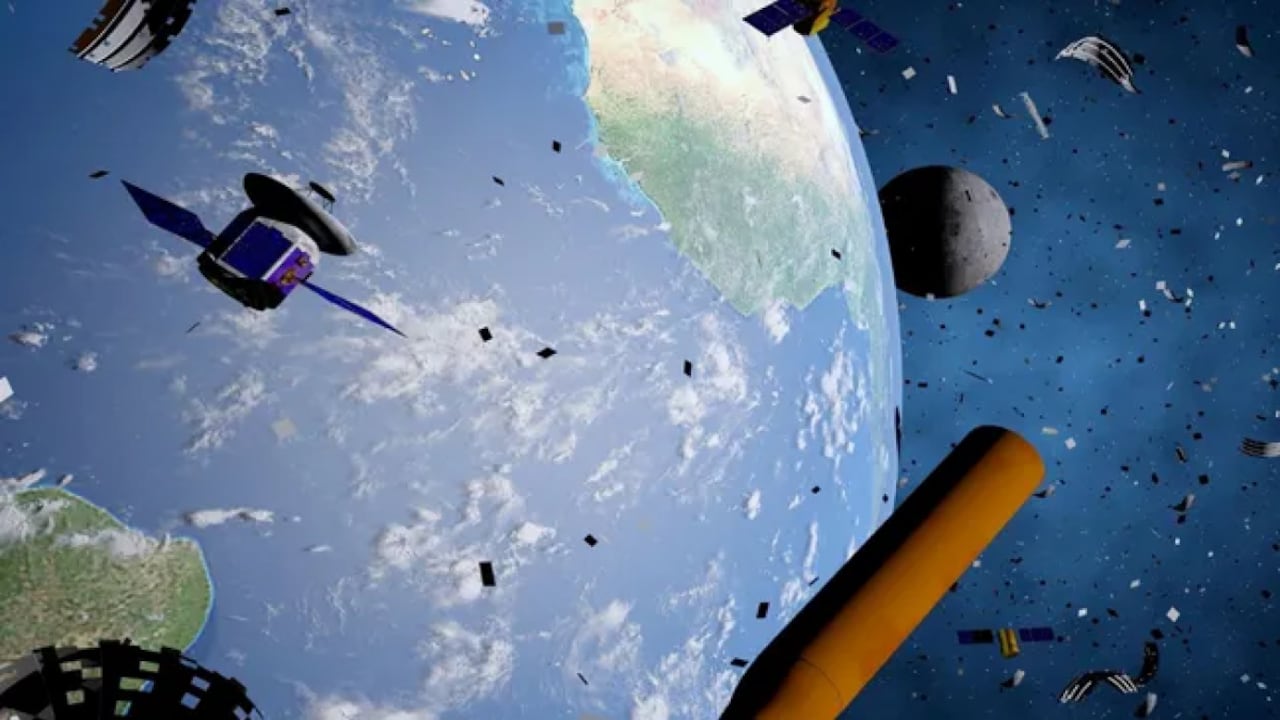
Right now, as you read these words, a multi-ton cylinder of spent titanium and aerospace-grade aluminum is falling blindly through the upper stratosphere.
It has no engine. It has no pilot. It possesses no functional radio to warn air traffic control or maritime authorities of its impending arrival. Somewhere between five and six times every single week, massive pieces of uncontrolled orbital hardware complete their decaying descent and punch through Earth's atmosphere. This is not a theoretical model or a science fiction projection. It is a mathematical certainty born from decades of commercial space expansion, and it happens completely out of sight.
The public perception of space debris remains frozen in the cinematic imagery of tiny metal flakes pitting a satellite window. The reality is far heavier and much more chaotic. According to tracking data from the European Space Agency and independent aerospace analysts, roughly 100 to 120 metric tons of uncontrolled space junk reenter the atmosphere annually. Objects weighing between 500 and 2,000 kilograms fall completely unguided every seven days.
The statistics are staggering, yet they provoke a collective shrug from regulatory bodies worldwide. Why? Because space is vast, and the ocean covers most of it. But relying on planetary geography to act as a safety net is a strategy running out of time.
The Blind Physics of Orbital Decay
To understand why every week brings a fresh wave of falling metal, you have to look at how low Earth orbit operates. Low Earth orbit functions as a celestial highway choked with traffic that has nowhere to pull over when it breaks down.
When a rocket delivers a commercial satellite or a military payload to orbit, it typically discards its upper stage. Historically, space agencies treated these spent stages as temporary waste. Left unpropelled, atmospheric drag slowly asserts itself. Over months or years, air molecules drag against the metal hull, decaying the orbit until gravity pulls the object down.
The physics of this descent are brutal. When an object hits the thermosphere at 28,000 kilometers per hour, kinetic energy transforms into extreme heat. The surrounding air molecules compress so violently that temperatures soar past 1,500 degrees Celsius.
For a hypothetical example, consider an empty rocket booster weighing two metric tons. As it drops, thin titanium skins vaporize instantly. However, heavy fuel tanks, thick engine bells, and dense actuator blocks resist the heat. These survive the fiery gauntlet, shedding mass while turning into molten, supersonic shrapnel.
The trouble is not that things burn up. The trouble is that we cannot predict where the surviving chunks will hit.
The Margin of Error That Threatens Cities
Ask any orbital dynamics specialist about reentry prediction windows, and they will tell you about the horizon of uncertainty. Even with the advanced radar networks maintained by the military and specialized space surveillance centers, predicting the exact touchdown point of an uncontrolled object remains an imprecise science.
Models carry a mean relative error of 20 to 30 percent. When applied to an object orbiting at hyper-velocities, that percentage translates into a massive temporal and spatial gap. A miscalculation of just twenty minutes means the debris object will land thousands of kilometers away from its projected path.
Consider a real-world parallel from recent years. When massive core stages from heavy-lift rockets tumble back to Earth uncontrolled, global space agencies track them with white-knuckled intensity. Newspapers publish countdown clocks. Governments issue warnings to commercial airlines. Yet, the definitive impact corridor often spans multiple continents until mere hours before the crash.
Most fragments plunge safely into the Pacific or Atlantic oceans, burying themselves in silent trenches. Others do not. Over the years, unguided debris has landed on inhabited farms, punched through residential roofs, and scattered across remote terrain. The mathematical probability of a direct casualty during any single event remains low, but a low probability multiplied by a rising weekly frequency alters the risk equation entirely.
The Regulatory Vacuum
The core failure driving this weekly deluge is not technological. It is regulatory.
International space law remains anchored to treaties drafted in an era when only two superpowers lofted a handful of metal cans into orbit per year. The foundational framework, including the 1967 Outer Space Treaty, holds launching states liable for surface damage caused by their space objects. But liability after the fact is a poor substitute for prevention.
NASA maintains a safety standard dictating that any new spacecraft or rocket stage must be designed to ensure that the casualty risk for any single uncontrolled reentry is less than one in 10,000. It is a sensible metric on paper. The glaring flaw? That standard carries no binding international legal force.
Emerging spacefaring nations and aggressive commercial launch providers face immense financial incentives to cut corners. Designing a rocket with a controlled deorbit system—featuring precise fuel reserves, restartable engines, and targeted burn profiles—adds weight, reduces payload capacity, and costs money. Opting for a passive, uncontrolled drop is cheaper. As long as compliance remains voluntary, profit-driven entities will choose the cheaper path, passing the environmental and physical risk down to the surface of the planet.
The Atmospheric Pollution Nobody Measures
The physical threat of a falling chunk of titanium is only half the crisis. A secondary, less visible catastrophe occurs higher up, written into the chemical composition of the upper atmosphere itself.
As hundreds of tons of defunct satellites and rocket stages vaporize in the mesosphere and thermosphere each year, they deposit massive quantities of metallic oxides directly into the atmosphere. Recent atmospheric sampling studies have detected distinct plumes of aluminum, lithium, copper, and exotic shielding metals accumulating where none belonged before.
This particulate buildup changes the chemistry of the upper atmosphere. Scientists are discovering that these metal aerosols create condensation nuclei for polar mesospheric clouds, potentially altering reflective properties and ozone chemistry in ways we barely understand. We are turning our planet's protective atmospheric shield into an industrial incinerator exhaust pipe, trusting that the system can absorb an infinite quantity of toxic space debris ash.
The Inevitability of Reform
The cadence of falling debris cannot continue its exponential climb without forcing a reckoning. When launch providers doubled down on mega-constellations and high-frequency cadences, they assumed the sky had infinite volume. It does not.
Fixing this structural failure requires an enforcement mechanism that treats orbit management like terrestrial aviation. Airplanes cannot fly without a flight plan, an airworthiness certificate, and a certified method of safe disposal. Rockets and satellites should face identical standards. Mandatory active deorbit kits, strict accountability for core stages, and heavy financial penalties for untracked hardware must replace toothless guidelines.
The next time a metric ton of heavy industrial waste streaks across the night sky, remember that it is not a shooting star. It is a symptom of an industry operating without guardrails, waiting for a catastrophe large enough to force change