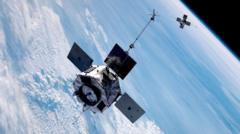
NASA is letting a 1,300-pound hunk of metal fall from the sky. The headlines are already dripping with the usual "what if" scenarios, calculated risks, and the faint, breathless hope of a disaster that won't happen. They want you to look at the reentry of a retired satellite as a failure of stewardship or a looming threat to terrestrial life.
They are wrong.
The real danger to our orbital infrastructure isn't the stuff that falls down. It’s the stuff that stays up. If we want a functional future in Low Earth Orbit (LEO), we don't need fewer reentries; we need a massive, aggressive increase in them. We shouldn't be mourning the "death" of a satellite or fearing its atmospheric cremation. We should be celebrating the fact that it’s finally getting out of the way.
The Myth of the Falling Sky
Every time a decommissioned craft like the RHESSI (Reuven Ramaty High Energy Solar Spectroscopic Imager) or a similar-sized bus heads for a terminal plunge, the media treats it like a game of Russian roulette. They quote the "1 in 2,467" odds of someone getting hit.
Let’s dismantle that math.
Earth has a surface area of roughly 197 million square miles. Most of that is water. Most of the land is uninhabited. The atmospheric friction at orbital velocities—roughly 17,500 mph—is a brutal, efficient incinerator.
When a satellite hits the "Entry Interface" at approximately 400,000 feet, it isn't just falling; it is being subjected to plasma temperatures exceeding 3,000°F. Aluminum melts at 1,221°F. Most of these "threats" turn into harmless vapor long before they could ever dent a roof in the suburbs. The components that do survive—typically titanium tanks or stainless steel housings—are the exceptions, not the rule.
The focus on the "risk" of reentry is a classic distraction. It’s a way for agencies to look responsible while ignoring the escalating catastrophe of orbital congestion.
The Kessler Syndrome is Not a Theory
While the public worries about a piece of charred metal landing in a field, the industry is terrified of the "Kessler Syndrome." Proposed by NASA scientist Donald Kessler in 1978, this is the tipping point where the density of objects in LEO is high enough that one collision creates a cloud of debris that triggers a chain reaction of further collisions.
We are already there.
The "lazy consensus" suggests we can manage this with better tracking and "Space Traffic Management." That is a fantasy. You cannot manage 30,000 pieces of trackable debris—and millions of untrackable flecks of paint and frozen coolant—traveling at ten times the speed of a high-velocity rifle bullet.
Every satellite that finishes its mission and doesn't re-enter immediately is a ticking time bomb. It is a massive kinetic energy reservoir waiting to be converted into a shotgun blast of shrapnel. When a competitor's article focuses on the "1,300 pounds" falling to Earth, they ignore the 1,300 pounds that might stay in orbit for another century, effectively blockading future launches.
Why 25 Years is a Death Sentence
For decades, the "gold standard" for satellite disposal was the 25-year rule: operators were expected to de-orbit their craft within a quarter-century of mission completion.
This is an archaic, negligent policy.
In 2026, the density of "Mega-constellations" like Starlink and Kuiper makes a 25-year grace period look like an invitation to disaster. I have spoken with mission planners who privately admit that leaving a dead bird in LEO for two decades is essentially orbital littering on a planetary scale.
The FCC finally pushed to shorten this to five years, but even that is too slow. If a satellite stops paying its rent (functioning), it needs to be evicted immediately. We should be mandating active de-orbit systems—electrodynamic tethers or dedicated propulsion reserves—on every single piece of hardware launched. If you can't afford the fuel to bring it down, you can't afford to go up.
The High Cost of "Safety" Obsession
The obsession with "controlled" versus "uncontrolled" reentry is another area where the industry is gaslighting the public.
A controlled reentry requires massive amounts of fuel to perform a targeted burn, ensuring the craft hits a specific "spacecraft cemetery" like Point Nemo in the Pacific. This is expensive. It reduces the payload capacity and the mission life.
Because of this, we see a trend toward "design for demise." Engineers are moving away from robust, heat-resistant materials toward materials that vaporize more easily. While this sounds great for the people on the ground, it creates a new problem: high-altitude metal pollution.
We are dumping tons of alumina (aluminum oxide) into the stratosphere every year as these "safe" satellites burn up. This stays in the upper atmosphere, potentially reflecting sunlight and affecting the ozone layer. We’ve traded the one-in-a-billion chance of a physical strike for a 100% certainty of atmospheric chemistry alteration.
The Missing Link: On-Orbit Recycling
The real contrarian take? We shouldn't be burning these things at all.
Reentry is a waste of refined, space-hardened materials that cost $10,000 per pound to launch. Dismantling a 1,300-pound NASA satellite and using its chassis or solar arrays for a new orbital station is the only logical path forward.
We talk about "sustainability" on Earth while practicing a "launch and abandon" philosophy in the most expensive real estate we own. Companies like Astroscale and ClearSpace are starting to look at active debris removal, but the business model is broken. Nobody wants to pay to pick up their own trash when they can just let it drift until it becomes someone else's collision warning.
If we don't shift toward orbital manufacturing and recycling, the "threat" of a satellite falling to Earth will be the least of our worries. We will be trapped on this planet, not by gravity, but by a shell of our own garbage that makes any launch a suicide mission.
Your Fear is Misplaced
Next time you see a notification about a "massive" spacecraft re-entering the atmosphere, don't look for cover. Look for the hundreds of other dead satellites that didn't fall.
The NASA craft isn't a threat; it’s a success story. It’s a piece of the orbital puzzle that is finally being cleared off the board. The real villains are the silent, cold hulks still circling overhead, invisible until they turn a multi-billion dollar GPS network into a cloud of dust.
Stop worrying about the 1,300 pounds coming down. Start demanding the removal of the 9,000 tons staying up.
Fix the orbit or lose the sky.