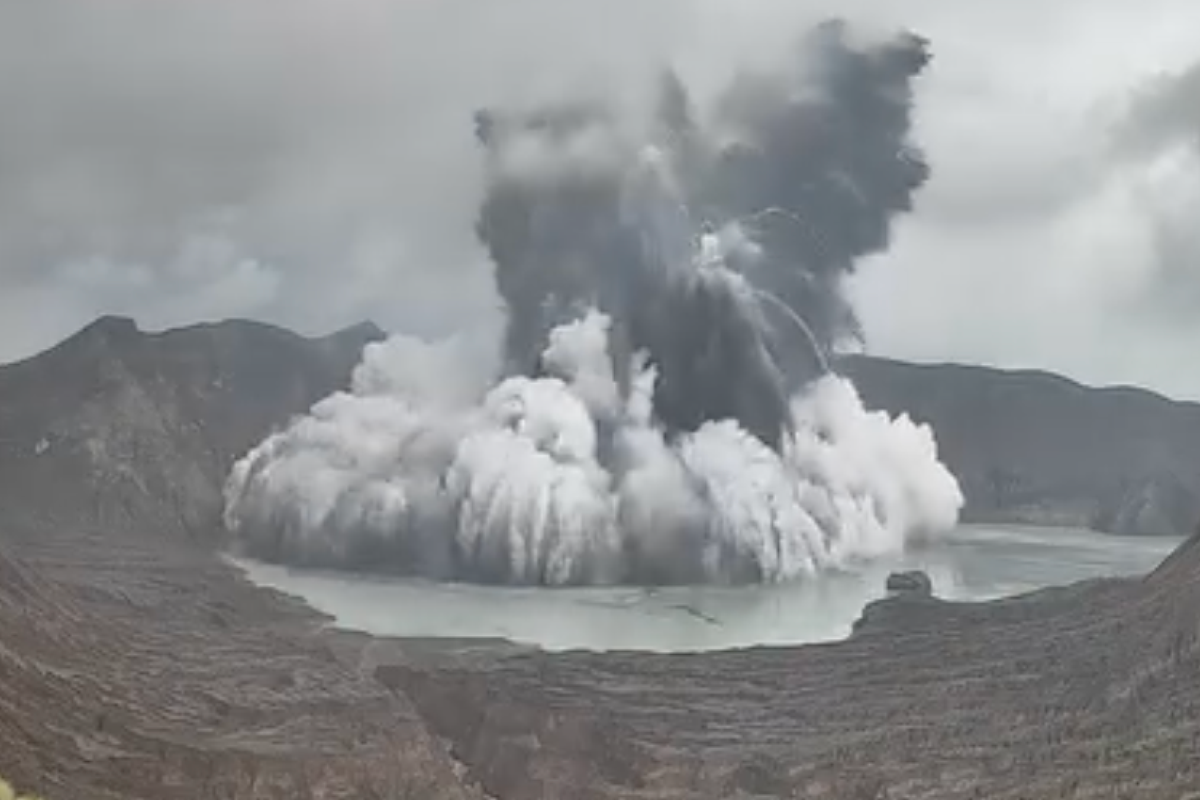
Mainstream media loves a good crisis broadcast. When a volcano in the Philippines shoots a column of steam and grey ash into the stratosphere, the cameras arrive instantly. The headlines write themselves. They call it a "spectacular explosion." They use words like "furious" and "cataclysmic." They anchor their coverage on thirty seconds of dramatic drone footage showing water and ash tearing through a tropical sky.
It is pure theater. It is also completely missing the point. For a deeper dive into this area, we suggest: this related article.
The recent coverage of phreatic eruptions in the Pacific Ring of Fire exposes a massive flaw in how the public consumes natural hazard data. Newsrooms treat volcanoes like giant, unpredictable bombs waiting to obliterate civilization. They focus entirely on the visible, airborne vertical column because it generates clicks.
But if you talk to volcanologists who actually spend their lives tracking magma movement, they will tell you a very different story. The dramatic explosion of water and ash you see on your feed is rarely the actual hazard that devastates communities. By obsessing over the visual spectacle of steam-driven blasts, the media actively distracts from the quiet, systemic dangers that actually kill people and ruin infrastructure. To get more information on this topic, comprehensive reporting can also be found at Al Jazeera.
We need to stop looking at the sky and start looking at the ground.
The Chemistry Deficit Analyzing Phreatic vs Magmatic Reality
To understand why standard reporting is broken, you have to understand the fundamental physics of a volcanic event. Media outlets routinely conflate a phreatic eruption with a magmatic one. They see a cloud of gray matter and assume the mountain is tearing itself apart from deep mantle pressure.
It isn't.
A phreatic eruption is essentially a glorified pressure cooker failure. It occurs when groundwater or surface water is rapidly heated by underlying magma, hydrothermal systems, or hot rocks. The water flashes to steam. Because steam occupies roughly 1,600 times the volume of liquid water, the sudden expansion shatters the surrounding solid rock, blasting a mix of steam, water, and old volcanic fragments into the air.
No new magma is involved. The volcano is merely clearing its throat.
Compare this to a true magmatic eruption, where fresh, gas-rich molten rock rises to the surface, undergoes decompression, and violently degasses. That is where real kinetic energy and long-term geographic displacement come from.
When a outlet publishes a headline screaming about a "spectacular explosion of water and ash," they are marveling at a hydrothermal burp. They are treating a symptom of subsurface plumbing as if it were the main event. This creates a dangerous loop where the public panics over minor steam vents while remaining completely oblivious to the far more destructive forces brewing beneath the surface.
The Real Killer The Invisible Menace Of Lahars And Gas
If the spectacular ash plume isn't the primary threat to life, what is?
Ask any veteran of the 1991 Mount Pinatubo disaster or the frequent crises around Mayon and Taal. The real destruction rarely happens during the live television broadcast. It happens months, sometimes years, after the initial eruption has left the news cycle.
The Lethal Mechanics of Lahars
A lahar is a volcanic mudflow. It is a dense, concrete-like slurry of pyroclastic material, rocky debris, and water that rushes down river valleys at speeds exceeding 40 miles per hour.
Imagine a river of wet cement, moving faster than a sprinting athlete, carrying boulders the size of houses. It does not simply coat a village in dust; it erases it from the map.
[Volcanic Ash on Slopes] + [Heavy Tropical Rainfall] = Lahar Mudflow
The trigger for a lahar is not a dramatic subterranean explosion. It is a completely mundane weather event: a tropical monsoon or a typhoon. When heavy rains hit a volcanic slope covered in loose ash, the water mobilizes the debris.
The media leaves when the ash stops falling. The residents, however, are left facing a ticking time bomb. A region can experience devastating lahars for a decade after a single significant volcanic event. Yet, because a mudflow moving through a rural valley lacks the cinematic appeal of a vertical ash column piercing the clouds, it receives a fraction of the international attention.
Silent Asphyxiation
Then there is the gas. Magma contains dissolved gases that are released as it rises and depressurizes. The main culprits are water vapor, carbon dioxide, and sulfur dioxide.
Carbon dioxide is heavier than air. It does not shoot into the atmosphere in a spectacular display. It pools. It flows silently down the contours of the mountain, settling into low-lying areas, valleys, and depressions.
It is completely invisible. It has no smell.
A community can wake up in the middle of the night suffocating because an invisible cloud of carbon dioxide has quietly rolled down the mountainside and displaced the oxygen in their homes. In 1986, Lake Nyos in Cameroon experienced a limnic eruption, releasing a massive cloud of carbon dioxide. It killed over 1,700 people and thousands of livestock in minutes. No dramatic explosion. No fiery lava. Just a silent, heavy gas.
When we focus our hazard awareness entirely on the visual cue of an ash plume, we train people to look for the wrong warning signs.
The Hazard Map Fallacy Why Visual Boundaries Mislead
Go to any local disaster management website and look at their volcanic hazard maps. You will see neat, concentric circles drawn around the crater. These are typically labeled as Permanent Danger Zones, High-Risk Zones, and Moderate-Risk Zones.
These maps offer a comforting illusion of precision. They imply that if you are standing 200 meters outside the red line, you are safe.
This is a dangerous bureaucratic fiction.
Volcanic hazards do not respect neat geometric shapes. Topography dictates risk far more than simple distance from the vent. A valley located fifteen kilometers away from a volcano can be infinitely more dangerous than a high ridge situated only five kilometers away, simply because the valley acts as a natural chute for lahars and pyroclastic density currents.
Furthermore, these maps are often based on historical precedents that may no longer apply. Volcanoes change their own internal structure with every event. An explosion can blast away a portion of the crater wall, completely shifting the direction of future flows.
By presenting the public with static, generalized maps, authorities inadvertently encourage complacency outside the designated zones. When a phreatic event occurs, people look at the map, see they are in the "green zone," and assume they can safely stand on their roofs to film the spectacular view. They fail to realize that the ground beneath them could become a hyper-concentrated debris flow within an hour if a rainstorm hits the upper slopes.
Dismantling The People Also Ask Conventional Wisdom
To fix our understanding of volcanic risk, we have to dismantle the bad questions that drive public perception. The queries typed into search engines during an eruption show exactly how skewed our collective knowledge has become.
Is it safe to fly through volcanic ash?
The short answer is absolutely not, but the reason given by mainstream outlets is usually wrong. The common belief is that ash blinds pilots or clogs the windshields.
The actual danger is chemical and thermal. Volcanic ash is not soft like burned wood. It consists of microscopic fragments of jagged rock, minerals, and volcanic glass.
Inside a commercial jet engine, temperatures exceed 1,400 degrees Celsius. The melting point of the silicate glass in volcanic ash is roughly 1,100 degrees Celsius. When an aircraft flies through an ash cloud, the glass fragments are sucked into the engine, where they instantly melt. This molten glass then coats the interior components, including the turbine blades, blocking the cooling air holes and causing the engine to flame out.
It turns a multi-million-dollar piece of engineering into a useless chunk of metal mid-flight. It is an engineering nightmare, not a visibility issue.
Why don't we just divert the lava?
This question pops up every time a Hawaiian or Icelandic eruption threatens a town. The media loves covering historical attempts to bomb lava tubes or build earthen barriers. They frame it as a heroic battle between human ingenuity and nature.
In reality, diverting lava is almost always an exercise in futility and legal liability.
To successfully divert a lava flow, you need two things: an incredibly specific type of slow-moving basaltic lava, and somewhere else to put it. If you build a barrier to protect Town A, you are inevitably directing that molten rock toward Town B or destroying valuable agricultural land. The resulting legal battles, insurance claims, and geopolitical disputes are often more destructive than the lava itself.
More importantly, most deadly volcanoes do not erupt slow, predictable lava flows. The stratovolcanoes of the Philippines, Indonesia, and Central America erupt highly viscous, gas-rich material that tends to explode or form unstable domes that collapse into lethal, fast-moving pyroclastic currents. You cannot build a wall to stop an avalanche of gas and ash moving at hundreds of miles per hour.
The Cost of Clickbait How Sensationalism Harms Funding
The hyper-focus on spectacular visual events has a direct, negative impact on global science funding and disaster mitigation.
Governments and international aid organizations are reactive entities. They respond to what is visible. When a volcano produces a massive, photogenic ash plume, funding pours in for immediate relief, evacuation shelters, and high-visibility recovery efforts.
But the real work of volcanology happens during the quiet decades. It involves installing expensive broadband seismometers, maintaining tiltmeters, analyzing gas chemistry at remote fumaroles, and educating local communities on topography-based escape routes.
[Media Sensationalism] -> [Reactive Crisis Funding] -> [Neglect of Quiet Monitoring] -> [Higher Casualty Rates]
This unglamorous infrastructure is constantly underfunded. When a volcano is quiet, politicians see monitoring networks as a waste of tax dollars. They do not understand that the data collected during periods of absolute calm is exactly what allows scientists to detect the subtle, underground changes that signal a future eruption.
By framing volcanic events as sudden, unpredictable, spectacular explosions, the media perpetuates the myth that these events cannot be forecasted. This lets negligent governments off the hook for failing to fund long-term monitoring networks. If an eruption is a "unforeseeable act of God," then no one is to blame when a town is caught unprepared.
But with adequate funding for telemetry and geochemical analysis, most major magmatic events can be anticipated weeks in advance.
Moving Beyond The Spectacle
Stop clicking on the dramatic drone footage of ash clouds. Stop treating these complex geological plumbing systems as if they were fireworks displays designed for your entertainment.
The next time you see a headline about a spectacular eruption in the Philippines or anywhere else on the globe, do not look at the height of the ash column. Look at the local weather radar to see if rain is falling on the slopes. Look at the wind direction to see where the sulfur dioxide is drifting. Look at the topography maps to identify the river valleys that will inevitably channel the next lahar.
True situational awareness means ignoring the spectacle and tracking the system. The mountain does not care about the cameras. It follows the laws of thermodynamics, fluid dynamics, and gravity. If we want to survive its shifts, we need to start doing the same.


