The smell of hot iron never really leaves your skin. Even after a hot shower and three separate applications of lemon juice, the gray residue of the shipyard stays trapped in the micro-cracks of your knuckles. You taste zinc when you breathe too deeply.
For forty years, building a ship meant baking your lungs in toxic fumes and praying the crane operator two hundred feet above your head didn't misjudge a three-ton block of carbon steel by a single centimeter. It is backbreaking, ear-shattering, terrifying work.
And then you watch a blind machine do it better.
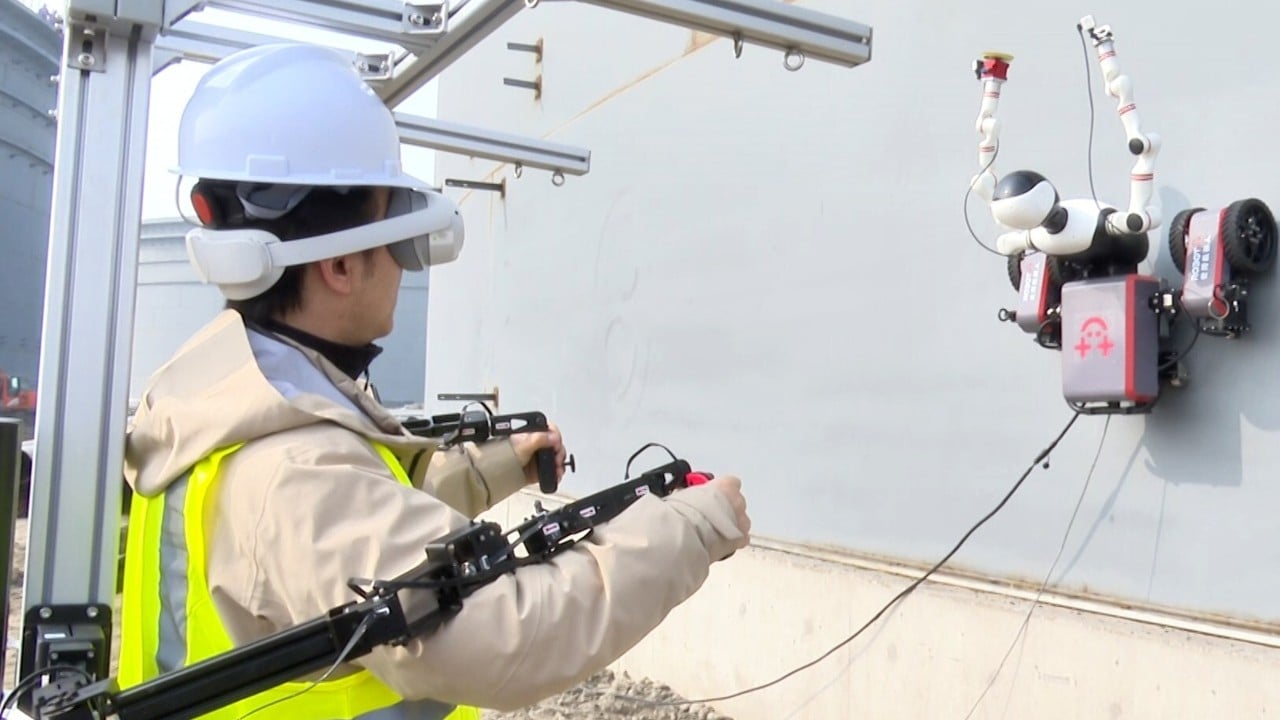
Across the sprawling coastlines of East Asia, a silent revolution is unspooling inside massive, cathedral-like assembly halls. These are not the traditional automobile plants where yellow arms weld doors with hypnotic precision. These are shipyards. And the machines moving through them are something entirely different: heavy-duty, magnetic-footed, autonomous mechanical workers designed to scale vertical hulls, crawl inside cramped ballast tanks, and lift massive plates with the gentle touch of a watchmaker.
For decades, robotics experts ignored the maritime sector. They chased the low-hanging fruit. Consumer electronics, clean automotive floors, and structured warehouse aisles. Shipyards were deemed too chaotic, too wet, too rusty, and too unpredictable for delicate electronics. Every hull is slightly different. Every weld has its own unique geometry. The environment changes with the tide, the temperature, and the salty air.
Yet, necessity forced a breakthrough.
Labor shortages swept through heavy manufacturing like a slow-moving drought. Young workers refused the welding torch and the deafening noise of the berth. They wanted air conditioning, screens, and futures that did not involve chronic lower-back surgery by age forty. Faced with a shrinking workforce and a massive global backlog of commercial cargo vessels, container ships, and green-energy tankers, shipbuilders had to look elsewhere.
They looked to specialized automation.
Consider what happens inside a modern drydock today. A steel plate the size of a tennis court arrives from the mill. In the old days, a crew of six would spend an entire shift grinding rust, applying primer, and manually checking tolerances. Now, tracked crawler units equipped with multi-spectral vision systems glide across the metal surface. They map imperfections down to the fraction of a millimeter, clear away debris with abrasive water jets, and apply protective coatings with absolute uniformity.
No human hand touches the plate until it is ready for placement.
This shift is not merely about replacing manual labor with cheaper silicon. It is about physical survival. Shipyards have historically ranked among the most dangerous workplaces on Earth. Confined space asphyxiation, falling objects, flash fires, and toxic paint mists form a daily gauntlet. When a magnetic crawler climbs into the pitch-black double bottom of a hull to inspect a weld, it takes a risk that no human should ever have to bear.
The financial calculus is equally stark. A commercial container ship costs hundreds of millions of dollars to commission. Every day a vessel sits in drydock past its delivery deadline translates to staggering financial penalties for the builder. By deploying heavy-payload robotic gantries that operate twenty-four hours a day without fatigue, shipyards have slashed construction timelines by weeks, sometimes months.
Critics often look at this transition through a lens of pure anxiety. They see machines moving through industrial bays and picture empty towns, broken communities, and lost traditions. That perspective, while understandable, misses the deeper reality on the ground.
When you speak to a master welder who has spent thirty years in the yard, their reaction to automation is rarely anger. It is relief.
Take Chen, a veteran fabrication lead at a massive facility near the mouth of the Yangtze. His hands are thick, scarred maps of a lifetime spent fighting metal. When the facility introduced its first fleet of autonomous welding crawlers three years ago, Chen was skeptical. He thought the programmers were desk-bound kids who didn't understand the subtle personality of hot steel.
He was wrong.
The machines took over the endless, mind-numbing fillet welds on flat panels—the repetitive, posture-destroying work that turns shoulders to dust. Chen was promoted. He now oversees a team of diagnostic technicians, programming the very machines that used to threaten his livelihood. He spends his days analyzing thermal imaging data on a tablet, troubleshooting path errors, and mentoring younger technicians who are learning the physics of robotics rather than just the swing of a hammer.
He tells you, with a slow, knowing smile, that he hasn't coughed up gray phlegm in two years.
This is the hidden mechanics of industrial evolution. It rarely arrives as a sudden apocalypse. It arrives as a gradual, grinding transformation of what it means to work with your hands. The hardware itself is a marvel of modern engineering. Because ship hulls are made of ferromagnetic materials, the new generation of shipyard robots utilize powerful rare-earth permanent magnets combined with active separation controls. They stick to vertical steel walls as if they were walking across a hardwood floor, carrying heavy welding heads and plasma cutters without breaking their grip, even when the hull vibrates from external hammering.
The software guiding them is equally sophisticated. Standard industrial robots require rigidly controlled environments where every variable is fixed. Shipyards refuse to cooperate with such neatness. Ships flex in the sun. Wind blows through open drydocks. Plates warp under the intense heat of an electric arc.
To solve this, engineers integrated real-time adaptive sensing. As a robot moves along a seam, it uses laser triangulation and acoustic sensors to measure the joint gap on the fly. If the metal expands by half a millimeter due to the midday sun, the machine adjusts its wire feed speed and voltage instantly. It improvises. It thinks, in its own cold, silicon way, about the material it is shaping.
The global race for maritime dominance is shifting because of this technology. Countries with high labor costs and aging populations—nations that once feared they could never compete with low-wage shipbuilders—are finding a new footing. When you remove the human body's physical limitations from the equation, geography matters less. Capital investment, sensor accuracy, and software reliability become the primary currencies of trade.
Look out over the water at dusk.
A massive twelve-thousand-TEU container ship sits at the outfitting pier, its towering hull painted a stark, unblemished red. High above the deck, amber warning lights blink on the booms of automated cranes. Down below, inside the cavernous hull, autonomous vehicles hum softly as they transport components through labyrinthine corridors of steel.
No one is shouting. No one is coughing.
The air smells clean, swept by heavy-duty ventilation systems designed to protect the machines and the few human supervisors watching over them from climate-controlled control rooms.
We are building the backbone of global commerce differently now. We are pouring our sweat into code, our precision into sensors, and our ambition into magnets that cling to the dark side of the hull. The work is no less grand. It is simply heavier, safer, and entirely re-engineered for a world that can no longer afford to break the people who build it.