The air inside the Combat Information Center of a guided-missile destroyer doesn’t smell like the ocean. It smells like ozone, recycled breath, and the faint, metallic tang of electronics running hot. There are no windows. There is only the glow of blue and green phosphor screens, casting a ghostly light on the faces of sailors who haven't seen the sun in fourteen hours.
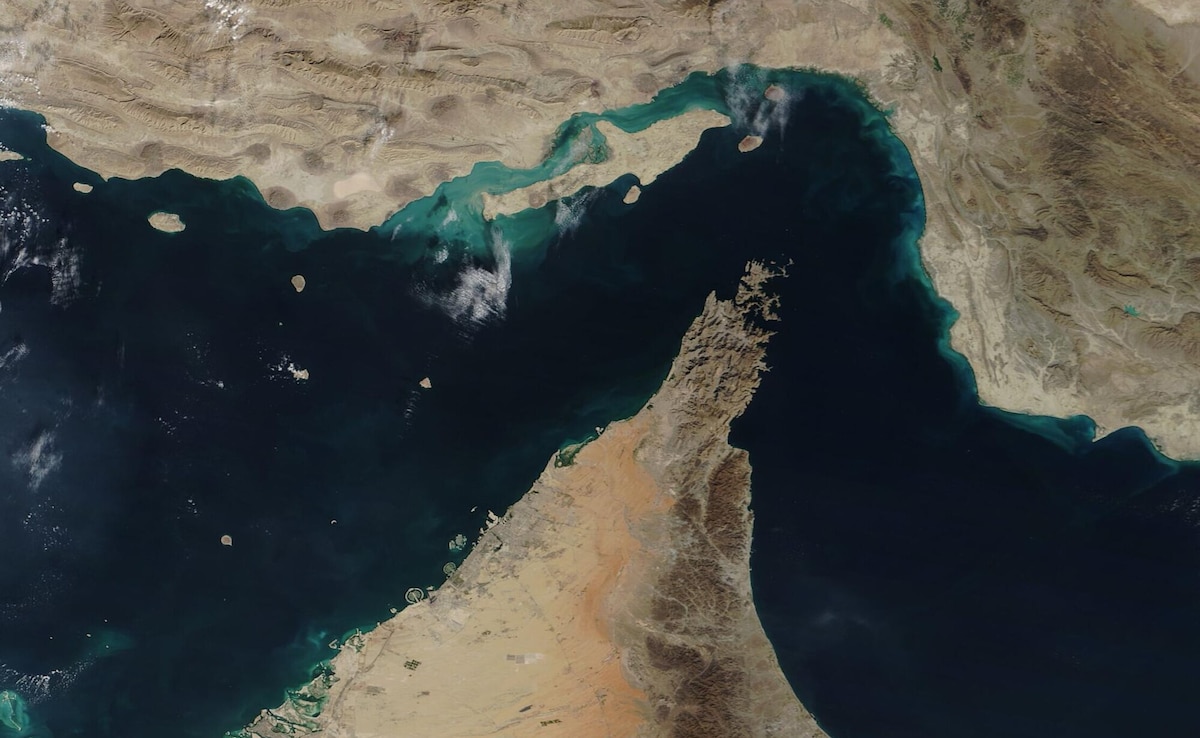
Below the waterline, the hull groans. It is a low, rhythmic protest against the pressurized currents of the Strait of Hormuz.
For the first time since the sparks of the Iran war caught fire and began to consume the region, two United States warships have turned their bows into this narrow throat of water. They aren't just moving through a geography. They are walking a tightrope stretched over a powder keg.
To the left, the jagged, sun-bleached cliffs of Iran. To the right, the Musandam Peninsula of Oman. At its narrowest, the strait is only twenty-one nautical miles wide. When you factor in the shipping lanes—the two-mile-wide "highways" that keep the world's economy from collapsing—the margin for error shrinks until it is almost microscopic.
One wrong twitch of a radar signature, one over-eager drone pilot on the coast, and the geography becomes a graveyard.
The Invisible Weight of the World
Think of the Strait of Hormuz not as a waterway, but as a carotid artery. Through this single, cramped passage flows roughly one-fifth of the world’s total oil consumption. When a ship transit happens here, it isn't just a military maneuver. It is a pulse check for global stability.
When the war began, the strait became a ghost town for Western gray hulls. The risk was deemed too high, the tension too thick. But staying away has its own cost. Silence can be mistaken for absence. Absence can be mistaken for weakness.
The decision to send these two ships—a destroyer and a littoral combat ship—wasn't made by a computer. It was weighed by people in wood-paneled rooms in D.C. and humid command centers in Bahrain. They knew that by entering these waters, they were forcing a confrontation with a fundamental question: Who actually owns the right to move?
Consider a young sonar technician, let’s call him Miller. Miller is twenty-two. He’s from a landlocked town in Nebraska where the loudest sound is a passing freight train. Now, he sits with high-fidelity headphones pressed to his ears, listening to the "biologicals" of the Persian Gulf—the clicks of snapping shrimp and the low moans of whales.
But he isn't listening for nature. He is listening for the rhythmic thrum-thrum-thrum of a Kilo-class submarine sitting on the sandy bottom, waiting. He is listening for the high-pitched whine of fast-attack boats—small, nimble craft that swarm like hornets. In this narrow channel, the billion-dollar advantage of a US warship is compressed. You can't use long-range eyes when the threat is close enough to see with a pair of binoculars.
The Geography of Tension
The transit is a choreographed dance of high-stakes boredom. For hours, nothing happens. The radar sweep goes round and round. The bridge team drinks lukewarm coffee. They watch the Iranian Revolutionary Guard boats shadow them from a distance, dark shapes skipping across the wake.
This is the "gray zone." It is the space between peace and total kinetic disaster.
The Iranian war has changed the calculus of these waters. Previously, these transits were routine, almost mundane exercises in "Freedom of Navigation." Now, every ping of a laser rangefinder or every radio challenge in Persian carries the weight of a potential escalation. The crew operates under "Condition Zebra"—all watertight doors sealed. They are a series of steel boxes inside a larger steel box, waiting to see if the world holds its breath or lets it out in a scream.
Critics often ask why we bother. Why put three hundred lives and two billion dollars of taxpayer hardware into a funnel where the enemy holds all the high ground?
The answer is found in your gas station, your grocery store, and your light switch. The global economy is a delicate, interconnected web of "just-in-time" delivery. If the Strait of Hormuz closes, the shockwaves don't just stay in the Middle East. They hit the truck driver in Ohio who can no longer afford diesel. They hit the factory in South Korea that loses its power supply.
By sailing through, these ships are acting as a physical shield for the concept of international law. They are saying, with thirty thousand tons of steel, that the commons belong to everyone.
The Human Toll of the Watch
There is a specific kind of exhaustion that comes from high-readiness transit. It isn't the exhaustion of manual labor; it’s the draining of the adrenal glands.
On the bridge, the Officer of the Deck stares through the glass. The heat shimmer off the Iranian coast makes the land look like it’s melting into the sea. Every fishing dhow is a question mark. Is it a father and son looking for tuna, or is it a scout vessel packed with explosives?
The crew doesn't get to "turn off." They live in a state of hyper-vigilance where a seagull diving for a fish can look, for a split second, like a descending loitering munition.
This is the first time since the war broke out that the US has decided the risk of staying out is finally eclipsed by the necessity of being in. It is a signal to allies that the lanes are open, and a signal to adversaries that the "No-Go" zones have been revoked.
But signals are dangerous things. They require someone on the other side to interpret them correctly.
As the two ships cleared the narrowest point of the strait and broke out into the wider expanse of the Arabian Sea, there was no cheering. There was no mission-accomplished banner. There was only the "Pipe"—the boatswain's whistle over the intercom—announcing a shift in the watch.
Miller took off his headphones. His ears were red and sore. He stepped out onto the "Vulture’s Row" walkway to catch a breath of air. It was 110 degrees, humid enough to feel like a wet wool blanket, and smelled of salt and diesel.
He looked back toward the horizon where the cliffs of the strait were disappearing into the haze. He knew that in a few days, or a few weeks, they would have to turn around and do it all again.
The ships are home now, or at least in safer water. But the strait remains. It is a jagged, narrow gate in the earth, and as long as the world runs on the liquid fire that beneath those sands, young men and women will continue to sail into the throat of the dragon, praying that today isn't the day the dragon decides to swallow.
The steel stayed strong this time. The sieve held.
Behind them, the wake of the two warships began to smooth over, erased by the restless, ancient currents of the Gulf, leaving no trace that they were ever there, save for the silent, tense relief of a world that gets to keep turning for one more day.



