Ask an old man in the narrow lanes of Tashkent where the wind comes from, and he will not point to the mountains. He will point to the dust on his boots, ancient and fine, carried across borders that maps tried to fix with ink but time continually smeared away.
History is rarely a straight line. Most of the time, it is a circle waiting to close.
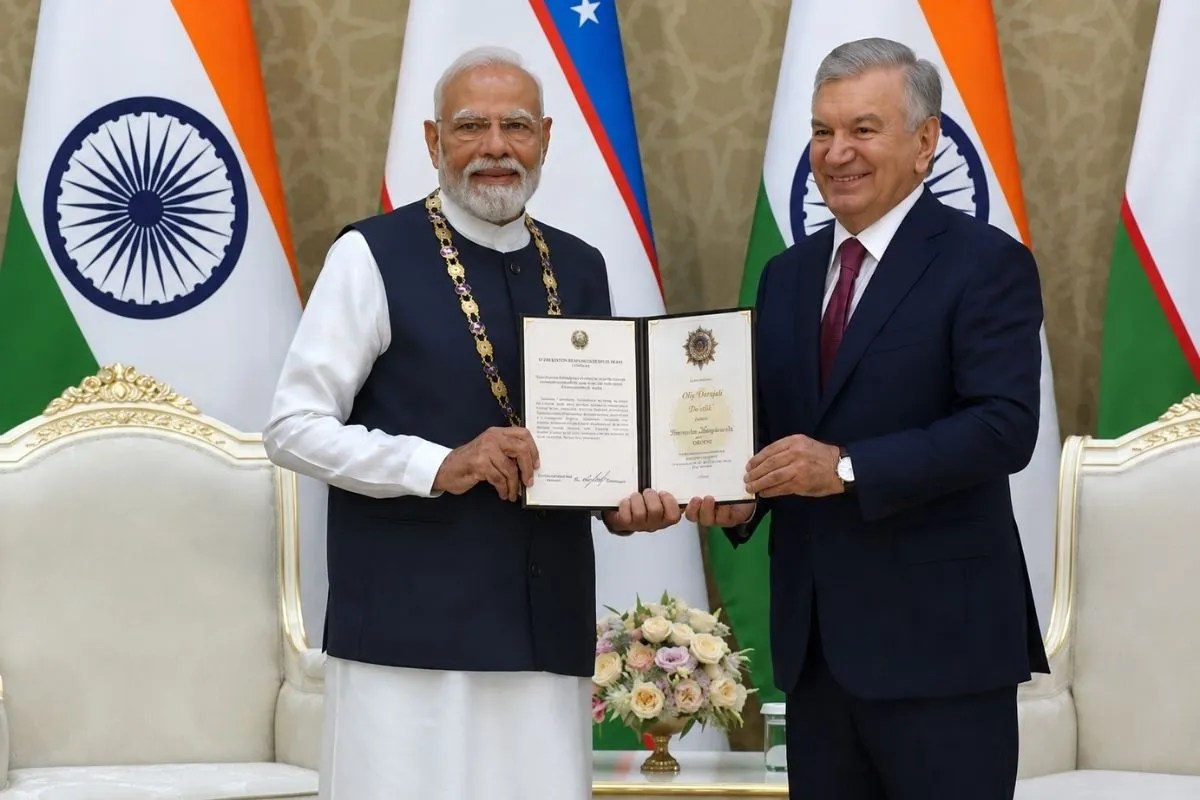
When Narendra Modi stepped onto the tarmac in Tashkent to receive Uzbekistan’s highest civilian honor, the Order of the Supreme Unity, the television screens flashed with the diplomatic equivalent of clean punctuation. Bilateral agreements signed. Trade routes discussed. Strategic partnerships reaffirmed. But diplomatic communiques are notoriously bad at capturing the smell of dust heated by a Central Asian sun, or the weight of a stone medallion resting against a statesman's collar.
Consider what actually happens when nations decide to look at each other across a map instead of through a rifle sight.
For decades, the physical distance between New Delhi and Tashkent felt longer than the actual mileage suggested. Mountains stood in the way. Complicated geopolitics built walls of paper and wire. Yet, ordinary people kept trying to cross. I remember sitting in a dimly lit tea house near the Chorsu Bazaar years ago, watching an elder trace patterns on a wooden table while speaking of Indian cinema with a fierce, uncomplicated nostalgia. He had never seen the Taj Mahal except on a flickering CRT television screen in the late nineteen-eighties, yet he spoke of Raj Kapoor the way a man speaks of an old uncle who lived down the road.
That cultural memory is the invisible ballast of statecraft.
When a foreign government pins its highest medal on a visiting leader, it is doing more than trading pleasantries for the evening news cycle. It is acknowledging a debt to the past and placing a down payment on the future. The Order of the Supreme Unity is not given lightly. It is a physical manifestation of trust in a region where trust is the scarcest commodity on earth.
Look at the geography. Uzbekistan sits at the historic crossroads of empires, a landlocked heartbeat surrounded by turbulence. To its south and east lie shifting powers and long shadows. To its west, the echoes of old Soviet borders still rattle the windowpanes. In this crucible, finding a steady partner who respects sovereignty without demanding subservience is rare. India has played that quiet, deliberate role. No bluster. No heavy-handed ultimatums. Just a steady hum of mutual respect, trade negotiations, and educational exchanges that slowly weave two disparate societies together.
We forget how fragile these bridges are.
It takes generations to build the kind of goodwill where a Prime Minister from South Asia can walk into a Central Asian capital and be greeted not as an interloper, but as a long-absent cousin returning for dinner. The mechanics of this relationship are grounded in pragmatism, but the soul of it is ancient. Centuries ago, merchants from the Fergana Valley packed their mules with spices, textiles, and lapis lazuli, heading south through the high passes toward the plains of Hindustan. They carried more than goods. They carried stories, music, and fragments of philosophy that seeped into the soil of the subcontinent.
Today, those mules have been replaced by cargo planes and fiber-optic cables, but the hunger for connection remains identical.
When leaders meet in summit rooms under the glare of camera flashbulbs, the conversation often drifts toward energy security, counter-terrorism, and trade corridors like the International North-South Transport Corridor. These are dry, technical terms that make your eyes glaze over if you read them on a spreadsheet at two in the morning. But translate them into human reality. Energy security means a child in a cold apartment can finish her homework with the lights on. Counter-terrorism means a mother in the valley can walk to the market without calculating the odds of a tragedy. Trade corridors mean a farmer three thousand miles away can sell his harvest before it rots in the midday heat.
That is what the medal is really for. It is a recognition of labor done in the quiet corners of diplomacy, where failures mean chaos and successes rarely make the front page.
There is a particular kind of silence that falls over Tashkent just before dusk. The marble plazas cool down. The pigeons gather by the fountains in Amir Timur Square. In that fading light, you can almost sense the ghosts of the old caravanserai owners whispering in the shadows, marveling at how the roads they carved with their bare hands are finally finding new life.
The modern world is obsessed with speed. We want our geopolitics delivered like fast food, hot and immediate, with clear winners and losers declared before the credits roll. But true statecraft moves at the speed of geology. It grinds slowly. It requires patience that borders on stubbornness.
When Modi accepted the honor from Uzbek President Shavkat Mirziyoyev, he wasn't just accepting a shiny trinket to hang in a glass case in New Delhi. He was accepting the custody of an old dream. A dream that the spaces between us do not have to be barriers. A belief that two distinct cultures, shaped by different gods and different histories, can look across the mountains and recognize a reflection of their own resilience.
The ceremony ended. The cameras packed their lenses. The politicians shook hands and departed for the airport, their motorcades slicing through the darkening streets.
Back at the bazaar, the tea was poured, the old man cleared his throat, and the dust of the Silk Road settled back onto the earth, patient and enduring, waiting for the next traveler to come along and kick it into the air.