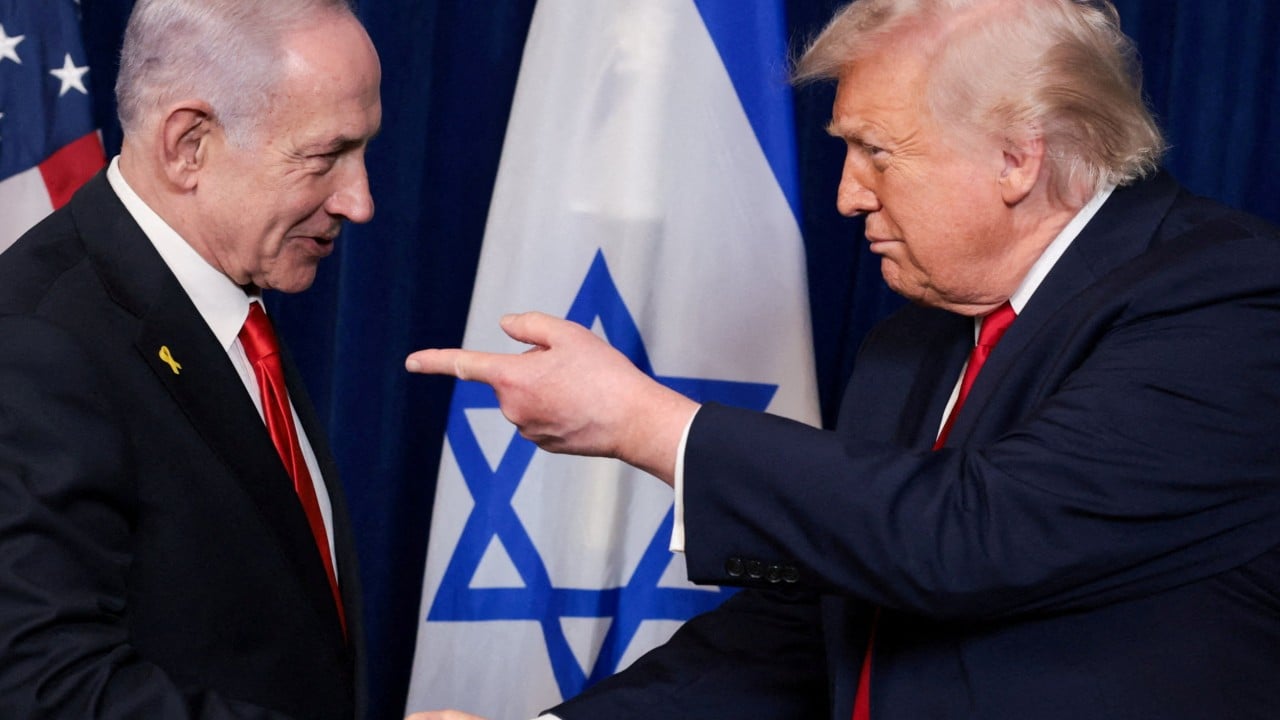
The media is collectively obsessing over a fundamentally lazy question: Is Donald Trump actually "calling the shots" over Benjamin Netanyahu, or is it all just prime-time bluster?
Commentators watch Trump declare "I call all the shots" to the Financial Times regarding a potential US-Iran nuclear pact, and they immediately sprint to their keyboards to analyze the "theatrics." They treat the US-Israel alliance like a soap opera power struggle between two oversized personalities. They point to Jerusalem’s quiet grumbling, or the brief, violent lapses in the April and June ceasefires, as proof that America's grip is slipping, or that Trump is merely pretending to hold the leash.
They are missing the entire game.
This is not a story about diplomatic posture or alpha-male posturing. If you look at the cold, hard structural shifts quietly happening beneath the surface, you will realize that Trump isn’t trying to manage Netanyahu’s daily military schedule. He is doing something far more disruptive: he is treating the entire Middle Eastern security apparatus like a corporate restructuring project.
The question isn’t whether Trump is dictating Israel's tactical targets. The truth is that Trump has fundamentally rewritten the financial and strategic rules of the relationship, forcing Israel from a subsidized client state into a locked-in corporate joint venture.
The Death of the Foreign Aid Subsidy
For decades, the consensus view of US-Israel relations has rested on a single, unchallenged pillar: the $3.8 billion annual Memorandum of Understanding (MoU) in direct military aid. Pundits view this money as the ultimate lever of American influence. If Washington wants Jerusalem to behave, the theory goes, it threatens to cut off the cash flow.
I have watched policy analysts waste years debating this precise dynamic, treating the aid budget as a holy, untouchable text. It is a completely outdated framework.
Look at what is actually happening right now. Formal talks kicked off to replace the current MoU before it expires. But notice the structural pivot: the flow of capital is shifting away from traditional, top-down foreign assistance and moving toward deep, integrated defense co-production and joint commercial investment. Netanyahu himself praised the plan to transition from financial subsidies to full-scale defense industrial integration within a decade.
This isn't a master-servant dynamic; it’s an forced corporate merger.
By pushing Israel away from a traditional aid model and toward integrated defense co-production—codified in legislative actions like Section 224 of the National Defense Authorization Act—the Trump administration is locking Israel into the American industrial supply chain permanently. Israel gets the co-developed tech, the joint research, and the hardware, but they lose the autonomy to act entirely outside the sphere of US industrial consent.
Imagine a scenario where a subsidiary company believes it is entirely independent because the parent firm stopped sending direct cash infusions. In reality, the parent firm simply integrated the subsidiary’s software engineering, manufacturing, and distribution directly into corporate headquarters. Who calls the shots then? The entity that controls the source code and the assembly line.
Why the Ceasefire Skeptics Miss the Point
Whenever a strike occurs in southern Lebanon or a petrochemical plant is targeted in western Iran, the press jumps up to scream that Trump’s regional architecture is crumbling. They see the temporary breakdowns of the April truce or the friction points of the June 2026 Israel-Lebanon ceasefire as evidence of American impotence.
This is a profound misunderstanding of transactional diplomacy.
Trump’s foreign policy does not demand perfect, ideological harmony or immaculate, permanent peace. It operates on a framework of enforced transactional parameters. When Trump announced that no Israeli troops would enter Beirut and turned back forces on their way, he wasn't acting as a traditional diplomat appealing to international law. He was acting as an aggressive broker enforcing the boundary lines of a deal.
The mainstream media asks: How can Trump claim he is in control when Israel still launches retaliatory strikes against Iranian missile positions?
They are asking the wrong question. The real question is: Why did Iran and Israel both rapidly pause their direct strikes in June after Trump told them to stop shooting?
They paused because the underlying structural pressure—the US military blockade on Iranian ports, the aggressive enforcement against non-compliant oil tankers like the M/T Marivex by CENTCOM, and the threat of direct US commando operations if diplomacy collapses—creates a high-stakes environment where neither side can afford to completely alienate Washington. Trump doesn't need to prevent every single skirmish to call the shots; he just needs to control the macro-economic and military levers that dictate when the music stops.
The Illusion of Netanyahu’s Autonomy
The lazy consensus loves to paint Netanyahu as the ultimate political survivor who can outmaneuver any American president. And to be fair, Netanyahu’s domestic survival instincts are unparalleled. But do not mistake domestic political positioning for genuine strategic autonomy.
When Israeli embassy spokespeople go on European radio to claim "Trump isn't calling the shots, it's an open conversation," they are performing for an internal audience. They have to protect the illusion of total sovereign independence.
But look at the brutal geopolitical reality:
- The Abraham Accords Framework: The regional integration strategy forces a defensive grid linking Israel, Egypt, Saudi Arabia, and the UAE.
- The Nuclear Ultimatum: Trump openly states that if a negotiated pact is reached with Tehran, Jerusalem will have "no choice" but to accept it.
- Counterintelligence Friction: The Pentagon’s Defense Intelligence Agency recently raising the counterintelligence threat level for Israel to "critical" shows that Washington is actively monitoring and tightening security protocols, refusing to give Jerusalem a blank check.
If you are a sovereign nation whose long-term defense strategy is being legally integrated into the US Department of War, whose regional alliances are brokered by the White House, and whose primary adversary is kept under a US-enforced naval blockade, you do not possess ultimate autonomy. You are operating within a sandbox whose walls were built in Washington.
The Hidden Cost of the New Paradigm
To be brutally honest, this contrarian approach of treating foreign policy like a corporate buyout has serious downsides that the administration's cheerleaders ignore.
By replacing traditional, institutional diplomacy with raw transactional leverage, you destroy the predictability of long-term alliances. Shuttering traditional aid channels and bypassing international bodies creates a chaotic, volatile environment. When everything relies on personal calls, Truth Social decrees, and sudden economic blockades, long-term planning becomes impossible for regional actors.
But do not confuse volatility with lack of control.
The traditional foreign policy establishment thinks control looks like a 50-page joint communique from a summit in Geneva. Trump’s brand of control looks like a sudden midnight phone call that turns an armored column around on the road to Beirut. It is messy, it is loud, and it breaks a dozen diplomatic norms a day—but it works on a logic of sheer, unadulterated leverage.
Stop looking at the podiums. Stop analyzing the carefully worded press releases from Jerusalem trying to save face. When you control the currency, the naval blockades, the joint defense manufacturing licenses, and the ultimate diplomatic cover on the world stage, you don't need to pretend. The competitor articles can keep debating the theatrics; the real story is that the structural ownership of Middle Eastern security has already been transferred.