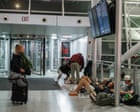
Every time an air traffic control staffing shortage, a system outage, or a sudden political standoff freezes departures across the United States, the media runs the exact same playbook. They send a camera crew to Terminal B at O’Hare or Atlanta, shove a microphone in front of a stranded family sitting on a carpeted floor, and publish a tearjerker headline about how frustrating the chaos has become.
It is lazy journalism. Worse, it completely obscures the structural rot actually causing your flight to get canceled.
If you are angry at the gate agent, or even the airline CEO, when a stoppage paralyzes American airspace, you are yelling at the wrong villain. The real culprit is a decades-old operational philosophy that treats aviation infrastructure like an afterthought while optimizing every single seat for maximum load factor. When you run a complex logistical network at 99 percent capacity with zero slack in the system, a single flat tire does not just slow down one car. It triggers a thousand-car pileup across four time zones.
The Myth of the Resilient Hub
Mainstream travel coverage loves to frame airport stoppages as freak anomalies—sudden storms, unexpected tech glitches, or isolated labor disputes. That framing lets the architects of our modern transit system off the hook.
I have spent fifteen years analyzing aviation logistics and watching carriers bleed tens of millions of dollars during irregular operations. The dirty secret inside airline operations centers is that modern hub-and-spoke networks are designed to be brittle. To keep base fares artificially low and satisfy Wall Street’s obsession with Revenue Per Available Seat Mile (RASM), legacy carriers eliminated buffer aircraft, thinned out maintenance crews, and scheduled aircraft turnarounds down to the precise minute.
In supply chain management, this is known as extreme lean optimization. In commercial aviation, it is a ticking time bomb.
Consider what happens during a ground delay program—a traffic management procedure implemented by the Federal Aviation Administration (FAA) to control air traffic volume to airports where demand exceeds capacity. When a stoppage occurs, whether due to a severe staffing deficit in a regional Air Route Traffic Control Center or a sudden shutdown of federal funding, the FAA throttles the arrival rate.
Because airlines have packed their schedules so tightly, a two-hour ground stop does not just delay a flight by two hours. It causes the flight crew to time out under Federal Aviation Regulation Part 117, which strictly mandates rest periods to prevent pilot fatigue. Once a crew times out, that plane is dead in the water. Because there are no reserve crews sitting idle at outstations—reserve pools cost money and drag down quarterly margins—the flight gets canceled. That canceled plane was supposed to fly three more legs that day. Now four flights are dead, six hundred passengers are stranded, and the dominoes keep falling for seventy-two hours.
The media calls it an unexpected stoppage. Operations analysts call it Tuesday.
The Privatization Debate Nobody Wants to Touch
When the public asks why US airports fall apart faster than their European or Asian counterparts during a crisis, the conversation usually stalls at partisan talking points. One side blames underfunded government agencies; the other blames greedy corporations. Both miss the structural reality of how American airspace is governed.
The United States operates the busiest, most complex airspace in the world, yet it still relies on an air traffic control apparatus funded through the erratic, politically volatile congressional appropriations process. Unlike NAV CANADA—the private, non-profit corporation that has safely and efficiently managed Canada’s civil air navigation service since 1996—the FAA cannot easily issue long-term bonds for infrastructure upgrades or insulate its hiring pipeline from Washington budget fights.
Whenever Congress plays chicken with a continuing resolution or a government shutdown, air traffic controller training at the FAA Academy in Oklahoma City grinds to a halt. You cannot train a certified professional controller overnight. It takes two to four years of grueling classroom instruction and on-the-job radar supervision to certify a controller for high-density airspace like the New York TRACON.
When hiring stops for six months because politicians cannot pass a budget, the aviation system suffers a staffing deficit three years later. That is the exact bill coming due right now. You are not stuck at the terminal because of a sudden stroke of bad luck. You are stuck there because of budget paralysis that happened during a previous administration.
There is an obvious downside to shifting toward a corporatized air traffic model like NAV CANADA or the UK’s NATS: user fees. General aviation groups and private jet lobbies have fought privatization tooth and nail for thirty years because they do not want to pay per-flight fees to access the sky, preferring to keep their costs subsidized by commercial airline ticket taxes. Until taxpayers and travelers decide whether they want cheap access for private planes or a reliable commercial grid, the bottlenecks will remain permanent.
Why Your Travel Insurance Will Not Save You
When chaos erupts at the terminal, consumer advocates immediately trot out the same tired checklist: buy travel insurance, know your Department of Transportation rights, and pack a charger in your carry-on.
Let us dismantle that advice immediately. Most standard travel insurance policies are riddled with force majeure and administrative exclusions that render them useless during systemic stoppages. If a mechanical failure on your specific aircraft causes a delay, you might get a meal voucher and a hotel room. If an airspace stoppage, government shutdown, or widespread air traffic control restriction halts departures, airlines classify the event as outside their control.
Under current US Department of Transportation guidelines, an airline owes you a cash refund only if your flight is canceled or significantly delayed and you choose not to travel. If you still need to get to your destination, the airline is legally obligated only to put you on their next available flight. When every flight for the next three days is already booked at 95 percent capacity, "next available" means sleeping on a cot next to a Cinnabon until Thursday.
Even the most expensive credit card trip delay protections typically require a delay of six to twelve hours before coverage kicks in, and they cap daily reimbursements at amounts that barely cover an airport Marriott during surge pricing. Relying on fine-print policies to rescue you from a broken transit grid is a losing bet.
What Travelers Actually Need to Ask
If you want to survive modern air travel without losing your mind—or your vacation—stop asking which airline has the best customer service. When the grid locks up, every carrier’s customer service collapses at the exact same speed. Instead, start asking structural questions about how you book your movement.
Is a Nonstop Flight Worth a 40 Percent Markup?
Yes, every single time. Connecting through a mega-hub like Denver, Dallas-Fort Worth, or Charlotte exposes you to compound risk. Every connection introduces a new set of crew schedules, a new weather system, and a new air traffic control sector. If you fly nonstop, you only need one plane and one crew to survive the day. If you connect, you are gambling that two separate logistical chains will remain unbroken simultaneously. Pay the premium for the direct route, or take a shorter trip.
Should You Book the Last Flight of the Day?
Never. Booking the 8:30 PM departure is financial and logistical self-sabotage. By evening, any minor delay from the morning push has snowballed into multi-hour backlogs. Worse, if your evening flight gets canceled, there are no subsequent flights left to rebook you onto, and the customer service lines will already be five hundred people deep. Fly at 6:00 AM. The planes are already sitting at the gate from the night before, the crews are fresh off mandatory rest, and the airspace is wide open.
Why Are You Waiting in Line at the Gate?
Watching two hundred panicked passengers sprint to a single overwhelmed gate agent during a ground stop is like watching people try to bail out a sinking cruise ship with a thimble. That agent is typing on a green-screen terminal built in the 1980s, trying to manually re-ticket hundreds of angry people one by one.
Do not get in that line. The second the delay board turns red, pull out your phone, open the airline’s mobile app, and simultaneously dial the carrier’s international support number—not the domestic toll-free line. Domestic call centers get flooded within sixty seconds of a major stoppage. International desks in Europe or Asia have access to the exact same reservation systems, shorter hold times, and agents who are not currently being screamed at by a crowd in Terminal C.
The Uncomfortable Truth About Cheap Fares
Imagine a scenario where the US government mandates that airlines maintain a 15 percent reserve buffer of aircraft and flight crews at every major hub, while simultaneously funding a massive expansion of air traffic control facilities. Delays would plummet. Stoppages would be absorbed within hours rather than days. The chaos at American airports would vanish.
Your $250 cross-country round-trip ticket would also instantly become a $550 ticket.
That is the trade-off nobody in the media wants to say out loud. Consumers spent the last three decades demanding rock-bottom airfares, rewarding ultra-low-cost carriers, and sorting flight search results strictly from lowest price to highest. Airlines responded by stripping out every ounce of redundancy, packing seats closer together, and running their fleets into the ground.
The misery you see on the evening news is not a malfunction of the American aviation system. It is the exact product you paid for.
Stop waiting for the airlines to grow a conscience, and stop waiting for Congress to fix the airspace before your next trip. Book the first flight out, avoid connecting hubs like the plague, keep a refundable backup ticket on a competing carrier when traveling for critical events, and accept that until Americans are willing to pay for slack in the system, the terminal floor is part of the itinerary.



