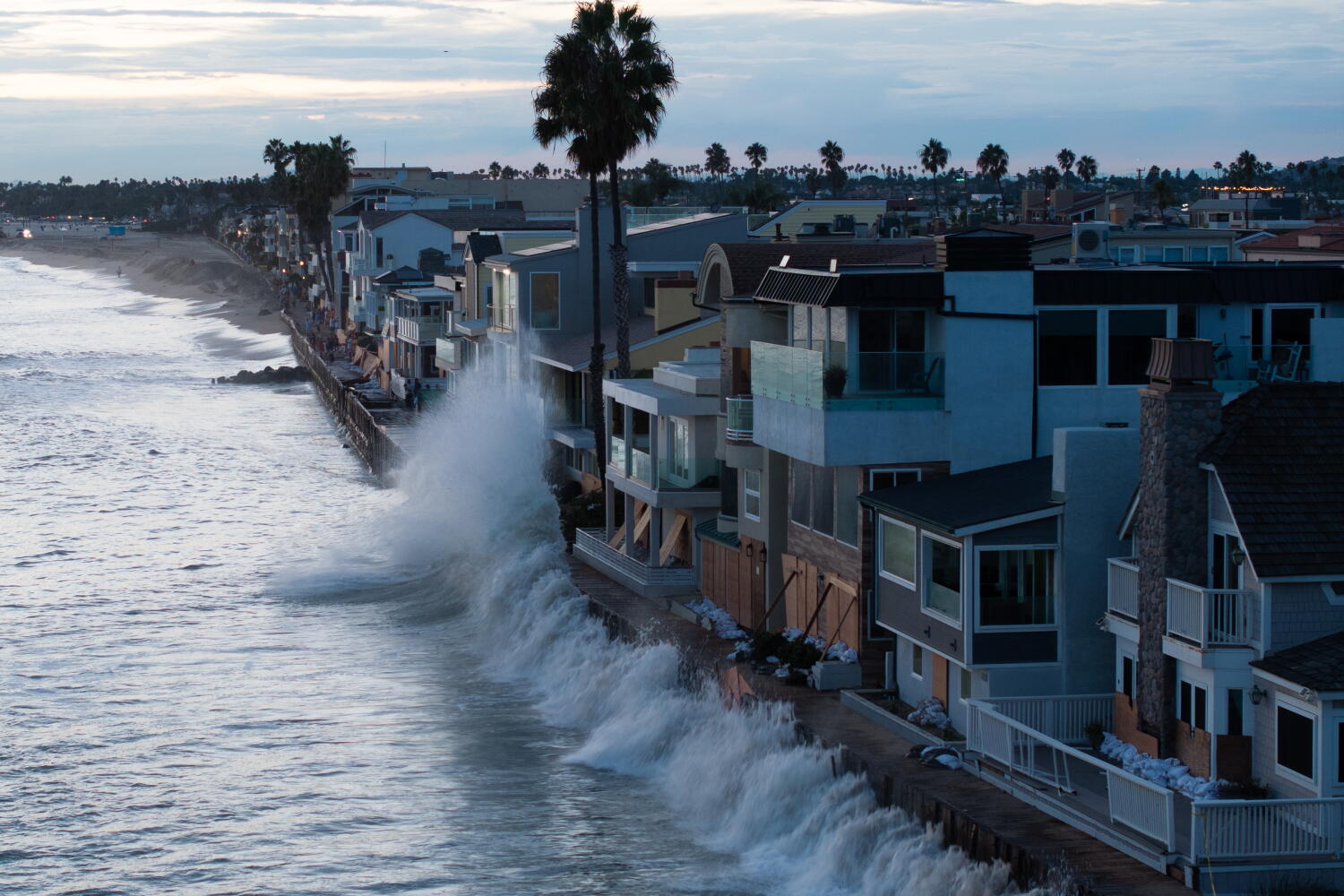
Every time the Pacific decides to flex, the media dusts off the same tired playbook. Sirens blare, anchors stand knee-deep in foam pretending they are reporting from a war zone, and the collective panic centers on a single scapegoat: El Nino. We get the breathless warnings about rogue swells, crumbling cliffs, and an inevitable aquatic apocalypse swallowing Pacific Coast Highway whole.
It is lazy journalism built on a convenient meteorological boogeyman. Don't miss our recent coverage on this related article.
Blaming El Nino for California shoreline destruction lets every city planner, zoning board, and coastal homeowner off the hook. It treats a routine planetary oscillation like an unprovoked assault, ignoring the reality that the ocean is simply reclaiming what humans had no business building on in the first place. I have spent two decades watching developers squeeze million-dollar multi-story boxes onto unstable sandstone bluffs, pretending that pouring a few truckloads of riprap into the surf constitutes a permanent engineering solution. When those homes slide toward the tide, the headline blames the weather. That is not a natural disaster. That is a billing error on humanity's invoice.
The Myth of the Anomalous Wave
The core fallacy underpinning every panic-stricken dispatch from the coast is the idea that these high-energy winter swells represent an unprecedented anomaly. They are not anomalies. They are baseline conditions. The eastern Pacific operates on multi-decadal cycles of wave height and storm track migration. If you want more about the context of this, USA Today offers an excellent summary.
When ocean surface temperatures in the equatorial Pacific rise, the atmospheric jet stream shifts. That part is true. The mistake lies in assuming this shift creates a freakish, unnatural battering ram that targets Malibu, Santa Cruz, and Pacifica out of spite.
Think of the Pacific basin as a massive, spinning turntable. El Nino acts like a nudge on the speed dial, altering where the grooves land, but the record has been playing the same heavy metal track for millennia. The sheer kinetic energy slamming into the Golden State right now has been measured, mapped, and mathematically anticipated since the mid-twentieth century.
Yet, every time a winter swell knocks out a stretch of concrete seawall, coastal municipalities act like they were ambushed. They scramble for emergency FEMA declarations, truck in thousands of tons of quarried rock from inland quarries, and dump millions of dollars of public funds into fighting physics.
Physics always wins. Every single time.
The Seawall Swindle
If you want to understand why California's coast is disappearing, look at the very structures built to save it. Hard armoring—seawalls, revetments, bulkheads—is the greatest scam ever perpetrated on property taxpayers.
When a developer builds a concrete barrier at the base of a receding cliff, they are playing a zero-sum game against hydrodynamic energy. The wave hits the wall, and instead of spending its energy chewing up a gradually sloping beach, that kinetic force gets deflected downward and sideways. The scour effect accelerates erosion directly at the base of the wall and strips away the adjacent sand.
You do not protect a beach with a wall; you murder it.
I have walked sites in Ventura and San Diego where pristine sandy expanses vanished into rocky rubble zones within five years of seawall installation. The property owners got a temporary security blanket for their foundations while the public beach—the very asset that made those properties valuable in the first place—was systematically erased.
The standard mitigation playbook involves beach nourishment. Dredge sand from offshore deposits, pump it onto the shorelines, and watch the winter swells drag it right back out to sea six months later. It is an expensive vanity project. We are spending public treasuries to play a Sisyphean game of castle-building in a sandbox while the tide rolls in.
Redefining the Coastal Crisis
The real crisis is not meteorological. It is chronological and psychological. We are trying to impose permanent human real estate onto a dynamic, migrating geological boundary.
Coastlines are not lines. They are zones. They breathe, shift, advance, and retreat on geological timeframes that mock our thirty-year fixed mortgages. When we draw property boundaries on a shifting sand spit or the edge of an active landslide complex, we enter into a bad-faith contract with nature.
Oceanographers at Scripps and researchers at USGS have published mountains of data mapping historical bluff retreat rates. These numbers are not secrets. Anyone with an internet connection can pull up hazard maps showing precisely which coastal stretches will lose ten to thirty feet of vertical cliff face over the next two decades.
Do developers look at these maps? Sure. Do they build anyway? Absolutely, because local governments are addicted to the property tax revenue. A single oceanfront parcel generates enough municipal income to blind zoning commissioners to the long-term liabilities. When the cliff finally shears off, the owners expect a bailout.
This creates a perverse moral hazard. If you subsidize rebuilding in a disaster zone, you guarantee more destruction.
The Uncomfortable Solution
Fixing this mess requires abandoning the delusion of defense. We need to stop throwing public money at holding back the Pacific and start funding strategic, managed retreat.
That means rewriting state zoning laws to ban hard armoring on newly threatened parcels. It means refusing to rebuild public infrastructure in high-hazard zones after the next big swell takes it out. If a coastal highway drops into the surf for the third time in a decade, you do not spend another hundred million dollars shoring it up. You reroute it inland, let the roadbed go, and let the surf reclaim its territory.
Property owners hate this approach because it destroys asset values. But those asset values were imaginary to begin with, propped up by government flood insurance subsidies and a cultural refusal to accept ecological reality. You cannot own a piece of a cliffside indefinitely when the cliff refuses to stay put.
Stop waiting for El Nino to finish its rampage. Stop buying the narrative that the ocean is waging war on California. The Pacific is just doing what it has done for ten thousand years. The only thing broken on the coast is our collective willingness to face the map.
:max_bytes(150000):strip_icc()/woolly-mammoth-186450409-584ffd493df78c491e57ca5e.jpg)