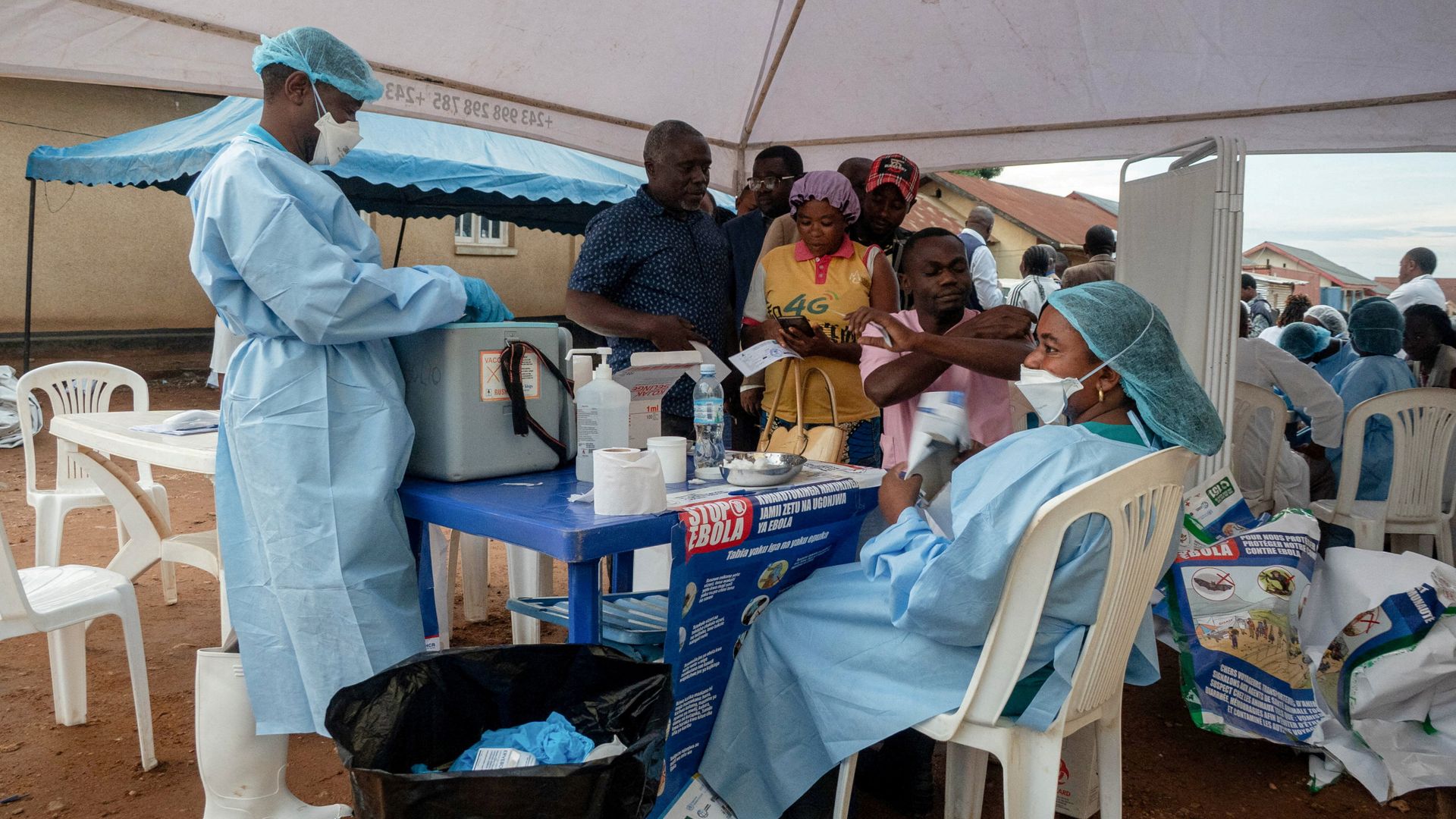
Every time an Ebola responder is murdered in the Democratic Republic of the Congo, Western headlines copy and paste the exact same script.
"An angry mob." "Superstition." "Distrust of science."
It is a comfortable lie. It allows international NGOs, foreign journalists, and global health bureaucrats to pat themselves on the back for bringing enlightenment to the dark corners of the earth, while washing their hands of the bloodshed. When a nurse is lynched after being accused of spreading the virus, the lazy consensus frames the perpetrators as irrational villagers who simply need a better public health brochure.
That narrative is not just condescending. It is factually bankrupt, and it gets people killed.
I have spent over a decade analyzing crisis response, conflict epidemiology, and humanitarian logistics across Central Africa. I have watched billion-dollar aid architectures parachute into active war zones, trip over their own arrogance, and leave local health workers to take the bullets—and the machetes—for institutional failures they didn't create.
When a community turns on a nurse during an outbreak in eastern Congo, they aren't reacting to a lack of biology lessons. They are reacting to a rational, historically validated suspicion of outside intervention.
The Architecture of Rational Distrust
To understand why a local population would believe a healthcare worker is intentionally spreading a lethal hemorrhagic fever, you have to stop looking at the virus and start looking at the political economy of North Kivu and Ituri.
For nearly thirty years, the eastern provinces of the DRC have been subjected to relentless, overlapping traumas. Resource extraction by foreign conglomerates. Proxy wars fueled by neighboring states. Decades of UN peacekeeping missions that absorbed billions of dollars while failing to stop massacres happening miles from their bases.
Now, drop an international Ebola response into that environment.
Suddenly, fleets of brand-new, white Land Cruisers flood dirt roads where people haven't seen a paved highway or a functioning clinic in a generation. Foreign consultants—paid thousands of dollars a week in hazard pay—set up fortified compounds. Local hires who happen to speak French or English are suddenly earning ten times the prevailing local wage to dig graves or spray chlorine.
Meanwhile, the everyday killers in those exact same communities—malaria, measles, cholera, obstructed labor, basic malnutrition—remain completely ignored by the international community.
If you live in Beni or Butembo, and your child died of malaria last month because there was no quinine at the local dispensary, watching millions of dollars materialize overnight for a disease that has killed a fraction of the people seems bizarre. When armed escorts accompany medical teams to forcibly isolate your sick relatives behind opaque plastic tarps, where they disappear and never come back, suspicion isn't ignorance. It is pattern recognition.
Calling this "anti-science superstition" is a defense mechanism used by the aid industry to avoid auditing its own catastrophic optics.
The Weaponization of Outbreak Response
The mainstream coverage of the murder of Ebola nurses treats the violence as a spontaneous eruption of mob madness. It rarely interrogates how epidemic responses become entangled with local politics and armed conflict.
During the 2018–2020 Kivu Ebola epidemic—the second-largest in history—the response was heavily militarized from day one. Public health officials partnered directly with Congolese security forces and UN peacekeepers to enforce quarantines, conduct contact tracing, and mandate "safe and dignified burials."
Ask any veteran conflict mediator what happens when you attach a public health campaign to the exact same military units accused of human rights abuses and collusion with local militias. The public health campaign becomes a legitimate military target in the eyes of the population.
Worse, the sudden influx of cash creates what researchers at the London School of Hygiene & Tropical Medicine and the Congo Research Group have explicitly termed the "Ebola business" (le business d'Ebola).
When an epidemic becomes a lucrative industry, perverse incentives take over:
- Political manipulation: Local politicians routinely weaponize outbreak rumors to discredit rivals before elections. When the government delayed presidential voting in Beni and Butembo in late 2018 due to Ebola, residents immediately concluded the virus was a fabricated political tool designed to disenfranchise opposition strongholds.
- Militia extortion: Armed groups like the Allied Democratic Forces (ADF) and various Mai-Mai factions quickly realized that attacking Ebola treatment centers brought instant international leverage and disrupted state control.
- Community gatekeeping: Local elites excluded from lucrative response contracts actively stoked resentment among unemployed youth, framing the responders as profiteers who needed the outbreak to continue so the paychecks wouldn't stop.
When a nurse walks into a village under these conditions, they aren't seen as an independent healer. They are viewed as a foot soldier for a corrupt, extractive cartel.
Why "Community Engagement" Usually Fails
Whenever a tragedy like a nurse's murder hits the wires, the standard institutional response is to promise "more community engagement" and "better sensitization campaigns."
In practice, that usually means hiring a few dozen young men to walk around with megaphones reading translated WHO talking points, or printing colorful posters explaining how fruit bats carry filoviruses.
It doesn't work because you cannot market your way out of a structural legitimacy crisis.
The Myth of the Information Deficit
Public health institutions operate on the Information Deficit Model—the assumption that if people oppose a medical intervention, it is simply because they lack accurate facts. Therefore, the solution is always more broadcasting.
In high-conflict, low-trust environments, broadcasting harder actually backfires. When an institution you already distrust spends millions of dollars aggressively telling you to trust it, your suspicion multiplies. People don't reject the message because they don't understand the words; they reject it because they distrust the messenger.
The Trap of Securitized Medicine
When responders face hostility, the immediate reflex of international organizations is to increase security. More armed guards. More armored vehicles. More fences around treatment centers.
Every layer of physical security increases the psychological distance between the healer and the patient. A nurse arriving in a convoy flanked by soldiers with assault rifles has already lost the battle for community trust before stepping out of the vehicle. You cannot build clinical rapport at gunpoint.
What People Are Actually Asking (And Why the Premise Is Broken)
If you look at the public reaction to attacks on healthcare workers in the DRC, the questions almost always miss the mark.
"Why do people attack the very doctors trying to save them?"
Because from their perspective, the doctors aren't trying to save them. If you take a sick family member into a closed tent, prohibit the family from performing traditional burial rites—which, in many Congolese cultures, are believed to prevent the deceased's spirit from tormenting the living—and return a sealed body bag without letting anyone verify the corpse, you haven't saved anyone. You've abducted them.
"How can we educate rural populations about infectious diseases?"
Stop trying to "educate" them on pathogens while ignoring their actual survival priorities. People in eastern Congo know how contagion works; they have dealt with infectious diseases for centuries. What they don't know is why an international apparatus suddenly cares about their survival only when they contract a virus capable of crossing international borders.
"Should international agencies pull out when workers are killed?"
Pulling out is abandonment, yet staying under the current model guarantees more deaths. The real question isn't whether to stay or leave—it's who should be holding the clipboard and the syringe.
Dismantling the Top-Down Response Model
If we want nurses to stop dying at the hands of the communities they serve, the entire architecture of emergency outbreak response has to be inverted.
1. Decouple public health from armed security.
The presence of state military or UN peacekeepers at treatment centers and burial sites must be eliminated. Security cannot come from the barrel of a gun; it has to come from negotiated acceptance with local customary leaders, religious figures, and community associations who hold actual social capital on the ground.
2. Fund the baseline, not just the crisis.
You cannot parachute in an Ebola clinic next to a dilapidated general hospital that lacks basic antibiotics and expect applause. Emergency response budgets must be legally tied to immediate, visible investments in primary healthcare. If an international agency opens an isolation ward, it should simultaneously stock the local pediatric ward, fix the town's water pump, and pay the arrears of local nurses who haven't received a government paycheck in six months.
3. Hand operational control to trusted local networks.
In eastern Congo, people do not trust Kinshasa, and they certainly do not trust Geneva. They trust local churches, grassroots women's associations, and long-standing community health workers (relais communautaires) who lived there before the crisis and will still be there after the Land Cruisers leave. Instead of importing thousands of outside staff, international money should flow directly through these existing, trusted veins—even if it means sacrificing the rigid bureaucratic accounting standards that Western donors obsess over.
4. Radical transparency inside treatment centers.
The opaque plastic walls of traditional Ebola Treatment Centers are factories for conspiracy theories. Modern designs—like the transparent ALIMA CUBE (Chambre d'Urgence Biosécurisée pour Épidémies)—allow families to see their loved ones, speak to them directly, and observe every medical procedure without risking infection. When people can see what happens inside, rumors of organ harvesting and intentional poisoning evaporate overnight.
The Cost of Surrendering Control
I won't pretend this approach is clean or easy. Handing operational control and massive budgets over to decentralized local networks in a conflict zone carries real, unavoidable risks.
Money will be siphoned off. Local power brokers will try to capture resources. Standardization will suffer, and data reporting to international headquarters will get messy. Donors in Washington, Brussels, and London hate messy; they want clean spreadsheets, strict compliance, and tight chain-of-command control.
That obsession with bureaucratic control is precisely what forces international agencies to build top-down, militarized bubbles that alienate the very populations they claim to protect.
You have to choose which risk you are willing to accept. You can protect your spreadsheets and your centralized command structure, and keep reading headlines about nurses being hacked to death by terrified neighbors. Or you can accept the friction of genuine local ownership, surrender the ego of the savior complex, and let communities manage their own survival.
Until the global health establishment admits that the blood on the ground in Congo is a symptom of its own broken operational model, the mobs aren't going anywhere.