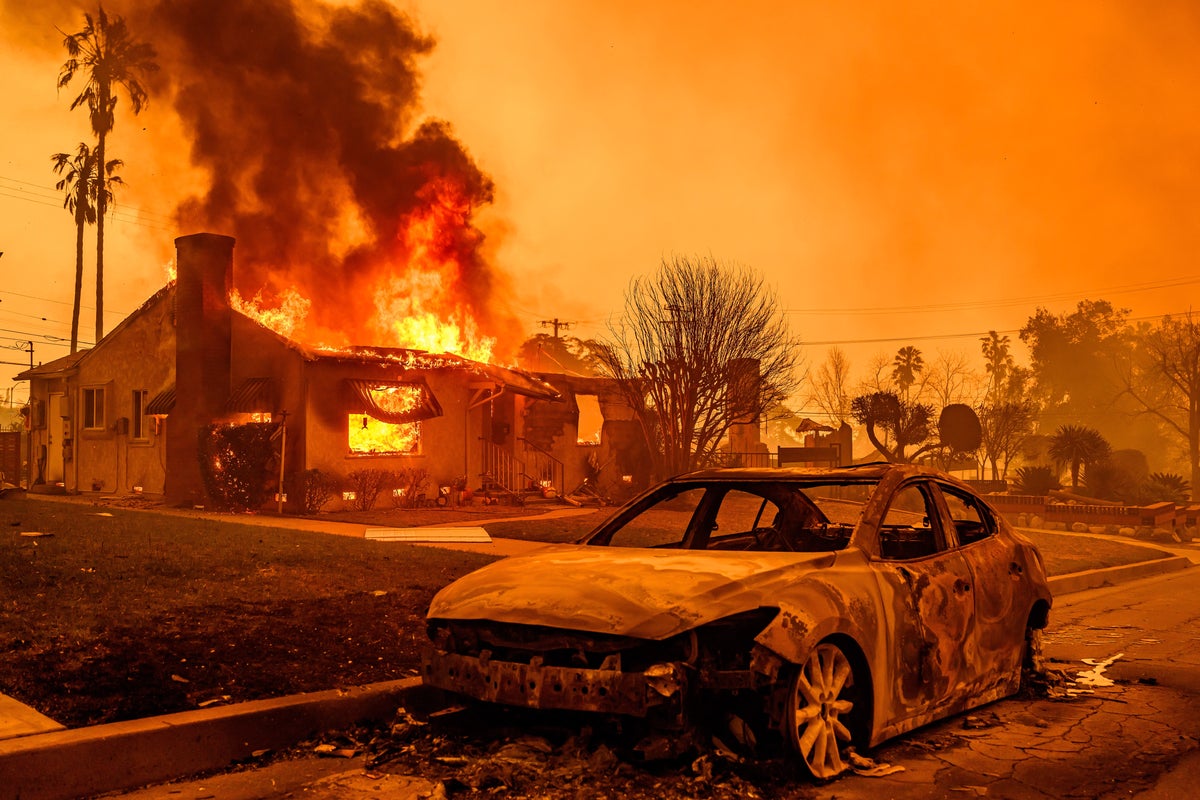
Blaming the utility company is the oldest, laziest reflex in modern disaster journalism. Whenever a hillside goes up in smoke and homes turn to ash, the headline writes itself: Southern California Edison equipment sparked the Eaton Fire. It is neat. It is tidy. It gives an angry public a corporate throat to squeeze.
And it completely misses the structural reality of living in a Mediterranean chaparral biome.
I have spent two decades walking burned-out footprints across the urban-wildland interface. I have watched municipal leaders, property owners, and headline-chasers point fingers at high-voltage transmission lines while ignoring the multi-billion-dollar systemic failures happening directly under their noses. Pinning the entire catastrophe on a downed wire or a faulty transformer feels satisfying, but it treats a symptom while letting the disease metastasize unchecked.
Southern California Edison certainly holds plenty of blame for historical infrastructure lag, but treating them as the solitary architect of the Eaton Fire is a convenient narrative built to shield urban planners, local zoning boards, and homeowners from accountability.
The Comfortable Fiction of Single-Cause Disasters
The lazy consensus goes like this: utility sparks fire, fire burns neighborhood, utility pays settlement, cycle repeats.
This reductionist thinking assumes that without a utility-related ignition source, the Eaton Fire would never have happened. That assumption ignores basic ecology. High-wind events in Los Angeles do not care about wire clamps or porcelain insulators. When Santa Ana winds roar through mountain passes at seventy miles per hour, relative humidity drops into single digits, and decades of accumulated dry brush turn the foothills into a powder keg.
If an electrical arc did not start the fire, a catalytic converter from a commuter's car, a stray spark from a landscaping tool, or a tossed cigarette butt would have done the job within the hour. Focusing exclusively on utility gear is like blaming the match while ignoring the fact that someone built a bonfire inside a gunpowder factory.
Utilities operate thousands of miles of overhead lines across unforgiving terrain. Undergrounding every single mile of wire in Southern California is physically impossible within our lifetimes, requiring trillions of dollars and massive environmental destruction to dig up millions of acres of protected watershed. Yet politicians love to stand at podiums and demand zero-fault transmission grids, pretending that engineering perfection is a realistic policy goal rather than an expensive fantasy.
The Zoning Madness We Refuse to Name
Let us talk about the real engine driving these disasters: the relentless march of suburban expansion into high-hazard fire zones.
For decades, local governments permitted massive residential developments right up against volatile canyon edges. Cities love property tax revenue. Developers love high-end hillside views. So they built sprawling neighborhoods with narrow evacuation roads, dense native brush clearance gaps, and wooden framing sitting squarely in the path of historical fire corridors.
Imagine a scenario where every home built in a high-severity fire zone was required to use non-combustible exterior materials, triple-pane tempered glass, enclosed eaves, and mandatory defensible space zones enforced by aggressive local fines rather than polite warning letters.
Instead, we let homeowners plant ornamental eucalyptus and pine trees right next to their wooden decks, create dense decorative landscaping that acts as a literal ladder for flames, and then act shocked when a wind-driven wildfire turns their neighborhood into an oven.
When a fire tears through these vulnerable subdivisions, the post-mortem report focuses intensely on whether a transformer dropped a spark. It rarely asks why a municipality zoned three hundred homes into a box canyon with a single two-lane exit road.
The Regulatory Theater of Public Safety Power Shutoffs
To appease regulators and avoid massive liability, utilities now rely heavily on Public Safety Power Shutoffs. When the wind picks up, they pull the plug, cutting electricity to hundreds of thousands of residents.
This is regulatory compliance disguised as risk management. It trades one set of dangers for another.
Shutting off power across entire zip codes disables well pumps, traps electric vehicle owners, knocks out traffic lights, cuts off emergency communications, and disables medical equipment for vulnerable populations. It turns modern suburbs into dark, panicked ghost towns at the exact moment crisis response requires maximum stability.
Utilities use shutoffs as a legal shield. By turning off the grid, they can claim they prevented an electrical ignition, washing their hands of whatever happens next. But when emergency water boosters fail because the power went out, firefighters battling the Eaton Fire find themselves wrestling with dry hydrants.
We have created a system where utilities are legally incentivized to turn off the lights rather than invest in the grueling, unglamorous work of grid hardening, vegetation management, and advanced sectionalizing switches that isolate faults without plunging entire regions into darkness.
What Real Accountability Looks Like
If we genuinely want to stop catastrophic fires in Los Angeles, we have to stop treating utility litigation as a substitute for environmental management.
First, we need to completely overhaul how we fund and execute brush clearance. Current laws place the primary burden on individual homeowners, many of whom lack the physical ability or financial resources to properly maintain hundred-foot defensible space perimeters. We need centralized, state-funded forestry and fire mitigation crews that sweep through foothill communities systematically, clearing dead fuel loads regardless of whose property line they sit on.
Second, local governments must institute strict, non-negotiable building codes for existing structures in high-risk zones, backed by state subsidies to help working-class families retrofit their homes with fire-resistant roofs and vents. Letting people live in flammable houses because their grandparents built them in 1965 is not a human right; it is a public safety hazard.
Third, courts and regulators need to stop treating utilities as insurers of last resort for climate disasters. Holding a company financially responsible for a spark while ignoring the decades of poor land-use planning that put combustible assets in harm's way is bad policy. It bankrupts the utility, drives up consumer rates to absurd levels, and distracts from the structural changes required to survive living in a fire-prone landscape.
The Eaton Fire was a tragedy, but blaming Southern California Edison is the easy way out. It lets everyone else off the hook.
Stop looking at the power lines. Look at the hills, look at the zoning maps, and look at the mirror.