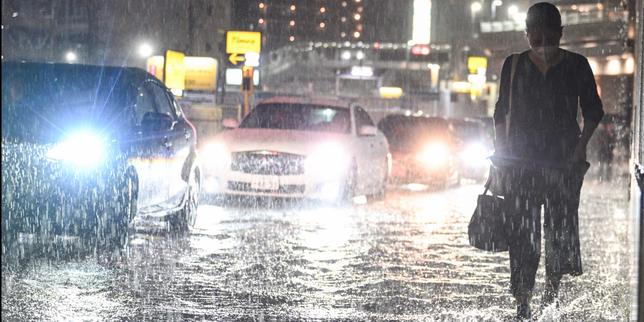
Every single time disaster footage loops across global screens from the eastern edges of Tokyo, the headline writes itself. Journalists rush to grab the exact same tired vocabulary. They cry unprecedented. They whisper climate anomaly. They act as though millions of tons of water fell from the sky because nature woke up in a particularly malicious mood.
It is lazy journalism, and it hides a far more uncomfortable reality. Learn more on a similar issue: this related article.
These floods are not natural anomalies. They are the predictable, mathematical byproduct of a society that decided to pave over every square inch of drainage basin and call it progress. I have spent years analyzing municipal infrastructure stress tests across East Asia, and I have seen firsthand how city planners hide behind the word unprecedented to excuse decades of shortsighted zoning laws and impermeable asphalt addiction. When you seal the earth in concrete, water does not negotiate. It accumulates.
The Myth of the Black Swan Disaster
Look closely at the reports coming out of Chiba and the eastern Tokyo metropolitan fringe. The media focuses exclusively on the sheer volume of rainfall, framing the downpour as a statistical outlier that defies human engineering. That framing is a deflection. More journalism by NBC News explores related views on this issue.
Rainfall intensity matters, but absorption capacity matters more. For decades, urban expansion swallowed up natural floodplains, rice paddies, and permeable soil reservoirs that historically acted as nature's sponge. In their place came dense residential sprawl, industrial parks, and high-speed transit corridors.
When an infrastructure system is designed to handle a fifty-year flood event under 1980s weather patterns, and you change the surface runoff coefficient by covering forty percent more ground in asphalt, you no longer have a fifty-year event. You have a five-year event wearing a heavy disguise. Calling it unprecedented is simply a convenient way for municipal authorities to avoid admitting that their drainage models are obsolete.
Engineering Hubris Meets Reality
Japan holds a reputation for possessing some of the most advanced civil engineering on the planet. Mention Tokyo drainage, and people immediately picture the monumental underground cathedral of concrete pumps situated in Kasukabe—the Metropolitan Outer Underground Discharge Channel. It is an engineering marvel. It is massive, expensive, and widely celebrated in architectural documentaries.
Yet, grand subterranean tunnels designed to channel overflow from major river systems fail when the bottleneck happens at the micro-drainage level in residential neighborhoods.
I have walked through municipal planning offices where engineers privately admit the bitter truth. The mega-projects protect the central commercial districts, while the peripheral residential zones act as sacrificial buffers. Water backs up through local storm drains not because the massive tunnel network is full, but because the neighborhood pipes feeding into it are too narrow, too old, and choked by decades of urban modifications.
When local politicians stand before cameras expressing shock at the speed of the inundation, they are ignoring the physics they approved on blueprints years prior.
The Climate Cop-Out
Blaming climate change entirely for urban flooding is intellectually lazy. Climate volatility certainly loads the dice, but human planning builds the casino.
When a river bursts its banks in a concrete-lined channel, water velocity increases exponentially. Without natural meandering paths, wetlands, and soil retention, water travels faster, hits bottlenecks harder, and rises higher than it ever would in a semi-natural watershed. The disaster is man-made from start to finish.
We keep designing cities as if water is an enemy to be fought with taller walls and wider concrete flumes. History shows us that you cannot defeat fluid dynamics with sheer arrogance. Every time you channel water into a narrower path, you simply increase its kinetic energy elsewhere.
What Actually Needs to Change
If we want to stop treating recurring disasters like surprise tragedies, we have to abandon the vocabulary of helplessness.
First, municipal zoning boards must stop approving high-density developments in low-lying alluvial plains without mandating decentralized retention basins. Every new commercial parking lot or housing complex should be legally required to manage its own stormwater runoff on-site through permeable pavements and sub-surface cisterns, rather than dumping it onto already overburdened municipal mains.
Second, disaster response agencies need to stop framing localized drainage failures as acts of God. When a neighborhood floods because local catch basins are blocked or undersized, call it what it is: a maintenance failure and a design flaw.
The water will keep coming. The storms will test our boundaries again next season. The only thing truly unprecedented is our collective refusal to admit that our concrete jungles are drowning in their own design.