Defense analysts love a tidy narrative. They look at the muddy trenches of Eastern Europe, see Ukrainian drones dropping offline when SpaceX restricts geofencing, and immediately scream that Taipei needs to launch its own sovereign Low Earth Orbit constellation before Beijing makes a move.
It sounds smart on a cable news panel. In reality, it is strategic malpractice. Recently making headlines lately: What Really Happened When Ukraine's Starlink Speeds Dropped on the Frontlines.
If you are still treating the Taiwan Strait like a maritime copy-paste of the Donbas, you are asking the wrong question entirely. The consensus view argues that Taiwan is fatally vulnerable because it relies on fragile subsea cables and lacks a homegrown Starlink. That argument completely ignores physics, orbital mechanics, and the brute reality of a 100-mile body of water.
Taiwan does not need to spend tens of billions of dollars chasing a commercial space monopoly that took Elon Musk decades and reusable rockets to build. Trying to replicate Starlink for an island the size of Maryland is like buying an aircraft carrier to cross a river. Further information on this are detailed by Gizmodo.
The Geography Fallacy Nobody Mentions
Ukraine is a sprawling continental landmass covering over 230,000 square miles. Front lines stretch for hundreds of kilometers across open steppe where traditional radio line-of-sight dies over the horizon and ground infrastructure gets pulverized by artillery. In that environment, beaming data straight up to a satellite passing overhead is the only way to keep a battalion connected.
Taiwan is a mountainous fortress roughly 245 miles long and 90 miles wide, sitting 100 miles off the coast of Fujian province.
Let that sink in. We are talking about a theater of operations smaller than the state of West Virginia.
In a conflict over Taiwan, the primary communications challenge is not crossing vast, empty terrain. The challenge is surviving an unprecedented wall of electromagnetic jamming, cyber warfare, and kinetic strikes within a hyper-compressed battlespace. Satellites—especially commercial-grade LEO constellations—are terrible at punching through localized, high-power electronic warfare when the adversary has land-based jamming arrays sitting right across the water.
I have watched defense contractors burn hundreds of millions of dollars pitching sovereign satellite networks to small nations, only for those architectures to fail basic red-team electronic warfare simulations. Why? Because physics is undefeated. A satellite orbiting 550 kilometers above the earth operates on a strict power budget. A diesel generator powering a directional jammer on the Chinese coast does not.
Why a Sovereign Starlink Is a Financial Trap
Let us do the actual math on what the "wake-up call" crowd is demanding.
Building a resilient, low-latency LEO constellation requires hundreds of satellites in inclined orbits just to maintain continuous coverage over a specific latitude. Even if Taiwan focuses purely on regional coverage rather than global reach, satellites in Low Earth Orbit do not hover over one spot. They scream across the sky at roughly 17,000 miles per hour. To keep a single terminal connected without dropping packets, you need a massive, constantly shifting constellation handing off signals every few minutes.
SpaceX pulls this off because it owns the launch vehicles, manufactures satellites on an assembly line in Redmond, and subsidizes the military utility with millions of global commercial subscribers paying monthly bills.
Taiwan has none of those advantages.
If Taipei diverts billions from its defense budget into launching a bespoke constellation, two things happen immediately:
- It starves asymmetric terrestrial defenses—like mobile anti-ship missiles, sea drones, and hardened fiber networks—of desperately needed cash.
- It puts its communications infrastructure into an orbital environment where the People's Liberation Army Strategic Support Force (and its successor aerospace units) already possesses anti-satellite missiles, co-orbital killers, and ground-based lasers.
Why move your critical command-and-control nodes into space, where Beijing has spent twenty years perfecting kinetic and non-kinetic kill chains, when you have 12,000-foot mountains right beneath your feet?
The Real Lesson From Ukraine Was Not About Space
Defense pundits misread the Ukraine case study because they focused on the hardware instead of the architecture.
Ukraine's real vulnerability was not the absence of a Ukrainian-owned satellite company. It was single-vendor dependency combined with centralized network routing. When Kyiv relied on one private American billionaire for tactical connectivity, it handed veto power over military operations to a corporate boardroom in Hawthorne, California.
Taiwan’s Ministry of Digital Affairs, led initially by Audrey Tang and carried forward by current planners, actually understood this far better than the armchair generals in Washington. Instead of trying to build a sovereign Starlink from scratch, Taipei pivoted toward a multi-orbit, multi-vendor strategy—investing in OneWeb terminals, Medium Earth Orbit (MEO) capacity through SES, and geostationary backups.
Yet even that is only half the equation.
If you ask what happens when the fourteen subsea fiber-optic cables landing in Taiwan get severed—an event that already happens suspiciously often near the Matsu Islands—the answer is not "beam everything to space." Subsea cables carry terabits of data per second. Satellites carry gigabits. Trying to replace submarine cables with LEO satellites is like trying to drain a swimming pool with a drinking straw.
Dismantling the Myths Around Wartime Connectivity
To build a network that survives an invasion, planners have to stop listening to aerospace lobbyists and confront three uncomfortable truths.
Does Taiwan actually need high-bandwidth internet during a blockade?
No. Civilians streaming high-definition video and businesses running cloud backups are peacetime luxuries. During an active blockade or amphibious assault, the state needs low-bandwidth, ultra-resilient command, control, and emergency broadcast channels. You do not need 200 megabits per second to transmit targeting coordinates, air-raid warnings, or logistical orders. Kilobits will do—and narrowband signals are infinitely harder to jam than wideband satellite downlinks.
Can commercial LEO terminals survive a modern electronic warfare environment?
Barely, and not without constant software patches. In Ukraine, SpaceX engineers had to work around the clock to rewrite code and counter Russian jamming of Starlink terminals. Moreover, every active phased-array antenna pumping radio frequency energy into the sky acts as a giant beacon. Electronic intelligence units can triangulate a transmitting terminal in minutes and drop artillery or a loitering munition straight onto the operator's head. On an island as dense as Taiwan, lighting up thousands of commercial satellite dishes is an invitation for precision strikes.
What happens if foreign satellite providers refuse service under pressure from Beijing?
They probably will. Elon Musk has massive business interests in Shanghai, and even European operators face immense diplomatic and economic coercion. Relying on foreign commercial goodwill during a superpower standoff is a gamble no serious military planner should take. You assume foreign commercial links will be degraded, throttled, or turned off on day one.
What Taiwan Should Actually Build Instead
If pouring billions into a sovereign LEO constellation is a dead end, where does the money go? It goes into the dirt, the mountains, and the stratosphere—places where Taiwan holds the home-field advantage.
1. Deeply Buried, Redundant Mountain Fiber
Taiwan’s Central Mountain Range is a natural bunker system. Instead of relying on coastal landing stations and exposed cellular towers, the island needs an aggressive expansion of deeply trenched, hardened fiber-optic rings linking underground military command centers, municipal shelters, and emergency broadcast nodes. Blast doors and granite beat orbital mechanics every single time.
2. High-Altitude Platform Stations (HAPS) and Stratospheric Balloons
Forget 550 kilometers up; look at 20 kilometers up. Solar-powered stratospheric drones and high-altitude balloons operating in the upper atmosphere sit well above commercial air traffic and most conventional air defenses, yet close enough to the ground to deliver massive signal strength. They can be launched rapidly from mobile trucks, recovered, swapped out if shot down, and networked into localized mesh grids—all at a fraction of the cost of a single orbital rocket launch.
3. Tropospheric Scatter and Microwave Line-of-Sight
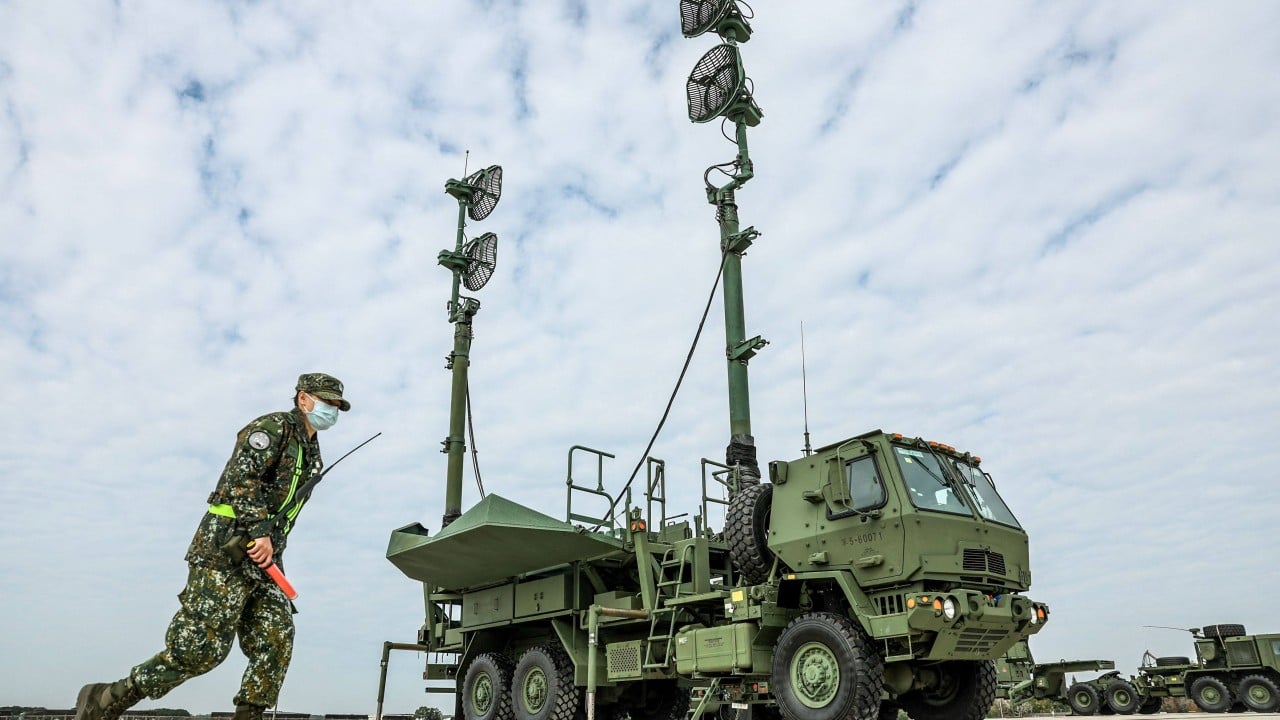
When satellites get jammed and cables get cut, cold-war-era physics becomes modern magic. Tropospheric scatter systems bounce high-power microwave signals off the upper layers of the troposphere, allowing secure, high-capacity point-to-point links over hundreds of miles without any satellite relay at all. Paired with directional millimeter-wave relays hidden across Taiwan’s rugged ridgelines, you get an internal backbone that cannot be severed from orbit.
4. Decentralized HF/VHF Mesh Networks
True resilience looks ugly and analog. Every neighborhood defense unit, hospital, and municipal office should be equipped with automated, frequency-hopping High Frequency (HF) and VHF digital radios. These systems bounce signals off the ionosphere, require minimal power, and allow island-wide text and data routing even if the entire modern telecom grid goes dark.
The Uncomfortable Trade-Off
There is a massive catch to this terrestrial-and-stratospheric approach, and pretending otherwise would be dishonest.
If Taiwan prioritizes buried fiber, troposcatter relays, and stratospheric platforms over global satellite constellations, the island effectively accepts digital isolation from the outside world during a crisis. Localized mesh networks keep Taipei talking to Kaohsiung, and they keep missile batteries talking to radar stations. They do not let Taiwanese citizens post videos to international social media platforms, nor do they allow global financial markets to keep clearing transactions in Taipei.
In a full-scale conflict, information warfare matters. Losing the ability to broadcast real-time footage of an invasion to Washington and Tokyo carries a real political cost.
That is the trade-off nobody in the commentary class wants to admit. You can spend your finite budget trying to preserve peacetime global internet access via fragile space assets that Beijing can blind, buy off, or blow up. Or you can accept an information blackout to the outside world in order to guarantee that the island’s internal nervous system never goes down.
Ukraine had no choice but to gamble on Starlink because its sheer size left no terrestrial alternative. Taiwan has mountains, dense urban infrastructure, short distances, and proximity to its own coastline. Copying Ukraine’s emergency workaround as a long-term blueprint is not a wake-up call—it is sleepwalking into the wrong war.
Stop trying to out-launch SpaceX from a tiny island in the Pacific. Dig deeper, build lower, and keep your communications where the enemy's space weapons cannot reach them.