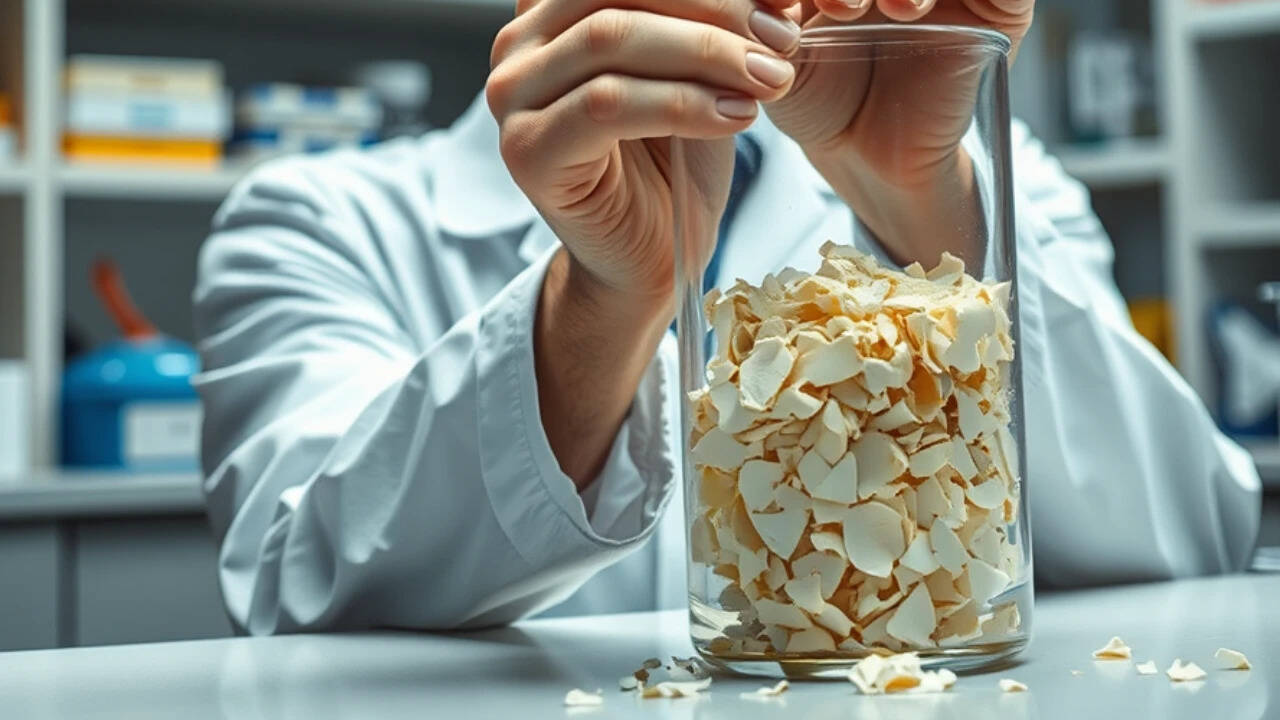
Every few months, the mainstream tech and science press falls over itself to manufacture a fairy tale. A high school student or an undergraduate takes a household waste product—usually something mundane like calcium carbonate from discarded poultry shells—applies a standard precipitation method taught in sophomore chemistry, and suddenly the headlines scream about a revolutionary material science breakthrough. The narrative writes itself. A bright-eyed kid beats the system, saves the planet from breakfast waste, and invents a crystal matrix that will supposedly transform everything from construction materials to bone grafts.
It is a comforting fable. It is also an absolute distraction from how industrial-scale material engineering actually works. For an alternative perspective, read: this related article.
I have spent two decades reviewing patent portfolios, venture pitches, and university lab spin-offs. I have seen laboratories blow millions of dollars chasing flashy, press-friendly material hacks that collapse the moment anyone tries to scale them past a glass beaker. The viral excitement over turning breakfast scraps into bespoke crystalline structures relies on a fundamental misunderstanding of chemical purity, supply chain logistics, and thermodynamic economics.
The lazy consensus in these feel-good profiles is that local trash can magically double as high-performance precursor material if you just add enough enthusiasm and basic reagents. Let us dismantle that delusion. Related insight on this matter has been published by Mashable.
The Purity Trap That Mainstream Science Journalism Ignores
When a news outlet reports that a student synthesized calcium carbonate crystals from eggshells, they omit the grueling, unglamorous preprocessing required to make those shells usable. Raw eggshells are not pure calcium carbonate. They are an organic-inorganic composite matrix containing an inner protein membrane, trapped moisture, trace lipids, magnesium contaminants, and random organic debris from the farm floor.
To turn that breakfast remnant into a reliable crystal structure, you have to wash it, strip the membranes, grind it into a precise micron-scale powder, treat it with acids to dissolve impurities, and filter out the unwanted residue. By the time you finish cleaning and purifying the precursor material to an acceptable industrial baseline, you have spent more energy, water, and chemical reagents than you would have spent simply buying bulk reagent-grade precipitated calcium carbonate from a chemical distributor.
The economics of scale do not care about your emotional attachment to upcycling. Industrial chemistry demands consistency. If your precursor batch varies by two percent in organic contamination because the chickens ate a different diet in Ohio than they did in Nebraska, your final crystal lattice will exhibit micro-fractures, irregular porosity, and unpredictable tensile strength. In structural engineering or biomedical implants, unpredictable means catastrophic failure.
The Myth of Decentralized Waste Valorization
Another favorite talking point of the viral science crowd is decentralization. The pitch goes like this: instead of relying on centralized chemical manufacturing plants, we can set up micro-refineries in local communities where restaurants and bakeries ship their eggshells for localized mineral conversion.
This is what happens when someone writes about industrial processes without ever stepping foot inside an industrial plant.
Waste streams are notoriously chaotic. Eggshells arrive wet, decomposing, mixed with cardboard fragments, and covered in salmonella vectors. Processing them requires biohazard containment, heavy washing cycles, high-temperature calcination kilns, and strict wastewater management to handle the organic runoff. Local bakeries are not going to operate calcination kilns in the back alley. The moment you centralize the logistics to handle safety and processing standards, you lose the local narrative entirely. You have just built a messy, low-yield chemical processing plant that costs more to operate and yields a vastly inferior product compared to established mineral processing giants like Imerys or Omya.
We need to stop pretending that every clever DIY science fair project represents an impending industrial revolution. It insults the decades of painstaking work that material scientists put into controlling crystal nucleation, polymorph stability, and dopant integration.
Why We Fall For The Prodigy Myth
Media outlets love the individual genius trope because it fits into a neat, digestible box. It gives readers a clean narrative arc: plucky student beats corporate lethargy with a kitchen-sink invention.
The reality of material innovation is painfully boring. It happens in dark rooms with X-ray diffraction spectrometers, electron microscopes, and teams of specialists running thousands of automated parameter iterations to find a single stable crystal phase that can withstand cyclic thermal stress. It is iterative, expensive, and deeply unromantic.
When we elevate student stunts over structural reality, we starve actual industrial research of critical public understanding. We convince the public that solving complex material shortages is just a matter of looking at garbage differently, rather than investing heavily in advanced synthesis techniques, chemical engineering infrastructure, and fundamental thermodynamic research.
The next time a headline breaks about a teenager turning household refuse into a miracle material, check the methodology section. Look for the baseline impurity analysis. Ask how many kilowatt-hours were burned purifying chicken debris to achieve a result that a standard chemical supplier can deliver by the ton with zero batch variance.
Stop looking for shortcuts in the compost bin. The future of material science will not be built on eggshells. It will be forged through precise, uncompromising chemistry that respects the laws of thermodynamics rather than ignoring them for a viral press cycle.