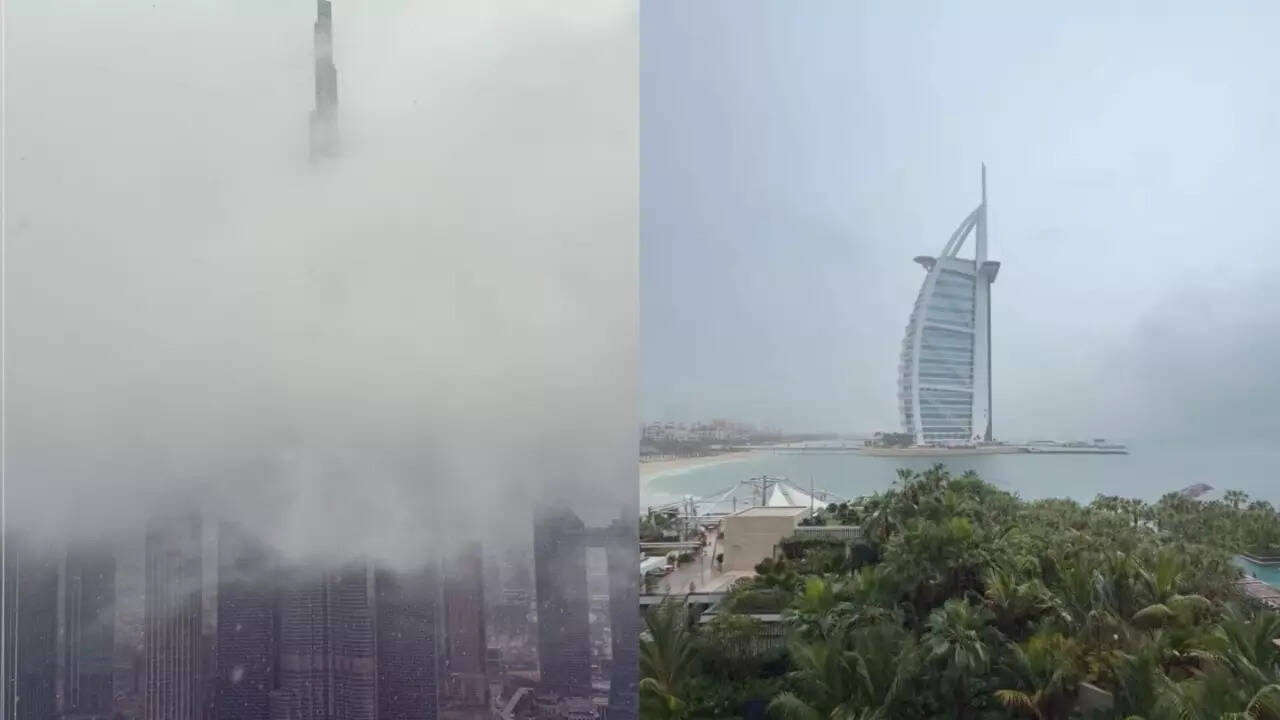
The lazy consensus among UAE residents is that rain is a "disruption"—a glitch in the matrix of a 365-day summer that needs to be "fixed" or "forecasted away." Every time a cloud darkens the horizon over Sheikh Zayed Road, the media cycles through the same tired script: When will it end? When can we go back to the beach?
You are asking the wrong question.
The real story isn't about when the rain ends; it’s about the fact that the hyper-arid "normal" you’ve built your life around is a fossil. We are currently witnessing a shift where the UAE’s spring is becoming a season of violent, atmospheric reckoning. The "unsettled weather" you’re complaining about isn't a temporary inconvenience. It is the new, high-stakes reality of the Gulf’s climate.
I’ve seen this script play out for a decade. Every time a storm hits, the same "cloud seeding" conspiracy theories start bubbling up in WhatsApp groups. People want a villain. They want to believe that a few salt-flaring Cessnas over the Hajar Mountains are responsible for flooding the Al Majaz waterfront or turning Dubai Marina into a swamp.
Let’s be brutally honest: Cloud seeding is the most over-hyped scapegoat in the Middle East.
The Cloud Seeding Myth: You’re Giving Humans Too Much Credit
The common misconception is that the National Centre of Meteorology (NCM) "creates" rain. They don't. They nudge. They find a cloud that is already pregnant with moisture and give it a microscopic push. In a clear, bone-dry sky, cloud seeding does exactly zero. In a humid, convective environment, it might—might—increase precipitation by 10% to 25%.
The massive, multi-day storm systems we are seeing this March? Those are synoptic-scale events. They are low-pressure systems moving in from the west, dragging moisture from the Arabian Gulf and the Indian Ocean. A few salt flares are like throwing a bucket of water into a Category 5 hurricane.
Yet, the media obsesses over it because it’s easier to blame a government program than to face the fact that we’ve built billion-dollar cities on a landscape that has no natural way to drain itself.
The "Sarayat" Trap: Why Your App is Lying to You
You look at your weather app, it says "40% chance of rain," and then it doesn't rain in Downtown Dubai, so you call the forecast a failure.
You’re misinterpreting the math. That 40% doesn't mean it’s 40% likely to rain on your head. It means that in 40% of the model simulations, rain fell somewhere in the forecast area. In a desert climate during the Sarayat (spring disturbance) season, the weather is chaotic. It’s not a blanket of gray clouds; it’s a localized explosion of energy.
The Sarayat—roughly March 20 to May 10—is defined by rapid surface heating. The ground gets hot (over 30°C), while the upper atmosphere stays cool. That temperature gradient creates a vacuum that sucks up moisture and spits out "towering cumulus" clouds that can drop a year’s worth of rain in twenty minutes.
Imagine a scenario where a single storm cell sits over Al Khail Road for an hour while it’s bone-dry in Jumeirah. That isn't a "failed forecast." That is the physics of a desert spring. Stop expecting the weather to behave like a European drizzle.
The Cost of Denial: Why "Normal" is a Dangerous Word
The "status quo" is to treat these events as outliers. They aren't.
- 2024: Dubai saw 6.45 inches of rain in 24 hours—the equivalent of two years' worth of rainfall.
- 2026: We are currently tracking a system that could dump 3 to 6 inches in a single week.
The infrastructure isn't the only thing that’s unprepared; the mindset is, too. We have spent billions on vertical forests and glass towers, but we haven't invested in the psychological infrastructure to realize that the Gulf is getting wetter. A warming atmosphere holds more moisture. For every 1°C of warming, the air can hold about 7% more water vapor.
The UAE isn't "broken" when it rains. It is simply reverting to a state that our modern, concrete-heavy planning didn't account for. The sand dunes that shifted with the wind are now being carved by water.
The Insider’s Advice: How to Actually Navigate a UAE Spring
If you’re waiting for the rain to "end," you’re missing the point. You should be preparing for it to return, harder and more frequently.
- Abandon the "Clear Sky" Bias: If the NCM issues an alert, take it seriously. I’ve seen people lose their cars in "puddles" on Sheikh Zayed Road because they assumed the "sunny" forecast from three hours ago was still valid.
- Understand the Soil: Fine desert sand doesn't absorb water like garden soil. It acts more like concrete once it’s saturated. This is why flash floods happen in minutes, not hours.
- The Drainage Deficit: Admit that most urban areas in the UAE were built for 100mm of rain a year. When we get 150mm in a day, there is no "engineering fix" that works instantly. The water has nowhere to go but up.
The rain isn't the enemy. Our refusal to adapt to a changing climate is. Stop asking when the sun is coming back and start asking if your insurance policy covers "acts of God" in a desert that’s decided to become an ocean.
The clouds aren't leaving. They're just getting started.
Would you like me to analyze the historical rainfall data for the UAE over the last five years to show you exactly how the "normal" has shifted?