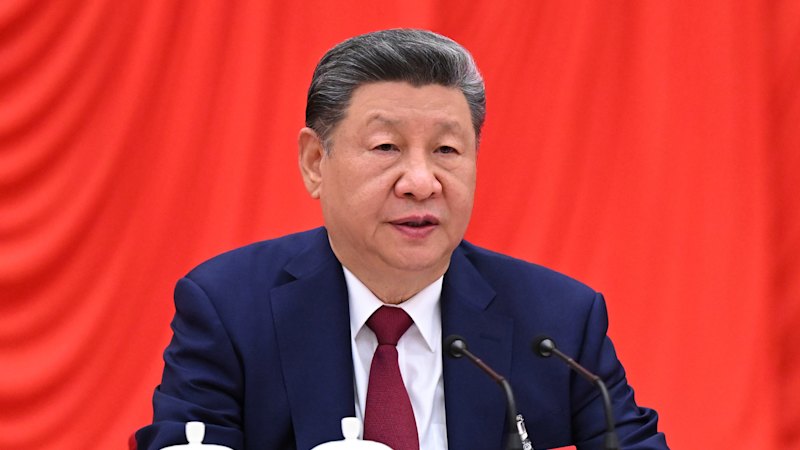
Western China-watchers love a good parlor game. Whenever Beijing holds a major political gathering, analysts squint at high-definition photographs of the Great Hall of the People, counting absent faces like Kremlinologists measuring the distance between Soviet officials on Lenin's Tomb.
When empty chairs appear alongside a sudden, seemingly inexplicable promotion and a stern warning from Xi Jinping that anti-corruption purges will continue, the mainstream media hits copy-paste on the same tired script. They call it paranoia. They call it factional infighting. They claim the regime is fracturing from within.
They are completely wrong.
Having spent fifteen years advising multinational boards and sovereign funds on geopolitical risk across East Asia, I have watched Western executives lose billions of dollars betting on this exact misreading of Chinese political mechanics. They treat Beijing's disciplinary campaigns like a corporate boardroom drama in New York or London, assuming that firing executives signals a failing company.
In the Chinese Communist Party (CCP), purging is not a sign of institutional collapse. It is the primary mechanism of institutional maintenance.
The Lazy Consensus of "Regime Fragility"
Look at the standard narrative surrounding the latest round of high-level disappearances and unexpected promotions. The consensus view argues that if Xi Jinping has to keep removing generals, ministers, and provincial secretaries he personally vetted and promoted just a few years ago, his judgment is flawed and his grip on power is brittle.
This logic relies on a fundamental misunderstanding of Leninist organizational theory.
A Leninist party does not govern through static checks and balances; it governs through continuous ideological and structural mobilization. In Western democracies, institutional rot is addressed—in theory—through elections, investigative journalism, and independent courts. In a single-party state without those external feedback loops, the system naturally trends toward entropy. Local officials collude with state-owned enterprise bosses, military procurement officers skim billions from defense budgets, and regional factions form impenetrable patronage networks.
If the top leadership stops purging, the state calcifies. The Soviet Union did not collapse because Mikhail Gorbachev was too ruthless; it collapsed because Leonid Brezhnev spent eighteen years prioritizing "stability of cadres," allowing bureaucratic corruption to rot the state from the inside out until nothing worked.
Xi Jinping studied the Soviet collapse obsessively. When he warns that the anti-corruption drive will never stop, he is not expressing personal insecurity. He is stating an operational requirement for regime survival.
Decoding the "Shock Promotion"
The second half of the mainstream media's panic centers on the "shock promotion"—the sudden elevation of a relatively obscure technocrat or mid-level military officer over established heavyweights. Pundits immediately label these appointees "yes-men" or "cronies," assuming competence is being sacrificed on the altar of blind loyalty.
Again, look closer at the actual profiles of the people moving up the ladder.
When Beijing bypasses an entire generation of entrenched commanders in the Rocket Force or the Ministry of Industry and Information Technology to elevate an outsider, it is executing a classic corporate turnaround maneuver: breaking the chain of complicity.
Think about how systemic corruption operates in large bureaucracies. If a division is compromised, you cannot promote the deputy director to fix it. The deputy director rose through the exact same patronage network, owes favors to the exact same contractors, and knows where all the bodies are buried—because they helped dig the graves.
To clean out a compromised apparatus, you must parachute in someone who owes nothing to the existing hierarchy. Their lack of deep roots within that specific ministry or military branch is not a bug; it is their primary qualification.
Furthermore, examine the technical backgrounds of recent surprise appointees across Beijing's economic and defense sectors. The Party is systematically stripping power from traditional generalist administrators—the smooth-talking political operators who built careers on GDP growth targets and real estate expansion—and handing it to engineers, aerospace scientists, and cybersecurity specialists.
This is not a retreat into ideological dogma at the expense of competence. It is a ruthless pivot toward a specific type of competence: national security resilience, technological self-reliance, and supply chain dominance.
Why Executives Misread Beijing's Signals
I once sat in a boardroom in Zurich where a European industrial conglomerate decided to double down on its joint venture in eastern China precisely because their local Party liaison had been abruptly replaced during an inspection sweep. The board convinced themselves that the purge meant Beijing was distracted, weakened, and desperate for foreign capital to stabilize the region.
Within eighteen months, their joint venture was subjected to an exhaustive regulatory audit, their intellectual property licensing agreements were rewritten under national security mandates, and their local leverage evaporated. They mistook a sharpening of the blade for a trembling hand.
Western observers make three recurring errors when analyzing CCP personnel shifts:
- Confusing Friction with Fracture: Removing top officials creates short-term policy paralysis. Ministers hesitate to sign off on major initiatives when an inspection team from the Central Commission for Discipline Inspection (CCDI) is camped out in their building. Analysts see this temporary freeze and declare the economy broken. In reality, Beijing is willingly accepting short-term administrative friction to force long-term bureaucratic compliance.
- Projecting Western Career Incentives: In Washington or Brussels, political survival depends on building coalitions and keeping allies happy. In Beijing, survival depends entirely on executing the center's strategic priorities without building an independent power base. When a rising star is suddenly purged, it rarely means they failed at their job; it usually means they became too successful at building personal loyalty among their subordinates.
- Ignoring the Deterrence Math: Publicizing empty chairs at high-profile meetings is deliberate political theater. The Party could easily fill those seats with alternates or quietly announce retirements months in advance. Leaving the chairs empty sends an unmistakable message to the remaining ninety-nine million Party members: no rank, no past service, and no personal connection to the leadership guarantees immunity.
The Real Questions You Should Be Asking
If you want to understand what is actually happening inside Zhongnanhai, stop asking whether Xi Jinping is losing control. That question is a dead end. Instead, ask three much more revealing questions about the mechanics of the purge.
First: Which sectors are losing their "untouchable" status?
Follow the investigators. Ten years ago, the purges targeted the energy sector and domestic security apparatus to dismantle rival political machines. Five years ago, the focus shifted to private tech giants and financial regulators to rein in systemic debt and capital flight. Today, the disciplinary hammer is falling hardest on the military-industrial complex, healthcare procurement, and semiconductor investment funds. That tells you where Beijing believes its money is being wasted—and where it intends to force real results over the next decade.
Second: What is the ratio of technocrats to political commissars in the new appointments?
When an empty chair is filled, look at the replacement's resume. Are they an ideological enforcer from the Organization Department, or are they an engineer from the China Aerospace Science and Technology Corporation? When technical experts replace political generalists, Beijing is preparing for operational execution, not just political theater.
Third: How fast are policy directives moving after the purge concludes?
Watch the legislative and regulatory pipeline six months after a major personnel shakeup. In a fractured regime, purges lead to permanent gridlock. In a consolidating regime, purges are immediately followed by aggressive, unopposed policy rollouts—whether that means sweeping industrial subsidies, sudden regulatory crackdowns, or shifts in military posture.
The Genuine Cost of Perpetual Purges
Dismissing the "regime collapse" narrative does not mean Beijing's approach is without severe, self-inflicted wounds. A contrarian view is useless if it blinds you to real vulnerabilities.
The primary danger of permanent revolution inside the bureaucracy is not a coup; it is terminal risk aversion.
When local officials realize that taking initiative carries a high probability of triggering an audit, while doing nothing carries almost zero penalty, the entire administrative state slows to a crawl. Chinese economists and policymakers openly worry about "lazy governance"—officials showing up to work, reciting the correct slogans, attending endless study sessions, and quietly refusing to make any decision that could backfire five years down the road.
For foreign businesses and investors, this creates a maddening operating environment. It becomes nearly impossible to find a mid-level regulator willing to grant an exception, clarify an ambiguous rule, or champion a complex cross-border deal. Every decision gets kicked upstairs to a shrinking circle of top decision-makers who are already overwhelmed.
Moreover, purging top military commanders—particularly in strategic branches like the Rocket Force—undeniably degrades short-term operational readiness. Replacing seasoned generals with newcomers disrupts command cohesion, delays weapons testing, and forces the military to spend months rewriting internal protocols rather than focusing on external contingencies. If Beijing were planning an imminent, large-scale military operation tomorrow, it would not be gutting its own logistics and procurement leadership today.
How to Read the Next Shakeup
The next time a major political conclave convenes in Beijing and the cameras pan across a row of conspicuously empty seats, ignore the breathless headlines predicting the end of the dynasty.
Treat those empty chairs as a diagnostic tool.
Look at the ministries those absent officials ran. Look at the budgets they controlled. Look at the specialized backgrounds of the obscure deputies suddenly elevated to take their place. Beijing is not falling apart; it is stripping out legacy code, deleting compromised networks, and rebooting its operating system for a harder, more confrontational era.
If your strategy relies on China's leadership stumbling over its own purges, you aren't analyzing geopolitics—you're just engaging in wishful thinking.