Every time an elite climber dies in the Karakoram or the Himalayas, the internet collectively loses its mind. People share final Instagram posts like sacred relics. They type tearful tributes to men and women they never met, projecting their own mundane existential dread onto individuals who chose to stand in the freeze zone.
The media feeds this emotional sludge. They frame every expedition as a tragic accident, a sudden twist of fate, or an unforgiving mountain exacting its toll.
That narrative is complete garbage.
Nirmal Purja did not die because a mountain suddenly decided to be cruel. He operated in a calculated, high-risk industrial sector. Treating commercial mountaineering like a romantic poetry club obscures the reality of what modern high-altitude work actually is. If you want to honor people who push physical boundaries, stop treating them like tragic victims of destiny and start treating them like the high-stakes professionals they are.
The Lazy Consensus of Mountain Tragedy
Open any mainstream report on a climbing fatality, and you will find the exact same template. The headline mentions a viral final photo. The body text laments the "unforgiving nature" of the peak. Experts are quoted talking about thin air, unpredictable weather windows, and the sheer audacity of human ambition.
It is a comforting script. It paints nature as an active villain and the climber as a noble martyr.
I have watched sponsors, tourism boards, and armchair commentators push this angle for decades. It shields everyone involved from uncomfortable truths. It prevents awkward conversations about commercial pressures, oxygen logistics, crowds on the bottleneck, and the financial engines driving modern mountaineering.
When a commercial operator or high-altitude icon heads out, they are not embarking on a spiritual pilgrimage. They are executing a logistical project with a known probability matrix. High altitude mountaineering at the elite level carries a permanent casualty rate. Pretending each death is a shocking anomaly is either naive or dishonest.
The mountain is indifferent. It does not possess malice, and it does not demand sacrifices. It is simply a pile of rock, ice, and low barometric pressure sitting at eight thousand meters.
When we turn a terminal accident into a viral tragedy-porn moment, we strip the agency away from the climber. We act as if they stumbled onto a hazard by accident, rather than signing up for a profession where the margin for error is measured in millimeters of frostbite and liters of supplemental gas.
The Economics of the Death Zone
Let us look at the actual mechanics of what happens when someone like Nims Purja mounts an expedition. This is not 1953. This is not a group of tweed-clad gentlemen struggling up an unclimbed ridge for pure exploration.
This is heavy industry.
Expeditions require massive capital. Brands need visibility. Content needs to be generated. Sherpa and high-altitude workers take on disproportionate risk to fix ropes and haul gear, while elite figures manage public relations, client safety, and summit bids.
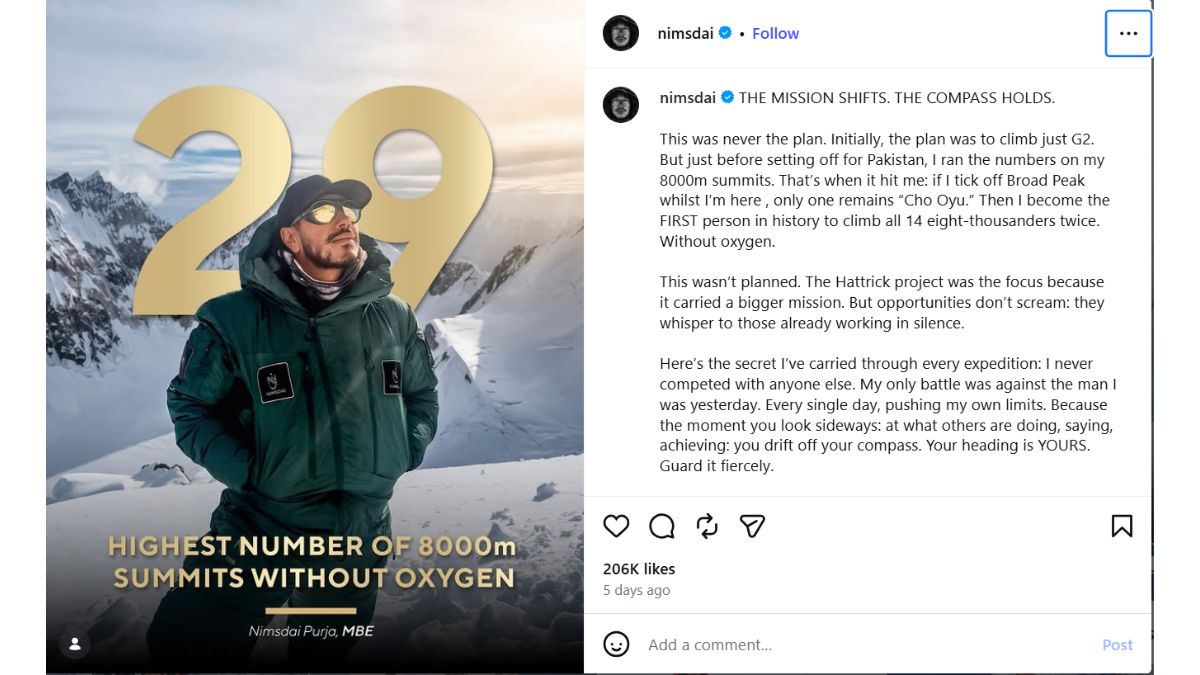
When an influencer-climber posts a photo before setting off for Pakistan, that image is a marketing asset. It builds engagement, satisfies sponsor contracts, and feeds the digital machine that keeps the funding flowing for the next project.
There is zero shame in this. Professional athletes in every discipline monetize their exposure. Formula One drivers sell merchandise and secure luxury watch sponsorships while knowing every corner could be their last. Big wave surfers document every session because imagery translates directly to livelihood.
Yet, when a mountaineer passes away, society suddenly wants to strip away the commercial reality and pretend they were purely chasing the ethereal beauty of the clouds.
We need to stop buying into our own romantic fiction. Nims Purja built an empire on speed, commercial scale, and relentless media documentation. He changed how the world views high-altitude logistics. He proved that peaks once thought to require months of siege tactics could be ticked off in a fraction of the time through aggressive oxygen use and exceptional physical conditioning.
You cannot celebrate the industrialization and speed-running of eight-thousanders while weeping theatrically when the math of probability finally catches up to someone.
The Physics Do Not Care About Your Feelings
Let us define terms clearly.
The death zone begins at roughly eight thousand meters. At this altitude, the human body is in a state of permanent, progressive physiological degradation. Atmospheric pressure is about a third of sea level. Every breath delivers a fraction of the oxygen your organs require to maintain cellular integrity. Digestion shuts down. Sleep becomes an intermittent hallucination. Brain cells swell. Lungs fill with fluid.
Every minute you spend up there, you are slowly dying.
When people ask, "Why do they keep going back knowing the risks?", they are asking a fundamentally flawed question. The risk is not a bug in the system; it is the entire product. If the risk were removed, if every eight-thousander had an elevator and a heated lounge at the summit, nobody would pay six figures to stand on top of it.
The value of the achievement scales directly with the lethality of the environment.
To pretend otherwise is to insult the intelligence of the climbers. They know the data. They know the mortality rates of the Karakoram. They know that gear fails, weather forecasts are probabilistic guesses, and avalanches do not check your resume before they sweep a slope.
When an accident happens, the post-mortem analysis usually focuses on human error or rogue weather. But beneath those variables lies a constant: cumulative fatigue. High-altitude athletes push past logical thresholds because their entire personal brand and business model rely on continuous escalation. Going slower, turning around earlier, or taking a season off does not generate impressions or secure renewals.
The Uncomfortable Downside of My Argument
I know what critics will say about this perspective. They will call it cold. They will argue that mourning is a natural human reaction and that analyzing economics over a fresh grave lacks basic empathy.
They are right, in a sense.
There is a human cost here. Families lose fathers, mothers, partners, and friends. Communities lose dominant personalities who inspired them. Ignoring that grief would make you a sociopath.
But there is a massive difference between private grief and public performance.
The viral weeping on social media is not authentic communal mourning. It is consumption. People use the deaths of extreme athletes to feel something, anything, while sitting at their office desks. They turn a real, visceral loss into a temporary trending topic before scrolling away to the next piece of content ten minutes later.
That exploitation is far more disrespectful to the deceased than treating them like rational adults who made a calculated trade-off.
If we want to respect people who operate in high-risk domains, we should stop treating them like children who didn't know the stove was hot. We should look at their achievements with clear eyes, acknowledge the brutal math of the environment they chose to work in, and respect the agency they exercised every single time they tied into a rope.
Stop Asking the Wrong Questions
People constantly ask: "Should governments ban climbing on dangerous peaks to save climbers from themselves?"
That question is born from a paternalistic nanny-state mindset that assumes adults cannot weigh risk for themselves.
Instead of asking how to wrap these mountains in red tape or how to police personal choices, ask why we treat extreme sports athletes like public property the moment things go wrong. Ask why tour operators are allowed to drag under-prepared clients up technical routes just because the check cleared. Ask why the media refuses to report on the systemic labor issues facing local high-altitude workers, preferring instead to focus entirely on the tragic fate of the charismatic western-facing leader.
The real scandal in modern mountaineering is not that people die in the high mountains. People have always died where the air is too thin to sustain life.
The scandal is the willful ignorance of the public and the media, who refuse to accept that high-altitude mountaineering is a dangerous, calculated, and professional endeavor—not a fairy tale where everyone lives happily ever after if we just share enough emotional posts on the timeline.
Put down the phone. Stop writing eulogies for people who knew the stakes better than you ever will.
Honor their work by respecting the reality of how they lived it.